Acquisition and transfer of the relics of Alexius, the Metropolitan of all Russia and miracle worker
In the days of the pious great prince Vasily Vasilievich [Here is understood the great prince Vasily Vasilievich Dark.
He ruled from 1425 to 1462, the autocrat of all Russia, after about 60 years since the death of St. Alexius, the God who marveled at His saints and glorified them as all-good, thus revealed an invaluable treasure, that is, the multi-purpose powers of this great saint, the metropolitan
What's going on?
Since the first temple built in this monastery [under this monastery is understood the Monastery of Miracles, arranged in 1365 by the holy metropolitan Alexios in the Kremlin, on the site that was given to him by the healing Tatar queen Taidula.
Named Miraculous in memory of the miraculous healing of the latter from blindness by the saint.] by St. Alexius himself in memory of the holy archistrate Michael, in memory of his former miracle at Chonach [The commemoration of this miracle is performed by the Church on September 6]. , was wooden, it happened that the roof of this temple, which came from
It fell into disrepair during a divine liturgy, and by God's will, all who were in the temple at that time were unharmed.
Then the great prince ordered the construction of a stone temple, and when the inside of the former wooden temple began to dig trenches for the foundation of the new temple, they found the relics of the great saint of St. Alexis intact and even the clothes on it undamaged.
Shortly after this, a stone temple was built in the name of the holy archstrateg Michael with a parapet on the south side in honor of the Annunciation of the Blessed Virgin Mary.
This temple was three steps up from the ground, but it was smaller than the former wooden temple, which although it was wider, was arranged in one step, and the floor in it was laid straight on the ground.
When the newly built temple was properly decorated and consecrated, the multi-purpose relics of St. Alexis were brought into it and the Blessed Virgin Mary was placed in the porch of the Annunciation.
After this many years passed, and in the principality of the great prince Ioann Vasilievich [Ioann III Vasilievich was the great prince of Moscow from 1462 to 1605.] with the most exalted metropolitan of Gerontia [Metropolitan Geronty occupied the Moscow cathedral from 1473 to 1489.] the efforts of the archimandrite of this monastery.
A new temple with a refectory in the name of the holy metropolitan Alexios was built, but this temple was not finished, as archimandrite Gennady was appointed archbishop in Great Novgorod [This happened on December 12, 1484.
Archbishop Gennady took an active part in the struggle against the heresy of the Jews. In June 1504 he gave up the leadership of the diocese, settled in the Miracle Monastery and died there on 4 December 1505.
Some time after this, when, by the diligence of the same archbishop Gennadius, the temple and the refectory, as well as other buildings, were finished and the temple was decorated and consecrated, the honourable relics of St. Alexis were moved from the vestry of the Annunciation of the Blessed Virgin Mary and placed at the southern wall.
the side of a temple built in his name.
In 1534, Grand Duke Vasily Ioannovich [Vasily IV Ioannovich, successor of John III, was Grand Duke of Moscow from 1505 to 1533, hence the year when the prince was ordered the cancer for the relics of the saint, indicated in the prologue incorrectly.] ordered to make for the relics of the miracle worker Alexius a silver one.
And the altar shall be made of silver, and shall be adorned with gold, and with precious stones, and with pearls.
The cancer was finished after the death of the great prince, in 1535, and the body of St. Alexius was laid in it by his son, the great prince John Vasilievich [John IV Vasilievich the Terrible was the Tsar of Moscow from 1533 to 1584], on the day of the saint's death, on the 12th day of February of the month from Thursday to Sunday.
Friday of the first week of Lent.
The shell with the relics of St. Alexis stood on the site for about two hundred years, until 1686.
Since the temple and the refectory built by the archbishop of Novgorod, Gennady, were in disrepair, in 1683 by order of the pious king and great prince Feodor Alexiyevich, the autocrat of all Russia, and with the blessing of Joachim,
The Holy Patriarch of Moscow and All Russia, by the efforts and diligence of the then abbot of the monastery Archimandrite Adrian, - which soon after this was the metropolitan of the royal city of Kazan [Kazan is called a royal city, you have to think, because it was once the capital of the Kazan
After the fall of the Ottoman Empire, the new church was built on the site of the old one, which had been destroyed by the Ottoman Empire.
It's a big meal.
It was almost entirely removed from the monastery and only a small part of it and one north wall entered the monastery together with the temples, of which the first - in honor of the Annunciation of the Most Holy Mother of God, formerly attached to the church of the holy archistrates Michael, and the second next to the first, as we have already seen.
And they saw, - in the name of the holy metropolitan Alexius, and by them two parlours, or tables, prepared for the accommodation of those who came to the miraculous spirits to worship them, to pray and to hear the church service.
On the same foundation between these two temples a new temple was built in the name of the holy Apostle Andrew the Firstborn for monks of the monastery, so that they could always and especially in winter time listen to various church services separately from outsiders visiting the monastery temples.
Besides this, on the western side of all these buildings, another dining table was arranged for the pagans to eat, so that they would be separated in everything from the people who came to the monastery - vain worldly people, think only of God and care for their salvation, exercising zeal in prayer, fasting and handwork, so that
That's what all other women's lives are about.
For this purpose, different entrances to the temple were arranged from outside the monastery, for men - a special entrance to the temple of St. Alexis, and for women - also a special entrance to the church of the Annunciation of the Most Holy Mother of God, so that those who come to the multi-purpose relics of the saint entered these temples from outside the monastery and stood in them, not mixing.
Each sex in a separate temple, men separately and women separately.
For the monks who lived in this monastery, other entrances from inside the monastery were arranged for these temples and meals.
This is so that the monks can lead a quiet, quiet life, and also so that, according to the tradition of the holy fathers and the monastery's charter, the monastery gates are always closed and thus prevent the laity from entering the monastery without time, and the monks from leaving it at any time.
For in former times the monastery had a statute that three days a week, Monday, Wednesday, and Friday, the nuns were not allowed to go outside the walls of the monastery, and the other four days they left if they had any need, and not of their own accord, but asking for it.
You must first contact the abbot or the head of the monastery.
When the temples and tables were finished and decorated with proper ornamentation, the hands of the pious kings and great princes of John and Peter, of all Great, Small and White Russia, of the Samirders, and their royal dignitaries accompanied by the most holy patriarch of all Russia.
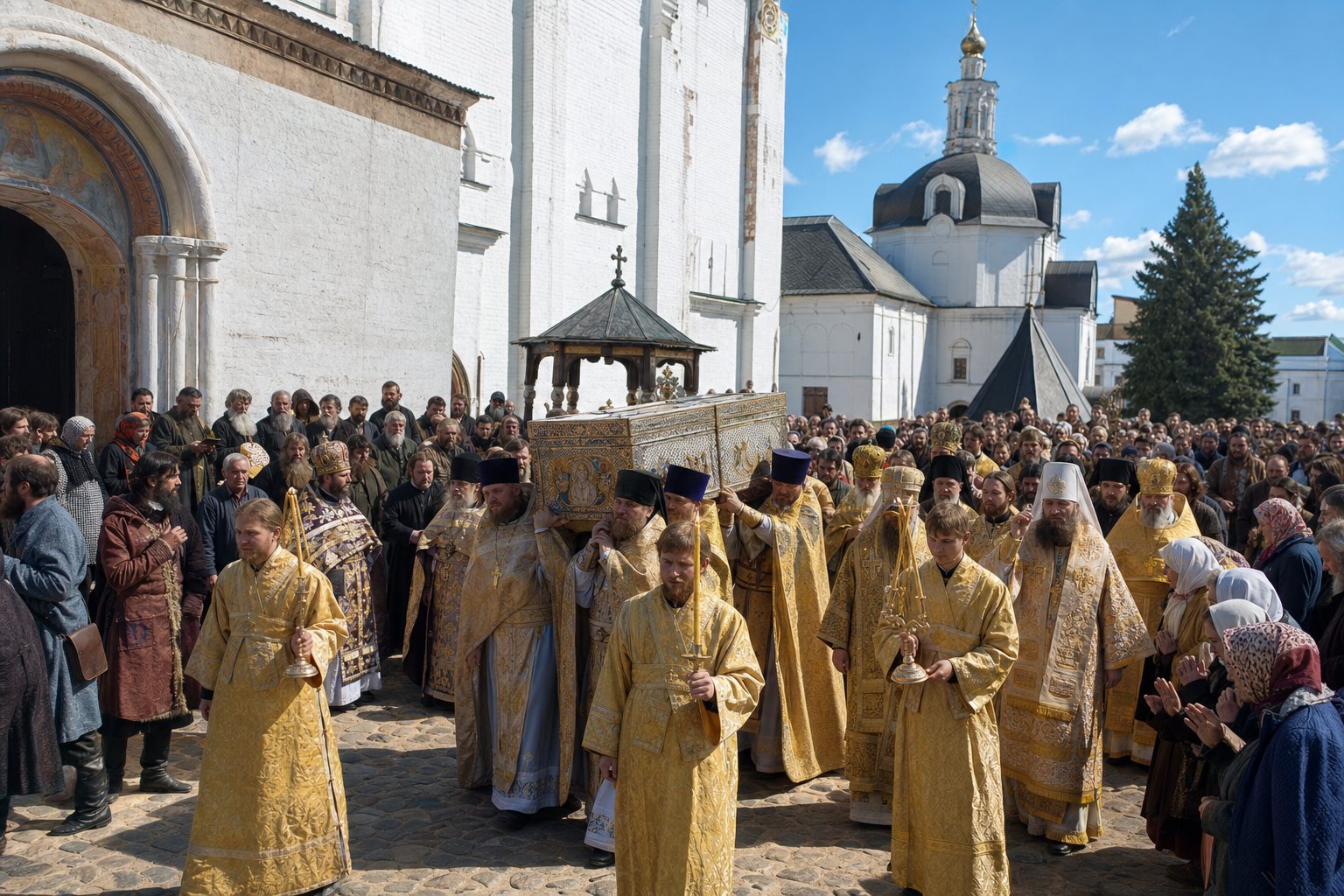
Joachim, then in Moscow bishops, all the clergy and many of the people the multi-purpose relics of the great saint, Metropolitan Alexios with all the spices and aromas were moved from the old dining temple to the newly built and placed in the prepared place between the two temples, the Annunciation.
Holy Mother of God and St. Alexius.
It happened on the 20th day of the month of May, 1686. The temple in honor of the holy metropolitan Alexios was consecrated by the most holy patriarch Joachim the Great in glory of the One God, glorified in the Trinity, Father and Son and Holy Spirit.
To the apostolic successors of the archbishops of the Holy See, to the shepherd and teacher of all Russia, blessed Father Alexius, Lord of all, pray, peace to the flock of thy gift, and salvation to souls, and great mercy.
We are rich in treasure, hidden for many years in the earth, and your honorable powers have made us miraculous participants. Blessed is Father St. Alexius, from whom we are enriched by the medicine we accept, and Christ is glorified by us.
As the sun never rises from the grave, so your honorable power is hidden for many years, and your grace is acceptable, Saint Alexius, for all this country and all the miracles and goodness enriched by the work of grace, let us sing to you: rejoice, Father, light of Russia.
On the same day, the reenactment of St. Dovmont-Timotheus, Prince of Moscow, in 1299.
The fourth voice, the throbbing.
Tropar, vow 4: To the Apostolic successors of the Archieires Co-refs, to all the shepherds and teachers of Russia, blessed Father Alexios, Lord of all, I pray you to give peace to your flock, and salvation to souls, and mercy.
The trapper, voice number two.
Treasures of great riches, hidden in the earth for many years, your honorable powers, miraculously acquired, blessed father, holy Alexius: from them the medicine we accept enriches us, and Christ is glorified. Glory be to the glorious saints.
The Condak, voice eight.
As the sun that is indispensable from the grave shines upon us for many years, your honorable powers are indestructible, to the saint Alexei, your grace is acceptable. All this country and all the miracles and kindness enriched by the action of grace, let us sing: rejoice, father, shine Russia. On the same day the rebirth of St. Dovmont-Timotheus, the prince of Moscow, in 1299.
4 John III Vasilievich was Grand Prince of Moscow from 1462 to 1605. 5 Metropolitan Gerontius was Grand Prince of Moscow from 1473 to 1489. 6 This occurred on 12 December 1484. Archbishop Gennady took an active part in the fight against the heresy of the Jews. In June 1504 because of his own infirmities he gave up the management of the diocese, settled in the Wonder Monastery and died on 4 December 1505.
11 Patriarch Adrian, the last of the All-Russian patriarchs, ruled the Russian Church from 1690 to 1700.