The memory of the saintly prince Constantine and his children: Michael and Feodor, Murom's miracle workers
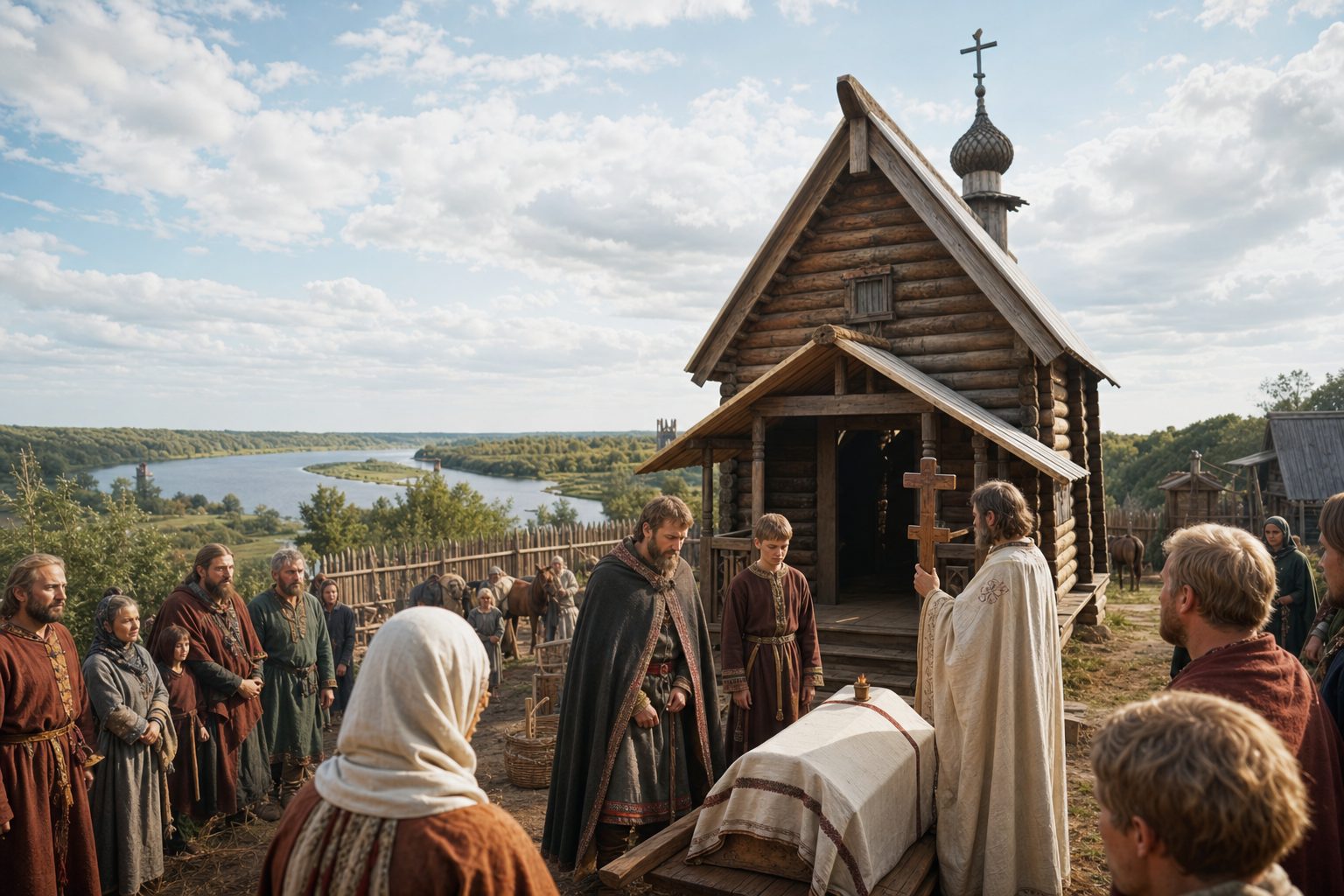
This saintly great prince, Konstantin Sviatoslavovich, was descended from the great prince Vladimir, who baptized the land of Russia with holy baptism. In 1192, Konstantin-Yaroslav Sviatoslavovich was the youngest son of Sviatoslav Yaroslav, first prince of Chernihiv, and then grand prince of Kiev (1073-1077), grandson of Yaroslav the Great and great-grandson of Vladimir the Holy.
The reference in the Prologue to the year 1192 (1092?), as the year of the arrival of the holy prince in Murom, should be considered erroneous.] together with his sons the princes Michael and Feodor from the famous city of Sheva he came to the Ryazan land to the city of Murom. In this city lived at that time pagans who were not yet enlightened by the knowledge of the true God [Murom - the center of the northern Rostov-Suzdal region, now a small county town of Vladimir province, - in ancient times belonged to the settlements of the Finnish tribes, such as Muromans, Meria and Morovans, despite the fact that the city was inhabited by foreigners, it was already existing to this day the Spassky Monastery.
Long before the holy prince Constantine, his relative, the son of the great prince Vladimir, the good-hearted prince Gleb, who was appointed to the possession of the city by Mur, made many efforts to master it and persuade its inhabitants to accept the holy baptism, but could not do so and for two years lived away from him at a distance of two square meters [The square is a distance of 690 meters They think that, meeting the resistance of the Moors, the holy Gleb settled on the river Ishne, 12 kilometers from Murom.] , and then the Holy Regiment deceitfully summoned his father, and on the way he was killed [The death of the holy prince Gleb's son followed in 1015; his memory is celebrated on September 6].
He then fought the people of the city again, and after his victory over them, he took the Moor as his possession and became its prince.
First of all, he built the first church in the city, in the old mountain part of it, in honor of the Annunciation of the Most Holy Mother of God, and buried here his murdered son, the noble prince Michael, and then converted the pagan townspeople to the Christian faith and baptized them with holy baptism. Thanking God for the success in this work, the holy prince later built many other churches [So, he built a church in the name of Saints Boris and Gleb.] and counted in his city his episcopal chair. After living a life in true faith and integrity in everything, always being a defender of the poor and orphans, he quickly returned to the horse. His majesty caused great grief to the Lord.
Later, a relative of the holy prince Constantine, the good-hearted prince Georgy Yaroslavovich, restored the original Church of the Annunciation of the Most Holy Mother of God, and from that time on glorified the Lord of the holy princes, Constantine and his sons, as their coffins began to perform miracles. Many years after this, in 1553, the good-hearted king and great prince of all Russia, Ioannis Vasilyevich, and in a campaign against the wicked to the city of Kazan, went to the city of Murom and stayed here for two weeks.
When they began to dig the moats for this church, they found the relics of the holy princes intact and not at all damaged. After the construction of the church, a special place was arranged in the niche of the church wall, where their holy relics were laid. The good-hearted king and great prince John Vasilievich, the autocrat of all Russia, then ordered the Ryazan bishop Guri to consecrate the newly built temple and sent to consecrate its various church utensils.
Constantine rejoiced, and before the throne of the Holy Trinity, seeing his fatherland, clothed with a spiritual splendour, followed by his sons Michael and Theodore, and all three prayed together for our souls. Condac, proclamation 8: To the eminent voivode, and to the faithful prince Constantine, with his son at his side, his fatherland boastfully cries out, having its chief and patron: he who has rid him of the charm and impurity of the idols.
The fourth voice, the throbbing.
Tropary, voice 4: Constantine rejoices in the day 7 , the Holy Trinity stands before the throne, seeing his homeland, the spiritual mast shining 8 , followed by Michael and Theodore, his sons: and all three together pray for our souls.
The condac, voice eight.
Kondac, vowel 8: The exalted vizier, and the right-wing prince Constantine, with his son, his proud homeland cries out, having his chief and viceroy: as they have rid themselves of the beauty and filth of idols. That is why we shout to him: rejoice in the overlordship of Prince Constantine. On the same day the memory of the Greek saint Cassian of Uglych miracle-workers, who died on 2 October 1504. ________________________________________ 1 Constantine-Yaro Świętosław was the youngest son of Svyatosław Yarosław, first prince of Chernihiv, and then grandson of the Grand Duke of Constantinople (1073-1077), and was then the grandson of St.
St. Constantine lived in Murom from 1096 until his death in 1129. The Prologue indicates that the year 1192 (1092?), the year of the arrival of the holy prince in Murom, is considered erroneous. 2 Murom - the center of the northern Rostov-Suzdal region, now a minor county town of Vladimir's province - belonged in ancient times to the settlements of the Finnish tribes, such as Murom, Meira and Mordva, although the city was inhabited by foreigners, the Spartan monastery existed there until the present time.
4 The death of the holy prince Gleb followed in 1015. His memory is celebrated on 6 September. 5 Thus, he built a church in the name of the saints Boris and Gleb. 6 The restoration of the Evangelical church by Yuri Yaroslavovich dates back to 1351.