The life of the holy equally apostolic king Constantine and his holy mother Elena
The memory of 21 May
While the pagan world, armed against Christianity with fire and sword, contemplated in the late third and early fourth centuries to wipe out the very name of Christianity from the face of the earth [Emperor Diocletian's edict of February 23, 303, ordered the eradication of Christianity with all its institutions and temples.
The violent persecution then began with the looting and destruction by military force of the Christian temple at Nicomedia, the capital of the Eastern Roman Empire, where up to 20,000 believers were burned at one time; and then the horrors of the persecution spread to Syria, Palestine, Asia Minor, and Egypt with Italy.
On the cruelty of the persecutions of Lactatius (On the Death of the Persecutors X V and X VI) he reports: "If I had a hundred mouths and an iron tongue, I could not count all the torments that the faithful endured:...
The iron became dull and broke; the murderers were tired and worked in shifts, in turns....<unk>] , God's plan prepared for the Church of Christ, among the very persecutors of Christianity, its royal protector in the person of Constantine - the king, still in life of his recipient - the name, forever
He is the greatest figure in the history of Christianity, of the Equal Apostles, and of the world.
Born in 274 B.C.E. to parents who were not Christians but who were familiar with Christianity and who supported it, Constantine was alienated from pagan superstitions and drew closer to Christ, the true God.
The Lord's own right hand was gradually preparing it and cleansing it in many ways as a chosen vessel for God's glory.
Constantine's father was Constantine Chlorus, Caesar in the western half of the empire [Emperor Diocletian for the convenience of governing the vast Roman Empire divided it into two halves, one of which - the Eastern ruled himself, living in Nicomedia and having Caesar Galerius as co-ruler, and in the other - the Western placed
The emperor Maximian, his co-ruler, Caesar Constantius Chlorus, who ruled Gallia and Britain directly.], being outwardly - officially - an idolater, in his heart he was far from pagan superstition; inwardly he renounced the service of many false gods and acknowledged the One
He and all his household, including his children and household, dedicated themselves to the one true God, Jehovah.
The Life of Constantine, Book I, Ch.17] How far away Constantius was from superstitious idolatry is evidenced by the following remarkable incident from his life.
Constantius, who had renounced the worship of idols, sacrifices, and smoking, once wanted to test the true disposition of his courtiers; he pretended to perform superstitious pagan rites and told his courtiers:
Whoever wishes to enjoy my favour and love and remain in my honour, let him sacrifice to idols, and whoever refuses this, let him go out of my sight and look no further for my favor, for I cannot remain in the company of the unbelievers.
When the courtiers heard Caesar's words, they immediately split into two groups: one, a hypocrite, without real religious convictions, with a flexible conscience, able to lean to the right or to the left, immediately agreed to the offer of the emperor, although until then it was based on low calculations and
Others, who had sincerely rejected pagan superstitions and now remained true to their beliefs, as true slaves of Christ, have renounced earthly and corruptible honors and have begun to leave the royal suite.
When Constantius saw this, he sent back the true Christians who had left the imperial palace and said to them: "Since I consider you faithful servants of my God, I want to have you also my servants - friends and advisers, for I hope you will be faithful to me as you are to your God.
He said, "I have no patience for you in my court. Will you be faithful to me unless you are faithful to your Lord?"
And thus having disgraced them, he removed these hypocrites from his presence; and he drew the faithful servants of God near to him and made them rulers in his domain [Eusebius: Life of Constantine, book I, 16].
And so, while Diocletian's persecution was raging in all other parts of the vast Roman Empire, Christians lived in peace and prosperity in the region of Constantius [Eusèbia: Church History, book VIII,13, Life of Constantine, book I,13].
However, since he could not disobey Diocletian, the eldest of the emperors, Constantius allowed one thing to happen - he destroyed some of the Christian virtues.
Such was the father of the equally apostolic Constantine Constantius Chlorus.-His disposition towards Christians and their preference for pagans; the conversion to Christ of his wife, Saint Helena, mother of Constantine, and daughter Constantius [Constantius was the only son of Helena; Constantius was the daughter of another wife of Chlorus
Theodora, who Constantius had other children with.
Contemporaries, unfortunately, do not talk about the influence of St. Helena on Constantine in childhood.] , the sisters of Constantine from an early age instilled in the soul of the latter a true love for God and His law and laid a solid foundation for the education and strengthening of his moral character.
And that little seed planted in a child's heart grew into a big tree.
Constantine had to spend his youth not in the midst of his native family, but at Diocletian's court in Nicomedia, where he was taken almost as a hostage, albeit an honorary one, to ensure his father's loyalty to the elder emperor Diocletian.
The court life in the capital was then in a small way all the moral and religious depravity to which mankind could possibly come, enslaved by unclean, passionate heart desires and falling into "perverse thinking". - Romans 1:28.
Vanity and luxury, drunkenness and revelry, wanton debauchery of thought and life, intrigue and gluttony, hatred of true worship and hypocritical, false worship of imaginary gods - this is the grim picture in which Proymsus portrayed to Constantine all the insignificance and ignominy of paganism.
But at the same time, and for that reason, the life of a different society was painted before Constantine's eyes, a Christian community, where old men and old women, young men and young women, commoners and learned sages, even children, proved their truth of faith, purity and the height of its content not only with words, but also with words.
Let her works be a testimony of her good life, for which she suffered even to the point of death.
For at that time a terrible persecution broke out against the Church of Christ, exceeding all other persecutions and the rage of the persecutors, and the variety of sufferings, and the number of martyrs, and the triumph, the triumph of the faith of Christ over all the schemes of the heathen.
Constantine, placed by the Fishery at the very center of pagan malice, could not help but see the futility of all her efforts to overcome the insurmountable, directly, with his own eyes he contemplated the power of God in weakness accomplished and everything subdued.
In every Christian confessor, in every martyr's gaze, Constantine was an undeniable witness to the truth of the faith of Christ, its superiority over paganism, its divine origin.
And Constantine preserved in his soul the pledge of goodness sown in his childhood - purity and innocence of heart and respect for God's law, although he walked in a morally corrupt environment.
But this inner estrangement of Constantine from the decadent court life, his inquisitive mind and spiritual well-being, concealed in modesty, naturally aroused the wrath of the courtiers who surrounded him; and his majesticly beautiful posture with his high stature and outstanding physical strength,
He was admired by the people, and the whole army loved him, and he was the cause of the envy of many, and especially of Gallio Caesar.
The latter plotted to destroy him and even conspired to prevent Constantine from attaining the royal dignity to which he had a birthright.
Constantine's life was in danger, but the hand of Promyslas saved his chosen one and gave him what his unbridled, insidious envy wanted to take away.
After the death of Constantius Chlorus, the former army under him proclaimed (in 806) Constantine, then in his thirty-second year, emperor of Gaul and Britain, as the beloved son of the respected Caesar.
Under the vivid impression of the terrible persecutions of Christians in the East, Constantine, having inherited power from his father, considered it his first task to confirm all his decrees in favor of Christians, and declared freedom of religion in his provinces.
The hour thus approached for the victory of Christ's faith over pagan superstition!
But the coming of better times for the Church was preceded by the time of God's judgment upon her persecutors. Emperors Diocletian and Maximian, weary of their own malice against the unwavering sufferers for the holy truth, resolved to seek peace in removing themselves from the royal thrones; but their renunciation of power,
By giving peace to the fierce persecutors themselves, he also gave rise to social unrest.
Galerius, who had reigned in the East in place of Diocletian and was dissatisfied with Constantine's reign in the northwest, did not recognize him as emperor, but instead recognized the North, which ruled Italy and Africa; meanwhile, Maxentius, Maximian's son, was proclaimed emperor in Italy.
Supporting the North, Galerius went to war against Maxentius, who had asked his father for protection, but Maxentius again assumed power, and the North surrendered to Maximian and was killed.
It turned out that the Roman Empire was ruled by six emperors at once, all of whom were at war with one another.
Peace and prosperity were enjoyed only by the subjects of Constantine, who contented himself with his father's inheritance and did not want to take part in the mutual struggle of other co-rulers, devoting himself entirely to governing the country by inducing his pure heart and sound mind into submission.
To the Divine Hunt.
"I became estranged", said Constantine of himself, "from the former rulers, because I saw the savagery of their morals [Eusebius: The Life of Constantine, Book II, 49].
Constantine understood that Christianity was a great force that could re-create the world, yet he was not yet a Christian; with all his deep respect for the slaves of Christ, he could not easily, without inner struggle, renounce the old-pagan covenants.
It was only in the face of formidable and difficult circumstances that he openly bowed down to the majesty of the "Crucified God", who miraculously lifted him out of his shaky state and strengthened him in his determination to become a Christian.
After Galerius, who died (in 311) of a terrible illness, and Maximinus, the ruler of Syria, who died (in 313) of a shameful death by suicide, the only ruler in the Eastern half of the empire was Licinius, who married Constantine's sister.
In the western half, the Italian region, Maximian reigned again, but Constantine recognized him as king in Rome and even sent a peace ambassador.
But Maxentius not only did not want to have peaceful relations with Constantine, but he did not even want to call him king, wanting to be the sole autocrat of all the lands and countries of the Roman province.
When he took the throne, however, he displayed his insidious cruelty and selfishness to the full, not only toward Christians but also toward his fellow pagans.
After seducing the people he wanted with gifts and promises, he began to persecute and torture honorary senators, plundering their property, kidnapping their wives and daughters to satisfy his animal passions, as well as the passions of his lovers.
And he was very grievous, and abhorred by all Rome for his cruelty and wickedness, and the Romans, suffering under his heavy yoke, resolved secretly to seek protection from Constantine, asking him to come and deliver them from this tormentor.
Constantine first sent a letter to Maxentius, friendly enough to persuade him to stop his violent actions, but Maxentius not only ignored his good advice and did not correct himself, but became even more enraged.
When Constantine heard about this, he decided to make a military campaign against the Roman emperor in 312 to free Rome from the evil tyrant.
- It was not easy for the bravest commander, beloved by the troops, to force an army to enter the heart of Italy with a sword, to wage war on the soil of the great Rome, sacred to the peoples of that time: such an enterprise would produce a tremendous effect on the imperial army and a deep cry of discontent.
And Constantine himself could not have been free of the involuntary fear of undertaking this campaign, especially since he had never personally seen Rome, which might have seemed to him a formidable giant.
At the same time, Constantine knew that his enemy's army was more numerous than his own and that Maxentius had strong hopes for the help of his national gods, whom he tried to appease with generous sacrifices, even by slaughtering young men and women - that Maxentius was protecting himself and his troops
and with all sorts of magic, and he has great demonic power.
Relying on human strength and resources alone was not enough for Constantine, and he had a sincere desire to have help from above.
Reflecting on the miserable state of the empire, in vain seeking protection from soulless idols, on the help of God, repeatedly revealed to his father and to him, on those political coups that took place before his eyes, on the shameful death in a short time of three persons who shared with him supreme power in
In the Roman Empire, he recognized it as madness to hold on to gods that did not exist and then, after so much evidence, to remain in error.
In the midst of such anxious reflections, Constantine began to pray to the God of his father, begging Him to make him understand about Himself, to give him courage and to extend his right hand in the task before him.
And his prayer was heard, as the prayer of the jailer (Acts 16:16): the Lord soon comforted him by direct appearance, and showed him what he ought to do.
"One afternoon, when the sun was beginning to set", said the king, "I saw with my own eyes a sign of a cross made of light and lying on the sun with the inscription: "We shall conquer".
And when he saw the cross, and all the army that was with him, they were greatly troubled; for the cross was an abomination to the heathen, and they looked upon it as a shameful instrument.
Then Christ appeared to him in a dream with a sign he had seen in heaven and commanded him to make a sign like the one he had seen in heaven and use it as a defense against enemy attacks.
When Constantine awoke, he told his friends the secret of his dream vision, and then he called the experienced masters to him and, describing the image of the miraculous banner, ordered them to arrange, like this, a choir of gold and precious stones; and he ordered his soldiers to depict a cross on their shields and helmets.
Stunned by this marvelous vision, Constantine resolved to worship no other God but the one who had appeared to him, Christ. He invited the Christian priests, who were the secretaries of his words, and asked them who God was and what the meaning of the signs he had seen was.
And when he heard their answer concerning the one God, and concerning the mystery of the incarnation of his only begotten Son for the salvation of men, and concerning the death of the Lord Jesus on the cross, who overcame the power of death, and concerning the sign of the cross, which he saw, that it was the sign of victory, he became a Christian in his heart.
From that time on he began to read the Scriptures diligently and kept the hierarchs with him at all times, although he had not yet received holy baptism [Eusebius: The Life of Constantine, book I, 28-32.]
"Calling upon the God of all and, as his helper and protector, upon his Christ, and also setting before his warriors a victorious horn with a saving banner, Constantine marched with his whole army from the borders of Gaul against Maxentius into the Italian region".
The campaign undertaken by Constantine to free Rome from a cruel tyrant did not bring the latter to his senses. The wicked Maxentius, after offering abundant sacrifices to the gods with solemn ceremonies, listening to the predictions of fortune-tellers on the intestines of pregnant women, with a large army came against the Roman Empire.
Constantine; but he did not ward off the deserved retribution of his dishonesty.
Constantine, covered with the saving sign of the Cross, after three confrontations with the enemy, approached the eternal city and defeated it decisively.
Maxentius, escaping across the Tiber, perished in the destruction of the bridge, like the ancient pharaoh, with his selected horsemen in the abyss of water.
Realizing that this victory was the gift of God, Constantine erected a sacred choir in the most crowded place of the city, and then, when the grateful Romans erected a statue in honor of the new emperor, he ordered to fix in the hand of his image a high spear in the form of a cross and write the following:
"by this sign of salvation I have freed your city from the yoke of tyranny and restored to the Roman people and the Senate their former glory and glory".
[History book I, X, 9; Life of Const.
Thus becoming ruler of the entire western half of the Roman Empire, Constantine was the first of the Caesars to decree (in 313) that his subjects would be fully tolerant of religion: he left the pagan right to perform their rites of worship, and he allowed Christians to worship the One God freely.
to the true God.
This decree was followed by a number of decrees [Evsevius: Church.
The Church of Christ was also encouraged to adopt a policy that was in favor of the Church of Christ: crucifixion was banned, blood games in the circus were abolished; pagan sacrifices and smoking on solemn days were stopped, the celebration of Sunday was established with a ban on the production of court proceedings on this day and
The work of both free and slave men was abolished; the orphans and children abandoned by their parents, the poor and destitute, whom paganism had left without help and care, were taken under the king's protection; in all the cities feasts of renewal and consecration of churches began; everywhere praise was heard
songs and thanksgivings to God; the bishops freely met to discuss the needs of the Church.
Constantine himself occasionally attended these meetings, discussed matters of faith, and willingly did whatever was required for the benefit of the Christian community.
And he set free the priests from all foreign offices, and from taxes, as the heathen priests were free from taxes, that they might consecrate themselves wholly to the service of God; and he restored not only the churches of the saints, and all the places that were taken away from them, but he gave them to the saints.
- gave pastors the right to settle disputes and disagreements between Christians.
Carrying on his helmet, as a visible sign of reverence for Christ the God, the monogram "Christus" [This monogram consisted of the two letters X and R, of which the second was covered with a stern.], Constantine gave his soldiers a prayer that they were to read on Sundays and which, being
By professing the heartfelt faith of the emperor himself, she disposed all to acknowledge the One almighty Giver of good and to seek His help in all affairs.
The emperor's favor caused great rejoicing among the Christians, whose hearts were filled with great spiritual joy at tasting the sweetness of life under the new government.
- Now a bright and clear day, not darkened by any cloud, has shone with the rays of heavenly light on Christ's Church.
We must recognize that our happiness is beyond our merits; we must marvel at the graciousness of the Maker of such great gifts; we must admire Him and say with the prophet: "Come, you people, see the activities of Jehovah, how he has set astonishing events on the earth". - Ps. 45:9.
People of all ages, male and female, rejoicing with all the strength of their souls, with their minds and hearts, exalt prayers and thanksgiving to God.
But while Christians in the West prospered under Constantine, the situation in the East, where Lycinius ruled, was quite different: Raised at the court of Diocletian, a general under Galerius, he, having attained the dignity of Caesar, hated Christians in his heart.
A relative of Constantine, Licinius was at first reluctant to oppose his powerful brother-in-law [He married Constantine's sister in 313] - he even signed the latter's decree (the Milanese) on tolerance; but soon after the death of Emperor Maximinus, Licinius was forced to resign.
As the ruler of the whole East, he began to oppress and humiliate the Christians.
Fearing to lose his imperial power and listening to appeals from representatives of idolatry, he closed and destroyed Christian temples under the pretext that they prayed for the betrayal of him about Constantine and demanded from everyone, and vice versa from his troops, a pagan oath and sacrifice to idols;
But he gave them up to be thrown into prison, tortured and put to death.
During this time, among other things, a brave brigade of 40 martyrs suffered. - Likinius was cruel not only to Christians: and all the nations under his rule suffered a lot from his selfishness and malice.
His suspicion and cruelty are well shown by the fact that he put to death the wife and daughter of his former patron, Diocletian, and killed all the children of the emperors, Maximinus, Severus, and Galerius.
The Roman Empire, as depicted by Eusebius, divided into two halves, represented two opposites of day and night: the inhabitants of the East were embraced by the darkness of the night, and the inhabitants of the West were illuminated by the brightest light of the day.
Licinius found in them treachery and double-mindedness; he assured Constantine of his friendship, but secretly hated him, tried to do him every evil; his schemes failed, and more than once they began quarrels that ended in wars.
Constantine remained the victor, but deceived by his son-in-law's false assurances, he made peace with him. However, over time, relations between the emperors became more and more acute.
In 323 a fierce war broke out between them, which was to decide the fate of Christianity in the Roman Empire, which embraced "the whole universe".
Both emperors gathered considerable forces and prepared for a decisive battle, each according to his own faith: it seemed that the stale paganism had risen up against Christianity, which had come into the world to renew humanity.
He took his best friends to the shady grove, where the idols stood, made a solemn sacrifice, and addressed all those present, saying:
"Fellow citizens, these are the gods we should worship, as our ancestors taught us to worship. But the centurion, who hates us, has abandoned the traditions of our fathers and has turned to a false god and worships an unknown god.
With his shameful banner he will disgrace his army; trusting in him, he raises arms not so much against us as against the gods.
If we win, it will be clear that our gods are the true gods. If the god of Constantine, whom we ridicule, the foreign god, wins, let him be worshipped.
But our gods will certainly prevail, so let us go boldly with weapons in our hands against the ungodly!
Constantius, on the contrary, retired to his tent before the battle, and there, by prayer and fasting, prepared himself for the battle; in these decisive moments of his life, he turned to his past, reviewed in his memory the events of his life, the dangers to which he was exposed and which passed safely for him, recalled,
The shameful death of the persecutors of Christianity and the courageous and peaceful death of the disciples of Christ, and, seeing in all this the wonderful arrangement of the Most High, entrusted himself and all his business to the highest heavenly guidance and intercession.
Christians prayed fervently for the emperor, their patron; the sacred banner was hoisted among Constantine's regiments and gave hope of heavenly help.
His troops looked with reverence at this victorious banner, while his enemies looked at it with fear; in many cities of the Lycian kingdom, in the middle of the day, they saw the ghosts of Constantine's troops marching victoriously with this banner.
Licinius himself urged his soldiers not to look at the enemy's horde, "because", he said, "it is terrible in its power and hostile to us".
Lichinius repeatedly attacked the approaching enemy, but each time he suffered defeat and escaped; pretending to repent, he asked for peace, secretly gathered new militias, sought help from the barbarians.
Finally, the naval victory of Crispus, Constantine's son, near Byzantium, and the battle at Adrianople decided the outcome of the war.
In 323, Constantine became the sole ruler of the entire Roman Empire.
This victory over Licinius convinced Constantine once again and so vividly that earthly blessings and successes are granted to the worshippers of the true God.
"Let no one boast about what he has received from the Most High", says the Scriptures.
From the British Sea, I have, with the help of some supreme power, driven all the terrors before me, so that the human race, brought up under my influence, may be called to the service of the most sacred law, and under the guidance of a supreme Being, to grow in the most blessed faith.
"I firmly believe", he adds, "that all my soul, all my breath, all that is in the depths of my mind, I owe to the great God.
With such determination in his heart, Constantine hastened to extend to the Christians of the Eastern Empire the same rights they enjoyed in the West.
In the East, too, he forbade sacrifices to idols on behalf of the emperor; he elected chieftains of provinces primarily of Christians; he took care of the rebuilding and rebuilding of churches; and he restored to the faithful the property seized during persecutions.
"Those who lost their possessions", said one decree, "in the fearless and fearless pursuit of the glorious and divine martyrdom, or in becoming a confessor and gaining eternal hope, who lost them in being forced to emigrate because they refused to yield to the persecutors who demanded
And the treacherous, We have made their property a pledge.
In cases where there were no close relatives, the property seized from Christians was given to the local churches; while private individuals whose martyrdom property was seized received a reward from the royal treasury.
Constantine's Christian sentiments were particularly fully and characteristically expressed in his rescript to the provincial rulers: "Now", he addresses God here, "I beseech Thee, great God!
Be gracious and merciful to thy people of the east, and grant healing through thy servant to all the governors of the provinces.
Under thy guidance I have begun and finished the work of salvation; under thy banner I have led a victorious army; and wherever any social necessity called me, I followed the banner of thy power and went against the enemy.
Therefore I commit my soul to you, well tested in love and fear, for I love your name sincerely and reverence the power that you have shown in many experiences and by which you strengthen my faith.
I desire that thy people may enjoy peace and quietness, and that those who err may taste, as the believers do, the pleasures of peace and quietness, for this restoration of fellowship may lead them also to the way of truth.
Let men of good sense know that only those will live holy and pure, whom Thou hast called to rest under Thy holy laws; and let the apostates, if they will, rule the lot of their false doctrines...
Let no man hurt another; let him use what he knows and understands, if possible, for the benefit of his neighbor; and when this is not possible, let him leave it, for it is one thing to accept voluntarily the struggle for immortality, and another thing to be forced to it by execution. . . .
Removing the conscience from everything that is contrary, we will all take advantage of the lot of the gifted good, that is, the good of the world.
By becoming the sole ruler of the entire Roman Empire and declaring tolerance "in all the universe" (Luke 2:1), Constantine was not "warm-hearted" (Rev. 3:15) in his reign.
Having renounced paganism and become the head of the Christian community, he saw in Christianity the most important pillar of the empire, the main guarantee of the power and prosperity of the state, which, in his opinion, should pave the way to the free, non-violent, establishment of the Kingdom of God on earth - to point and give
A means to educate and perfect the human race in the spirit of Christ.
Constantine, as the outspoken protector of Christians, was little loved in Rome, where many pagan customs and customs remained, and he himself disliked Rome and its Pantheon, where, so to speak, the pagan gods of all the conquered peoples were mechanically gathered, and rarely and reluctantly visited the old capital.
The Romans, who were grateful to the liberator for delivering them from the tyrant (Maxentius), did not understand and could not appreciate the emperor's activities; they saw in him a violator of their old-folk orders, an enemy of their religion, closely connected with the political greatness of Rome.
Their discontent and murmuring, even conspiracies and - sometimes outright indignation - caused Constantine to develop the idea of creating a new capital, a Christian city that would have nothing to do with paganism.
Constantine liked the location of Byzantium, an ancient small town on the banks of the Bosphorus, which was also marked by the sea victory over Licinius, and he chose it and made it the new capital of the empire; he himself with a solemn march marked the far along the border of the new city and began to build.
and its magnificent buildings.
Extensive palaces, aqueducts, baths, theaters adorned the capital; it was filled with art treasures brought from Greece, Italy, and Asia, but no temples dedicated to pagan gods were built in it, and instead of the Colosseum, where gladiator fights took place, a circus for horse racing was arranged.
The main decoration of the new city were the temples dedicated to the true God, in the organization of which the royal patron of Christians himself took a lively part.
His patronage extended this time not only to the magnificence of the houses of prayer, but even to such insignificance - for example, by his high rank: with the construction of new churches in the capital, there was a shortage of liturgical books, and the king took care of their speedy preparation - the bishop
Eusebius of Caesarea was equipped with a deliberate embassy with the order that "excellent scribes should write on parchment-covered parchments fifty copies of books" and that these scrolls should be delivered to him, and that "the wages of every man's labor he should leave to himself".
In his will, the liturgical books in the capital's churches were to be kept in richly embroidered envelopes.
The palace itself was a clear reflection of his Christian spirit.
"In the royal palaces the Church of God was set up, and the emperor by his zeal for pious exercises set an example for others; he daily at certain hours retired to inaccessible rooms and there alone conversed with God, kneeling in prayer, and asking for his necessities, and
He sometimes invited his courtiers to join him in prayer.
With special reverence, he observed Sunday and Friday - the day of the Lord's death on the cross - as days in which he ceased his usual activities and devoted himself to the service of God.
Constantine's palace thus represented something quite different from the palaces of the former Roman emperors: there was no idle talk or insidious intrigue, no noisy, vain, often bloody entertainment; there were "hymns of praise to God".
The king's interlocutors were "secretaries of God's word" - bishops and priests - his servants, and the guards of the whole house were men adorned with purity of life and virtue; the most spearheads, bodyguards were guided by the example of the pious king.
The main drawing in the gold recess of the ceiling was decorated with the image of the Cross made of precious stones in a golden framework.
The picture depicted the emperor's face, with a cross above his head, and a dragon being cast into the abyss beneath his feet. The meaning of the picture was that Constantine, the enemy of the human race, cast the pagan emperors into the abyss of destruction by the saving power of the Cross.
This picture impressed upon each one that the owner was a worshiper of the true God, who by the death of his Son on the cross gave new life to mankind.
The new Christian capital, named after its founder, "the city of King Constantine", Constantinople, which occupied the middle place between the former capitals of the empire - Rome and Nicomedia, as once Jerusalem - "the city of King David" not belonging exclusively to any tribe of Israel
[Mount Zion with the fortress of Jebus (Jerusalem) rises on the borders of the tribes of Judah and Benjamin; taken by David from the Canaanite tribe of the Jebusites, it stood as if outside the tribal division of the promised land.] , in its happy geographical position, and entrusted to the protection of God
Mothers, hurry up.
It flourished and eclipsed the glory and grandeur not only of the lavish Nicomedia but of the greatest Rome.
And just as in ancient times David, when he settled in Zion, was embarrassed because he was "living in a house of cedar" and "the Ark of the Covenant remained under skins" (2 Ki. 5:9; 7:2; 2 Chron. 17:1 et seq.), so now Constantine, having settled in beautiful Byzantium, could not remain indifferent to the desecrated "cradle of [<unk>All].
Our religion has its origin in this land and in this city.
He was reverent of the sign of the Cross, and wished to glorify the very "Tree of Life, on which the King and the Lord were crucified".
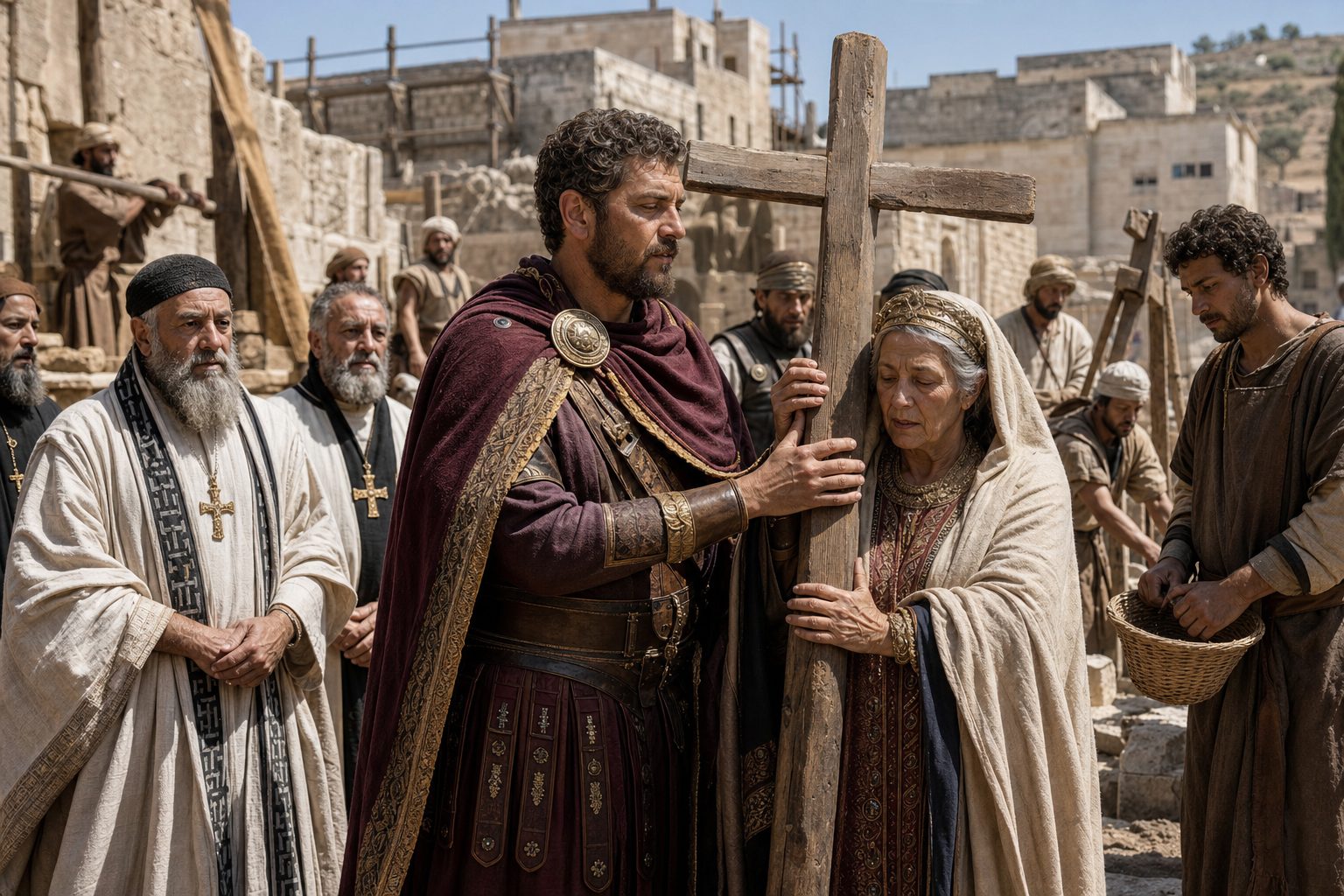
But as a warrior and a bloodthirsty man, he considered himself unworthy to do so himself. This pious purpose of the emperor was fulfilled by his equally honorable mother, Queen Helena, whom he released to Jerusalem, providing her with power and rich gifts.
According to Eusebius, this old woman, with youthful rapidity, went to the East to render proper worship to the feet of the Lord, "to the footstool of His feet" (Ps.131:7).
In a holy land marked by wondrous events, where everything reminds of "the great Mystery of piety - the manifestation of God in the flesh", the greatness of the humble soul of the royal old woman was clearly manifested; there St. Helena did not wear her traditional saree clothes, but in the most modest clothes she walked among the people.
In imitation of the Lord Jesus, she extended her humility to the point of gathering virgins into her home, feasting on them, and serving herself at the table as a simple slave.
The example of the queen's sincere piety made a deep impression not only on those who believed in Christ, but also on non-believers.
In Palestine, all the sites sacred to the Gospel have long since been desolated.
The pagans, out of hatred of Christianity, tried to erase the very memory of them; the most precious place for the believing Christian heart - the cave of the coffin of the Lord was covered with rubbish and thus hidden from the reverent eyes; not enough, as if to mock the "Crucified God" and his worshippers,
On a hill over the holy cave, a shrine was built to the "sweet-loving demon of love" (Venus).
On Helena's instructions, the idols placed in places sacred to Christians were destroyed and holy temples were built in their place.
Thus, beautiful churches were built, at the queen's request and at her own expense, in Bethlehem over the Cave of the Nativity, on the Mount of Olives - the place of the Ascension of the Lord; temples were decorated with Gethsemane - the place of the Dormition of the Holy Mother of God, the place of the appearance of God to Abraham at the oak of Mamry.
But the royal old woman's chief concern was to carry out her great son's plan to find the very tree on which the Savior of the world was crucified.
The place where the Lord's Cross was hidden was unknown; to find it, pious Helena used all her means and her royal influence.
And after much searching and searching, this place was pointed out to a certain Judas, an elderly Jew, the son of a Jewish teacher, pointed out under a pagan tomb built on a hill that covered the cave of the Lord's coffin.
On the order of the queen, the vile Venus was overthrown, her shrine destroyed immediately; the saintly Jerusalemite Macarius prayed at the desecrated site; they began to clean the height.
And pious zeal received a marvelous reinforcement: the workers, digging the earth faithfully, smelled the fragrance of the fragrance coming from under the earth.
Zeal for the glory of Christ's name moved the workers, in accordance with the wishes of Blessed Helena, to remove the materials of the destroyed pagan temple and all rubbish from under it as far as possible from the place of the burial of the Lord Jesus, so that nothing defiled by idolatry would touch the great temple.
It's a sacred Christian thing.
The cave of the Lord's coffin was found and cleansed; and near it, on the east side, were found three crosses, and underneath them a tablet with an inscription and honest nails. But how was it to be known which of the three crosses was the cross of the Saviour?
- The general bewilderment in this matter was resolved, by the arrangement of the Promises, by this miraculous event: it happened that by this place at that time a dead man was being carried for burial; the saint Makarios ordered the bearer of the dead to stop; they began to believe, on the advice of the bishop, that the found crosses were one by one.
to the resurrection of the dead.
When all saw the miracle, they rejoiced and glorified the living power of the Lord's Cross.
And as it was not possible, in the presence of the crowd, for each one to pay the proper homage to the found cross, as the queen did, St. Macarius, satisfying the general desire to see the sanctuary even from a distance, raised it reverently and stood on a high place, created the erection of the Cross
The first lifting of the holy and life-giving Cross took place in the year 326.
The Orthodox Church celebrates this event every year on September 14 [On the Feast of the Exaltation of the Holy Cross - the day of the fasting-worship of the Orthodox Church is dedicated to the glorification of the Cross of the Lord, the remembrance of the cross death of the Savior; at the all-night vigil after the great praise is performed
Solemnly carrying the Cross from the altar to the middle of the temple and worshiping it.
A special solemnity is the ceremony of raising the Cross in the cathedral churches, performed by the bishops when the clergy repeatedly proclaim: "Lord, have mercy".
Many of the Gentiles and Jews then turned to Christ; among those who did so was Judas, to whom he pointed out the place where the Holy Cross was kept [Judas, by baptism - Kiriak was later the patriarch of Jerusalem and suffered martyrdom under Julian the Apostate.
The Holy Cross was then placed in a silver coffin for safekeeping; on Good Friday it was carried to Golgotha (in the temple that was soon to be built, where it was stored) for worship.
Not long after that, the blessed queen mother died and was honorably buried.
Having received from his mother, Blessed Helena, a priceless treasure - a piece of the Holy Cross, Constantine decided to decorate the cave of the coffin of the Lord and build a temple near it that would be "more magnificent than all the temples that exist anywhere"...
"The cave as the head of all, according to Eusebius, the Christ-loving generosity of the king clothed with excellent columns and numerous ornaments.
And the remarkable care with which the Christian emperor took care of the building of the temple on the eastern side of the cave is best illustrated by the following lines from Constantine's letter to the Jerusalem saint Macarius: "As for the erection and fine decoration of the walls of the temple, know that the care
I have entrusted this responsibility to the rulers of Palestine.
And I have made sure that they have artists, and craftsmen, and all that you need for the building.
And as for the columns and the marbles, whatsoever thou seest to be most precious and profitable, examine it thoroughly, and write unto me at once, that I may see of thy letter how many materials are required, and deliver them from every place.
And I will also know what kind of vault you like, whether mosaic or otherwise, and if mosaic, then it can be decorated with gold. And let your majesty inform the governors mentioned as soon as possible, how many artists and artists are needed and how much it costs.
Constantine, by the way, thought it would be good to decorate the temple with twelve columns, numbered Apostles, topped with silver vases.
It is not surprising, then, that this temple was a marvel of beauty and delighted its contemporaries.
The historian Eusebius, among other things, describes this monument of the pious zeal of the first Christian emperor: "The basilica (temple) is an extraordinary building, immeasurable in height, and extraordinary in breadth and length.
Its interior is covered in multicolored marble, and its exterior, glittering with polished and interlocking stones, is extremely beautiful and not inferior to marble.
The dome-shaped ceiling is decorated with a marvelous carving, which, spreading like a great sea over the entire basilica with interconnected arches and shining everywhere with gold, illuminates the entire temple as if with rays of light.
The main object of the whole is a semicircle, located at the very edge of the basilica (on the east side), crowned by twelve Apostles and twelve columns, the tops of which are decorated with large vases cast from silver - a beautiful offering to God from the king himself".
But the godly emperor was not limited in his attitude toward Christianity only to his concern for its outward exaltation; he was also concerned about the inner life of Christ's Church.
According to Constantine, the church should be the most important support of the state; religious unity should be a powerful guarantee of the empire's prosperity.
The Church, brilliant in outward grandeur and splendor, should attract the pagan population by her inner world, gradually converting the whole state into one internal organism, animated by the One Spirit of Christ.
This unity and prosperity of the Church "gave the caring king peaceful days and quiet nights", in which he saw his own happiness and that of all the peoples of the world subject to him".
In his time, the Church of Christ, already crowned with the victorious crown of martyrdom and having received the right of civil existence even with advantages over paganism, was outraged by internal disorders that had arisen and matured in the difficult hour of persecution.
As soon as Constantine had reigned in Rome, he was surprised and saddened to learn that the whole region of his empire was being ravaged by the infighting of the Sons of the One Father.
- Among the Christians in Africa, a struggle broke out over the appointment of Cecilian, bishop of Carthage, as a "traitor".
His opponents elected Majorinus as their bishop, and soon after Majorinus' death, they installed Donatus as their chief opponent.
Adherents of the latter, the "Donatists", having become close to the "Novacians" [Novacians taught that those who had fallen during persecutions and in general who had sinned gravely <unk>mortally<unk> should be received into the communion of the Church not through repentance, but through re-baptism.] , claimed that they alone constituted the Church of Christ and in the
They were not shy about slandering their enemies, even forcibly taking away their temples, often resulting in bloodshed between the warring sides.
To reconcile them and to settle their mutual grievances, Constantine first sent to Carthage his "beloved and respected" bishop Ossius [Ossius, a native of Spain who was bishop for more than 60 years, became famous as a confessor of Christ during the Diocletian persecution.
Emperor Constantine summoned him to his court and surrounded him with love and trust.
Socrates 1, 7).] , instructing him at the same time to distribute financial aid to the needy Christians there [Eusebius: Church East X, 6.]; then, by order of the emperor on the Donatists' case, two councils were convened - a small one in Rome and "from many bishops of different places" in Areola [ibid., X, 5.]
The judgment pronounced on the restless schismatics by these councils was finally confirmed in Milan in 316 under the personal chairmanship of Constantine, and the case was apparently settled.
But the more the pious emperor became acquainted with Christianity, the less it justified his ideal idea of the holy unity of Christ's Church.
The Donatists' cause, which worried Constantine in the early stages of his reign, was not so much a matter of substance as of passion.
In 323, after his victory over Licinius and becoming the sole ruler of the empire, Constantine set out for the East with a sincere desire to rebuild the whole state on better, more solid foundations.
In his plans, he placed the Christian church first, which he thought should spiritually unite a politically united world empire.
He arrived here at a time when the controversies of the Arian heresy [Arianism blasphemously taught that Jesus Christ is not the eternal and beginningless God, that He is not one with the Father and is His creation - there was a time when He did not exist.
Arius received his theological education in Antioch at the school of the martyr Lucian; becoming a presbyter in Alexandria, he drew general attention to himself both by his intellectual gifts and by his strictly abstemious life.
Proud of his intellect and learning, Arius ignored the admonitions and warnings of his bishop, Alexander, and did not submit to the council convened by the bishop and condemned by him.
Having many supporters, he sent an embassy with a complaint to many bishops of the Eastern churches.
There he found supporters, led by Eusebius of Nicomedia, who had been acquainted with Arius from the school of Lucian, a scholar, a relative of the royal family, and therefore an influential man.
Eusebius, bishop of the capital (this was when the emperor Licinius, whose residence was Nicomedia, was still alive), did not recognize the authority of the Alexandrian bishop's court.
And he said unto Arius, Thou art a wise man, and thou wouldest that all men should be wise; for it is plain to all that nothing was created until it was made; and that which is made hath a beginning.
The bishop of Alexandria was therefore in a sad position; about 318 Alexander decided to take the extreme measure:- summoned a council of a hundred bishops; excommunicated Arius and his supporters from the Church; banished the blasphemer from Alexandria and in a circular message announced it to all the churches (see the Divine Vest.
This measure further inflamed the Arian disputes and spread their flame throughout the East. The Arian cause was now losing its local character and gaining a general church significance.]
Eusebius describes this time: "Not only did the leaders of the churches enter into disputes with one another, but the people were divided; the course of events became so disgraceful that the divine doctrine was insultingly mocked even in the pagan theatres".
It was a favorable time for the activities of blasphemers of the Lord Jesus Christ.
Lykinius, Constantine's brother-in-law, who lived during the last years of his reign and who had signed a decree with Constantine regarding tolerance, was suspicious of Christians in general, and even hated and cruelly persecuted them.
But in their mutual disputes, which were caused by the Arian heresy, he could see a desirable, useful thing for himself, and these disputes, weakening the power of the Church, could give him hope of support in his plans against his powerful brother-in-law.
Constantine himself, for example, commented on the Nicomidian bishop Eusebius: "he even sent me contemplatives and gave almost armed aid to the tyrant (Licinius) " [Bogosl. Western, Dec. 1906, p. 694].
However, he did not immediately grasp the significance of these events.
Both he and the mystics of divine doctrine who came with him from the West received a one-sided coverage of Arius's case from the Nicomedians, who saw in dogmatic matters not the object of pious faith, which had a vital importance, but the field of scientific research, and even empty talk.
Nevertheless, Constantine did not ignore the Arian cause; at first he sent an extensive conciliatory letter to Alexandria with a persuasive request to bishop Alexander and Arius to stop the mutual discord.
According to the king, the bishop was wrong about his carelessness and sharp questions, and Arius was guilty of breaking off the communion, disobeying the bishop; he recommends that both take the example of philosophers who, although they argue among themselves, live together peacefully.
Yet they both stand on the same ground: both acknowledge divine Providence, and therefore they are easily reconciled [Eusebius: Life of Constantine II, 64-72]. . . .
Along with this message, Constantine sent his "beloved" bishop, Osias, to Alexandria to investigate the matter on the spot and to help pacify the Alexandrians.
- He did not reconcile the opponents, but from his investigation of the controversy he concluded that the Arian heresy - not idle idle talk, but threatens to shake the foundations of the Christian faith - leads to the negation of all Christianity.
In 324, when Ossius of Cordoba returned to the king and explained to him the serious dangers of the Arian movement, Constantine decided to convene the Ecumenical Council, which, in his opinion, remained the only means to pacify the Church.
In the king's view, this Council, "waging war against the chief enemy" of the world of the Church at that time, the blasphemous Arian heresy, was to consider and give answers to other questions - definitions of the internal life of Christians [Eusebius: Life of Constantine III, 17 V, 6].
The Ecumenical Council by the power of the King determined to be in the city of Nicaea [Nicaea, now Isnik <unk> a poor village, was then a vast and wealthy city, - the chief in the coastal region of Bithynia; with the sea it was communicated by means of a lake and was equally well accessible from sea and land; there was a vast imperial
It was a palace and many buildings where the bishops and clerics could freely fit in; Nicaea was only 20 miles from Nicomedia, the then residence of the emperor, who thus had great convenience to participate in the Council.
The election of Nicaea as the seat of the Council, according to Eusebius, was influenced by its very name - <unk>ποβήτα<unk> (in Russian translation).
Constantine made it easy for the bishops to travel to the meeting place, and he took care of the expenses of those who came to Nicaea.
To Nicaea came saints from Egypt and Palestine, from Syria and Mesopotamia, from Asia Minor, Greece, Persia and Armenia, and from the Goths of the Danube; from Rome, instead of the elderly bishop, two presbyters arrived.
Among the gathered saints were: the elderly Alexander of Alexandria, the first denunciator of Arius, who brought with him the archdeacon Athanasius, a valiant and skillful fighter against the Arians (later the Great, archbishop of Alexandria), the saint of the Lycian city Mir Nicholas, the saint Spiridon
He's a miracle worker.
The Council was opened in June 325 in the vast palace of the king.
The bishops' room was surrounded by benches, and in the center was a table on which lay a book of sacred Scripture, a faithful witness to the truth.
When all were assembled, Constantine appeared in all the grandeur of his imperial stature, but without armed guards, accompanied by Christian courtiers, dressed in the most lavish royal garments, sparkling with gold and precious stones.
His appearance astonished the assembly, and especially those who were present, who had come from far countries and had never seen his royal face or his royal majesty; but he himself was troubled at the sight of such a gathering of the glorious pastors of the Church of Christ, among whom were the strict heretics and the heretics.
[The number of the Council fathers is not uniformly shown by historians; Eusebius (Life of Constantine III, 8) for example counts them up to 250; cf.
St. Athanasius of Alexandria in his writings, the emperor himself, speaks of 300.
The church; in its Greek inscription-Tsh-ona resembles the cross of Jesus, therefore it is accepted in general use, so that the Council of Nicaea, received the name - Council of the 318 Fathers.] , suffered for their faith, Silent, with his eyes bowed, he approached the golden chair prepared for him and stood waiting, while
The priests didn't invite him to sit.
After hearing the greeting and thanksgiving of Eustathius of Antioch and the historian Eusebius of Caesarea, Constantine himself addressed the assembly with a speech in which he expressed his joy at seeing such a great gathering of fathers, and begged them to resolve the contentious issues peacefully.
"God has helped me", he said, "to overthrow the wicked power of the persecutors, but it is incomparably more grievous to me than any war, any bloody battle, and any disastrous internal strife in the Church of God".
The Arians went to the Council and held themselves there boldly and confidently; they did not foresee that their cause would be completely and comprehensively defeated; on the contrary, they expected in their plans a happy success:- they had on their side up to 17 bishops; they were led by a metropolitan archbishop who had connections in the palace
The king.
The Arians hoped that even if the Council did not agree with their views, it would not condemn them severely.
But his unwavering, convinced devotion to the true church teaching of the Council fathers shamed the blasphemer's false wisdom.
The Alexandrian deacon Athanasius distinguished himself by his special power of speech and sharpness in exposing heretical bullshit: his word tore apart the heretic's crafty words like a light web.
The disputes were heated and protracted; Constantine used his influence in vain to reconcile the disputants and bring about a friendly settlement; the longer the debates went on, the more obvious it became how far the Arians had strayed from the truth.
Eusebius of Nicomedia, the head of the Arians, proposed to the Council a statement of faith that clearly expressed the idea that "the Son of God" is a "creation", a "creature", and that "there was a time when He did not exist" and was unanimously rejected by the Council Fathers as false and wicked - the very scroll on which it was written
It says it was torn.
Having thus condemned Arianism, the Council fathers decided to give the faithful an accurate confession of Orthodox doctrine - a symbol of faith.
Eusebius, a bishop of Caesarea, introduced to them a "baptism symbol" that had long been used in his church and was made up almost exclusively of expressions taken from the Holy Scriptures.
The Fathers welcomed the symbol; but in order to resolutely eliminate the possibility of inserting heretical thought into it, they saw the need to replace some general expressions in it with those that would perfectly define church truth.
The emperor, who was present at the Council, joined the Fathers in approving the Caesarian symbol and confessed his full agreement with it; but at the same time Constantine proposed to introduce into the symbol a formula on which the leaders of the Church still stopped at preliminary meetings to express the church's thought on the Caesarian symbol.
The Son of God and His relationship to God the Father is the title of His "only-begotten" Father.
The words spoken by the king were unanimously accepted by the Council and served as the defining basis of the teaching about the Face of the Lord Jesus, the central Christian dogma.
The final solemn assembly of the fathers in Nicaea was held in the imperial palace on 25 August 325; it coincided with the 20th anniversary of Constantine's reign [Eusebus: The Life of Constantine, book P.65.]
"Beware of bitterness, " he said", and do not be envious of those who are highly respected.
You who are high and noble, do not look down on the lowly, for God alone knows who is superior, perfection is rare everywhere and you must be patient with the weakness of your brothers, peaceful harmony is precious in all things.
When saving unbelievers, remember that not everyone can be converted by scientific reasoning - the teachings must be adapted to the different moods of each one, just as doctors apply their medicines to different diseases.
Thus was fulfilled the long-cherished desire of the pious emperor, which he once professed, even bringing God Himself to bear witness, - the desire "to unite into one the doctrine of the Deity of all the peoples of his empire".
The great thought, which the king was inspired by his holy religious sense, the realization of which he set for himself as a life task with a heartfelt desire, this thought of Constantine the Great, striking in its sublimity of content and breadth of scope, was now introduced into the general consciousness, became a possession.
The whole of Christendom.
Not only that, but the pious king also pointed out the most certain way - the Ecumenical Council - by which the sheep of Christ's pasture, both those who have been called and those who have not yet been called, by the grace of God, unerringly enter the court of the Heavenly Father for true life.
(John 10:9) What a blessing that will be!
And this true triumph of the equally apostolic king was also headed at that time by the joyful receipt of an invaluable treasure, a piece of the life-giving Cross of the Lord, brought to him from Jerusalem as a gift by his mother, Queen Helena.
Constantine lived for another 10 years, and throughout his reign he adhered to the Nicene Creed with unwavering fidelity.
The Arians, with their cunning wiles, sometimes gained the trust of the king and, abusing his generosity and peacefulness, at times made indecent attacks on the Orthodox; especially St.
Athanasius the Great suffered much from them.] , and zealously endeavored to establish the spirit of Christian piety in his kingdom, setting a worthy example in himself.
Having a thorough general education and a theological one in particular, he conducted extensive correspondence with church leaders on subjects of faith and piety and the arrangement of Christian life, and often in his palace he spoke before the assembly of the royal courtiers and the people even with "godlike" teaching.
He was unusually industrious and did not tolerate idleness: even in his old age he did not consider it a burden to write extensive legislative acts by his own hand.
True and generous in nature and modest, he was not seduced by his royal grandeur and the noisy delights of the crowd, these delights even made him bored.
Standing on a high level of moral development, Constantine wanted to raise everyone who came into contact with him to the same level.
And he said, If thou shouldest get all the riches of the world, and possess all the rivers of the earth, and have none more than this piece of land, yet wouldst thou be worthy of this?
Another example: After hearing a flattering speech by an honorable person (a clergyman) who called the emperor "blessed" and said that "he has won sovereignty over all in this life and in the coming will rule with the Son of God", Constantine replied to the flatterer:
"You better pray for the king, so that he too in the next life will be worthy to be a servant of God".
The king's charity flowed widely, according to his contemporary, "from morning till evening he sought someone to show kindness"; the poor and generally people thrown out on the street, he provided money, food, and decent clothes; he took care of orphans instead of his father; virgins deprived of their father;
He married his parents and gave them a share of his wealth.
Especially did he do much good on Passover day.
In his new capital, Constantine introduced the custom of lighting high wax pillars on all its streets on Easter night, "like flaming lamps", so that the mysterious night became brighter than the day itself, and only when the morning came, did Constantine extend his right hand to all the needy,
I'll give them presents.
The king also gave alms generously on the occasion of his family's joyous events, such as the marriage of his sons; - in the latter cases lavish feasts and dinners were arranged for the invited guests, the fun then being carried out of the palace even to the street - the king welcomed the women's hosts.
But the last years and especially the last days of the life of the emperor Constantine and his death were a worthy completion of his Christian piety.
The temple was decorated with twelve coffins in honor of the face of the Apostle, and a tomb was arranged in the middle of these coffins.
It was unclear at first why the tomb was erected here, but later it was clarified that the pious king had erected the tomb for himself.
In 337 C.E., Constantine celebrated Easter in Constantinople for the last time and soon fell ill.
When he saw that he was about to die, he devoted himself entirely to the sacred exercises: often bowing his knees, he poured out fervent prayers before God; on the advice of doctors, he moved to the city of Eleonopol to be treated there in warm baths.
This may seem very strange to us today, but in the early days of the Christian Church, many were baptized in mature years or even in old age, some out of a deep respect for the great mystery, for which they considered it necessary a long preparation,
Others were born again, not without sinful passions, but afterward they were born again to a new and living spirit.
Constantine, who had carried Christ in his heart from his youth, had long since become a Christian, and he was willing to prepare himself for baptism with the courage of a lifetime, in the humble awareness of his sinfulness.
Not receiving relief in Eleonopolis and feeling his physical strength declining, Constantine sailed to Nicomedia and here, having summoned the bishops, asked them to honour his holy baptism.
The hour has come, the hour I have longed for and prayed for as the hour of salvation, the hour for us to receive the seal of immortality, to share in the saving grace.
I thought to do it in the waters of the Jordan, where, in our image, the Savior Himself received baptism; but God, who knows what is profitable, has granted it to me here.
He was clothed in a white robe, which shone as the light, and he did not take it off until the day of his death, and he lay on a bed covered with white cloths, and the purple robe, which was the royal garment, the "slave of God" would not touch.
The king concluded his final prayer of thanksgiving "with a loud voice" by saying: "Now I consider myself truly blessed, for I have the unquestioning faith that I have come into the divine light and have been granted immortal life.
The great and equally apostolic Constantine died, leaving the kingdom to his three sons, on the very day of Pentecost 337, in the thirty-second year of his reign, at the age of sixty-five.
His body was carried with great solemnity to the city of Constantinople, which he had built, and according to his will was laid in the church of the holy Apostles in a tomb he had prepared.
to him be honor and glory for ever and ever. Amen.
Seeing your image on the cross in heaven, and as Paul the title not from man accept, in the kings your apostle Lord, reigning city in your hand put: save him always in peace, by the prayers of the Mother of God, the only man-loving.
Constantine today with the matter of Helena, the cross represent the tree of all honor, for all the Jews shame exists, but the weapon against the enemies of faithful kings: for us a great sign appeared, and in the armor terrible.