The Passion of St. Basil
Memory of 22 May After the death of the holy martyrs Eutropus and Cleon, with whom he suffered many sufferings, and after the death of the ruler Asclepiodotus, he arrived in the province of Pontus.
Now in the place of ancient Pontus are the bottom of the Turkish vilayets (provinces): Trapezun and Sivas.] sent by the torturers Maximian and Maximin [Maximian was emperor from 284 to 305 and ruled the western half of the Roman Empire, and Maximin ruled from 305 to 311 and ruled the eastern half of the empire.] , another ruler, named Agrippa, with the order to continue to persecute and kill believers in Christ.
Even before his arrival in the city of Amasia, Saint Basil, who was there in prison, prayed with tears to God in these words: "Lord Jesus Christ, remember me and do not forget me until the last minute of suffering, but help me quickly receive the martyr's crown, so that I will not be separated from those holy men who were with me,
"They have suffered before me, and have taken the crown of martyrdom".
And Jehovah appeared to him in a dream by night, and said, Behold, I remember thee, and I will not forget thee; and thy name is written before them that are taken with thee; and grieve not for thy loss, for thou shalt warn many; and I will make thy name great in all the earth.
And now, go, say good-bye to thy mother, and to thy brethren, and to thy kindred, and when thou comest back, thou shalt take the crown of martyrdom, and be buried in Comanah. Fear not the affliction that thou art about to suffer, for I am with thee, and the evil of man shall not destroy thy soul.
And when he saw that the doors of the prison were open, he said to his guards, and to the captain of the guard, Give me four days' leave, that I may bid farewell to my mother and my brethren in the village of Cumial, and return to my true Father, the Lord Jesus Christ.
And now, behold, thy God, whom thou servest continually, is witness that we would certainly have let thee go, had it not been for the king, whose coming we are looking for. And the holy man said, I will not be let go, until I go and make my peace with my mother, and with my brethren, and with my kindred, as I have said; for the Lord hath commanded me to do so.
"We are afraid that soon after your expulsion", insisted the soldiers, "you will not be required of us, for behold, we have heard that today the governor is coming to the city, and all the prisoners are written in the book of judgment". St. Basil said to this: "It is the will of my God that I go to my native village; therefore, if it is your will, let some of you go with me and return with me again.
And the soldiers yielded to his request, and some of them gathered themselves together, and went with Basilisk to his village, and the holy man was received with great joy by his brethren (he had three brethren) and his mother, and the soldiers were received into their house with great honour.
And the next day in the morning he called together all his kindred, and exhorted them in many things, and taught them the truths of the Christian doctrine, and said unto them, Through many afflictions we may enter into the kingdom of Christ.
For the world and all things in it are but a shadow passing away, but the Lord abides forever. I beseech you to pray for me to the Lord of us all, God, that he may give me the strength to do the deed, the suffering, as did St. Theodore Tyron.
And Euthronius, and Cleonice, who were taken captive with me. Fear, husbands, wives, brothers, sisters, and children, for I am departing from you, and you shall see me no more in this temporal life.
"When you have finished your holy life, pray for us and for all Christians to the Lord, that the persecution of the Orthodox faith by the torturers may cease and the worship of idols be destroyed, and that the grace of Christ may spread throughout the land".
At that time the governor Agrippa came to the city of Amasias and, having called together all the most honorable citizens, entered with them into a pagan temple, called Petazon [obviously here the temple in honor of the Egyptian-Hellenistic god Ptah - god of the dead.] , and then into another, called Serapion [Serapion - temple in honor of Serapis - Egyptian-Hellenistic god, corresponding to the ancient Greek Zeus].
Both Serapis and (mentioned above) the god Pta were gods of the Egyptian religion itself, but during the period of fascination with eastern religions (II century BC), the Greeks showed great respect to these gods and built numerous temples in their honor.
And the next morning the governor came to the place of the judgment, and inquired of the prisoners, and asked first of all about Vasiliski, because he had heard of him, and wanted to bring him before his judgment at the first.
And the keeper of the prison said, It is the second day, since Basilisk went with his soldiers to his own city. And the keeper of the prison said, I will command thee to be put to death, unless thou bring me the man that blasphemed our gods. And the fourth day I will bring him to thee.
And immediately the governor sent with him the magistrate, a man of a violent temper, and with him soldiers, and gave him a charge in these words, saying,
And I will know that thou art a man of jealousy for our gods, when thou seest this blasphemer, and bringest him to me; and thou shalt send him to Comman, for I am going thither myself. And the magistrate went out from the governor, and made copper boots with many sharp iron nails, and took with him a guard and soldiers, and went to his native village of Vasiliscus, carrying on a donkey the heavy iron chains prepared for the martyr.
"I went too", says the narrator of later events, St. Eusignus [Holy Martyr Eusignus, who described the life and exploits of the holy martyr Basiliscus, for 60 years was a warrior under three Roman emperors: Diocletian (284-305), Maximian (305-311) and Constantine the Great (311-337), and suffered under the reign of Emperor Julian the Apostate (361-363). - See.
He was following them in the hope of seeing the suffering and death of St. Basilisk.
And when they had come to that village, they took the martyr, who was going out of his house toward the city of Amaziah, to return to his prison, and bound him with double chains; and they bound his neck with an iron chain, and put copper shoes on his feet with nails in them, so that the nails entered into the feet of the saint to the very bones, and the blood flowed abundantly from his wounded feet; and the martyrs beat the martyr of Christ severely, as he was led to his city Coman.
His mother and brothers were coming with him, crying. When he left, his mother said to him, "My son, the one you love, be merciful to you".
Thou shalt live for a little while here, but in the world to come thou shalt have eternal life. Thou sufferest grievously now, but thou shalt receive the crown of glory from Christ God. Torture thou art tormented in the world, but the angels of peace receive thee into heaven. Thou art judged as a thief, but the thief himself, who was crucified with Christ, will receive thee into heaven.
It's an angel.
And remember us, my dear son, in this way to the Lord, on which you walk. Having said this, the mother returned to her house, praying to the Lord for her son, that he might strengthen him to bear the pain.
And he said unto them, Weep not for me, but pray ye for me to the Lord, that he may give me strength to overcome the devil, and to put his servants to shame.
Why are you weeping and breaking my heart? I am in danger of death. Please come back to me".
But when they would not hearken to his words, the magistrate and his soldiers began to beat them, and could scarcely drive them away from the saint; and being thus led, the saint bravely bore the weight of iron chains, and bravely endured the pain of feet pierced in many places with sharp nails, and his path stained with blood, and he himself sang with joy:
"Though an army encamp against me, my heart shall not be afraid" (Psalm 26:3), for you, Christ the Lord, are with me. Many things the saint proclaimed, turning to the Lord in song and prayer.
When they came to the village of Dacozarias, the magistrates and the soldiers wanted to rest, because it was hot and it was already noon. When the widow Trojan, the owner of the town, saw the magistrates and the soldiers, she invited them to her house to eat a meal. There were forty of them.
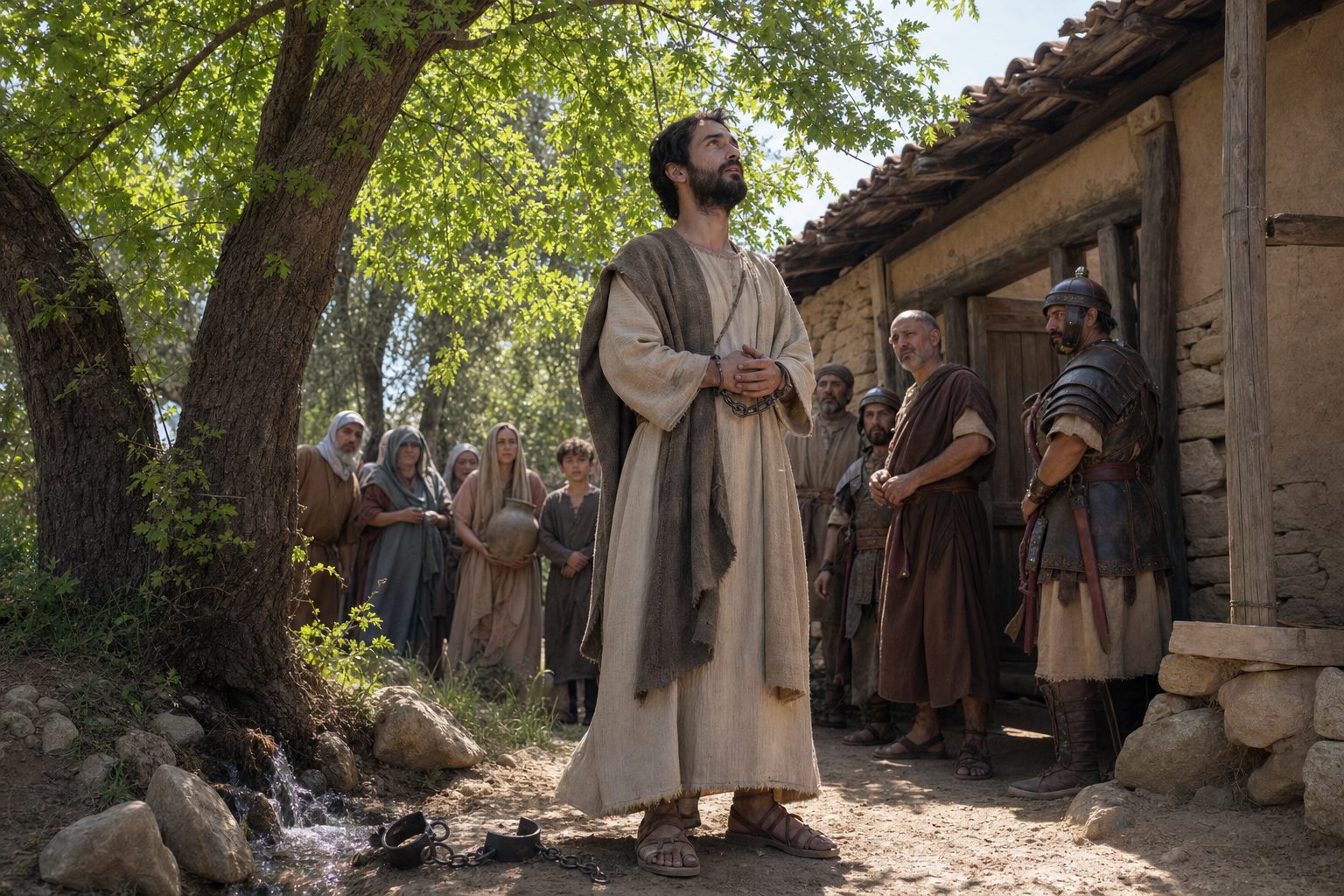
So they ate and drank and rejoiced, and bound the holy martyr Basilisk with his hands bound behind him to a dry oak tree which grew near the gate of her house.
The saint prayed to God, crying out: "Lord, visit me as you visited Joseph in prison (Gen. 41), Daniel in the lions' den (Dan. 6), three young men in the furnace of Babylon (Dan. 3).
And when the saint had finished his prayer, suddenly there was an earthquake, and a voice from heaven said, "Fear not, for I am with you".
And behold, the shoes of the brass that were on his feet melted like wax from the fire, and the chains fell from the sanctuary, and the dry oak grew green, and spread out its thick branches over the sanctuary, and covered it with its shade round about; and a fountain of water gushed out of the place where the sanctuary stood, and the ground was covered with his blood.
Then the saint gave thanks to God in the following words: "Lord Jesus Christ, the Eternal Word and the Son of the incomprehensible and ineffable Father, who was pleased to come down to earth and become a man, to redeem us from the ancient tormentor of the devil and deliver us from all his wicked schemes, who has lifted us to heaven, and who has corrected him and condemned him to dwell in the abyss, who has given us new life - with what lips will I praise you, with what words will I tell you my
I will remember you and tell of your great deeds and of your power, which you have now shown to me, your servant. You did this before in the lives of your saints, Euphropius and Cleonice, who were put to death by the governor Asclepius.
Who am I, that I should be worthy of thy great and marvelous loving-kindness toward me? And the earth trembled at thy hand.
The crowd was amazed at what had happened, and they praised the greatness of God. Many came to believe in Jesus and said, "This is the Holy One of God, who has come to set our place free".
And they brought to the saint a paralytic lying on his bed; and when the martyr of Christ touched him, immediately the paralytic stood up and was healed, and taking up his couch he went to his house, glorifying God. And the lepers were also brought to him, and he touched them and healed them, and all those who were afflicted with diarrhea and fever, and those who were afflicted with various diseases and those possessed by unclean spirits, and he healed them all by his holy word.
When they saw what had happened, they all believed and gave glory to the Lord. The people of that town rejoiced greatly. The governess of Troas, along with her son Troas, also believed and asked to be baptized.
That same day, in the evening, a herd of oxen, going from the pasture to the village and passing along the path where the holy martyr of Christ stood, as if praising the great works of God, fell down before the saint on their knees.
And when they were all gone out of the city, the whole people, and Trojan, the owner of the city, followed the saint; and the holy martyr besought them all to return unto him: and some returned, and others followed him.
But when they came to the great bridge over the river Ireos, the bridge was shaken by the presence of Christ, who was walking invisibly with his servant, St. Basil, as the holy martyr Basil himself told me afterwards, unworthy Eusignus, says the narrator.
During his holy procession to every lofty and beautiful place, he knelt and prayed to the Lord: "Bless Jehovah, O my soul, in all the places of his kingship". - Ps. 102:22.
And when they were come to the city of Zion, the mighty men and the magistrates prepared food, and urged the saint to eat bread with them; but he refused, saying, The Lord is my shepherd, I shall not want.
"Lord, we're not going to let you die of hunger. We're not going to let you go to the governor. You've been fasting for three days now. "
You are nourished by earthly bread, and I am nourished by the heavenly word of God; you are cheered by wine, and I am cheered by the grace of the Holy Spirit; you are nourished by flesh, and I by fasting; you are strengthened by the vigor of the flesh, and I by the cross in the name of Christ; you are made rich by gold, and I by the love of Jesus Christ; you are adorned with clothing, and I by virtue; you find joy in laughter, and I console my spirit by prayer; you love your temporal king, mortal and corruptible, ye long to see
You are seeking glory on earth, but I am in heaven; you are seeking glory among men, but I am hoping for glory at the Last Judgment at the resurrection of the righteous, when my Lord will say: "Come, you who have been blessed by my Father, inherit the kingdom prepared for you from the founding of the world". - Matt. 25:34.
When the saint had said this, the magistrate ordered the animals to be mounted and invited the martyr to ride on an ass, saying, "Three days you have been coming, hungry. Sit on the animal, so that you do not weaken to the end". But the saint refused to sit down, saying, "My Lord Jesus Christ gives me strength, and peace and joy of the Holy Spirit fill me.
And when the soldiers sat down to supper, the magistrate besought St. Basil to eat something with them, but he refused, and spent the whole night in prayer and singing, and the holy angels themselves sang with Christ's messenger.
And when they were come near to the city, they heard from many that were in the way, that the king had executed all that would not worship the idols.
And the king said unto them, Where is the ruler now? And they heard that the ruler was in the temple of Apollo, and that he offered sacrifices to the gods there. And he went and told him that he had brought Basilisk to him. And the ruler was exceedingly glad; and he told him also of the wonders that had taken place in their way; but the ruler believed him not, saying, All this is the magic of the Christians.
And he commanded that they should bring St. Basilisk to him into the temple of Apollo, and that they should make him to sacrifice there. And immediately the governor's soldiers ran to Basilisk, and dragged the saint by force into the temple, saying, Go to the temple of the governor, and worship the gods, if thou wilt live. And Magisterius and the soldiers that were with him from the journey began to relate to the governor's soldiers the wonders which they had seen, and added,
And they turned to the saint and said, Forgive us, O lord Vassilisks, our wickedness, which we have done in ignorance, and pray for us to thy God.
And while they were yet speaking, the governor's soldiers took the martyr, and brought him into the temple, and the saint went into the temple, rejoicing in the Lord his God. And when the governor saw him, he said to him, Art thou Vassilis?
And he said unto him, Who hath told thee of me, that I sacrifice not unto God? for I sacrifice continually unto my God. And the king being perplexed, said unto the saint, Well; sacrifice then to any of our gods that thou wilt. And he said unto them, What is the name of this god of yours? And they said, Apollo.
"You have rightly said that he is called Apollo", said the saint. "Apollo means destroyer. He is the enemy and master of the forces of darkness, and he destroys those who believe in him and worship him as a god, even though he is not a god.
"And what is the name of the god to whom you wish to sacrifice?" asked the king. "My God", replied the holy one, "is indescribable, incomprehensible, invisible, and inexplicable in His attributes". "And does not your God have a name?" asked the king. "In the holy books are the names of my God", replied the saint, "and if you will listen, I will tell you".
"My God, whose name is Father and Almighty, Lord of hosts, King of all, Savior of all, merciful and merciful and long-suffering, to him alone I will offer sacrifice of praise.
And he lifted up his hands to heaven, and said, O everlasting God, maker of heaven and earth, who hearest and givest truth to thy servants, hear and hearken to thy servant, and break this dumb and dumb image this day, that these wicked nations may know and be ashamed, and know that thou art God, the Almighty.
The ruler and the people who were in the temple fled in fear, and only St. Basil remained in the temple and sang: "Let God arise, and let his enemies be scattered, and let those who hate him flee from his presence.
Then the governor ordered him to be taken out of the temple, and gritted his teeth and said, "You who are an enemy of our gods, why have you broken your vow? You have promised to sacrifice to our god Apollo, but you have caused him to fall to the ground by your sorceries".
And it came to pass, as soon as he had spoken these words, that fire fell from heaven upon the temple of Apollo, and burned it up to the foundation; and the governor and all the people were afraid, and fled from thence. And when he had called St. Basilisk, the governor said unto him, O how great is thy magic! thou hast broken down God, and burned his temple. And the saint said unto him, If thy god be a god, as thou sayest, let him testify to me.
"Our gods are good", said the emperor, "and they do no harm to their enemies". "O foolish man", cried the saint, "how can the demons do good, being evil by their nature? They and you, their worshippers, will be dragged into hell with them". "Mad sorcerer", persuaded the holy emperor, "offer sacrifice to the gods; otherwise I will give you a cruel death".
"O beast of the forest, you dog that licks blood, you adulterer, you devil's image, you tormentor of lawlessness, why do you keep me? I'm about to die". The governor was furious with the saint and ordered him to be killed with a sword.
And the soldiers took him, and led him out of the city to the place called Diocletian, and the multitude of the people followed him, and the governor gave orders to cast the body of the saint into the river.
Our Lord Jesus Christ was seen standing in heaven and saying: "Come, my good and faithful servant, Basilisk, enter into the kingdom of heaven with the righteous, where are my servants who have been taken with you into torment for my sake".
And when we had heard and seen it, we bowed our heads and worshipped the Lord, because he had given us this vision, and Priscus the executioner took the body of the martyr and dragged it to the river.
"See that no one knows or tells the governor about this, or it will be trouble for you and me. " So we took the innocent body, " continued Eusygnus, "hid it, and carried it out at night into the ploughed field, buried it, and sowed seeds there. That night the seeds sprouted, and the next day they gave flowers.
When we were digging the tomb of the martyr, some of us wanted to drink water; and at the prayer of St. Basil, whom we had called, there immediately appeared a spring of water near the tomb; and when we had drunk, we praised and thanked God.
But no one dared to tell him that the martyr's body had been buried in the ground. Others said to him: "Why are you looking for him now?"
Then Agrippa went to the place where Christ's martyrs had been crucified and found some of his blood and dust, and he took it with his hands and bound it with his belt.
After some time, Marin, a devout man from Coman, built a church in the name of the holy martyr Basilisk and, taking his relics from the earth, he moved them to this church. By the relics of the saint many miraculous healings from all diseases were performed by his prayers and by the grace of our Lord Jesus Christ, to whom be honor and glory, now and forever, with the Father and the Holy Spirit. Amen.
In suffering strong and courageous you appeared, and in miracles wondrous, the name of Christ revealed, the tormentor shamed you.