The memory of our reverend father , Michael the Confessor .
Saint Michael, the bishop of Sinad, who bore the same name as the Archangel of the heavenly forces, lived an angelic life, adorned with virgin purity and virtue.
It was built in 264 B.C. and named after the Viennese king Nicomedes I. The site of ancient Nicomedia is now the city of Isidore.
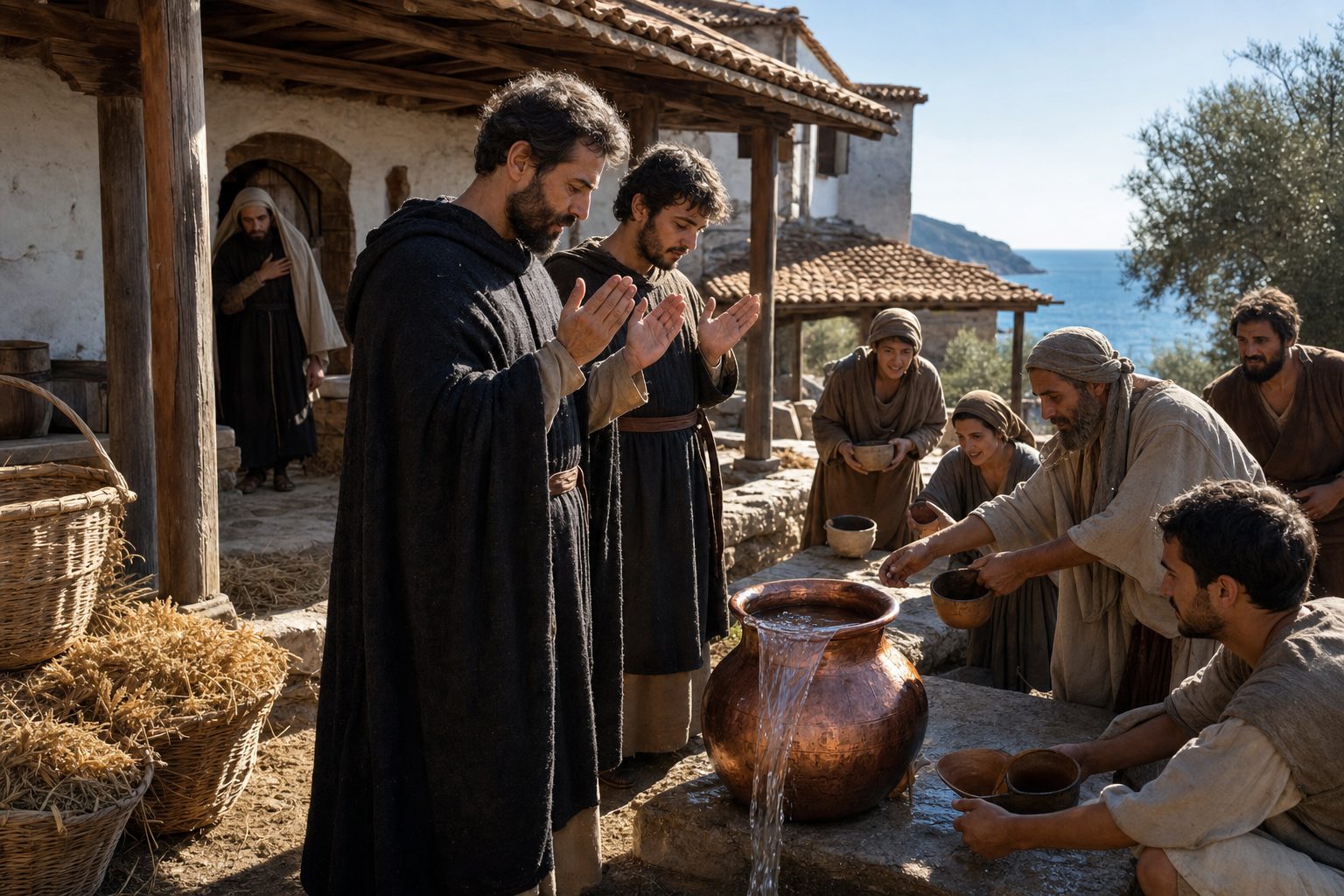
Both of them were sent to a monastery on the shore of the Black Sea, where they were able to do good works, and their prayers were very powerful.
And there was a great heat in the land in the time of the harvest, and they prayed to their God, and there came water out of an empty vessel of copper, and it flowed abundantly.
This miracle was reminiscent of one that occurred in the wilderness, when God brought water out of a rock for a thirsty Israelite (Ex. 17:6) and another when, for Samson (Israelite judge) who was dying of thirst, God drew a spring of living water from the dried jawbone of an ass (Judg. 15:19).
Afterwards, the most holy patriarch Tarasius, seeing the virtuous life of these venerable fathers, who shone like stars in the sky, recognized them as worthy of the high hierarchical rank.
When the most holy patriarch Tarasius departed from this life to the Lord, and after him took the throne of the Constantinople church of St. Nicéphore [St. Nicéphore patriarched from 806 to 816 - his memory June 2]. , the storm of heresy of iconoclasm rose again, which had already been condemned at the seventh ecumenical council of the holy father [Seventh Ecumenical Council took place in 787 in the city of Nicaea.] .
The wicked Emperor Leo the Armenian [Emperor Leo the Armenian reigned from 813 to 820] became infected with that heresy and began persecuting the Church of Christ, denying the veneration of holy icons and calling them idols, torturing and killing those who worshipped them.
First of all, he expelled the most holy patriarch Nicéphore, as well as other Orthodox bishops from their thrones, and appointed his fellow heretics in their place - and the abomination of desolation prevailed in the holy places. (Dan 9:27) At this time, St. Michael showed himself to be a zealous defender of Orthodoxy and a denunciator of heretical wickedness.
He was strengthened by the grace of the Holy Spirit, and he opposed the heretics, and stopped their mouths from denouncing the holy icons.
"I venerate the holy icons of my Saviour Jesus Christ and the Immaculate Virgin, His Mother, and the other saints, and I adore them; but I do not consider it possible to fulfill your decree".
He was driven from one place to another and suffered many bitter afflictions and troubles until he reached the heavenly abode and received eternal rest. Thus he ended his righteous life, adorned with a double crown, ascribed to the archbishops as archbishops, and to the martyrs as martyrs, to the glory of Christ our God.
As the archbishop is revered, and the piety of the priestly martyrs, the persecution of the evil name not fearing, heretical opposition overcame him, with a free voice loudly shouted: the icon worshiping Christ, and the Most Holy Mother.
The Condak, voice eight.
2 See his life under 8 March. 3 Nicomedia - a city in the northeastern corner of the bay formed by the Marble Sea. It was built in 264 B.C. and received its name from the northern Finnish king Nicomedes I. The oldest city in Nicomedia is now under the patronage of St. Nicholas, Patriarch of Taizé, who lived in the city from 8 February 786 to 8 February 806.
7 Emperor Leo (5th) Armenian reigned from 813 to 820. 8 Initially Saint Michael was exiled to the Thracian city of Eudokiad 9 The death of the holy martyr followed around 818.