The Passion of the Holy Martyr Theodosia
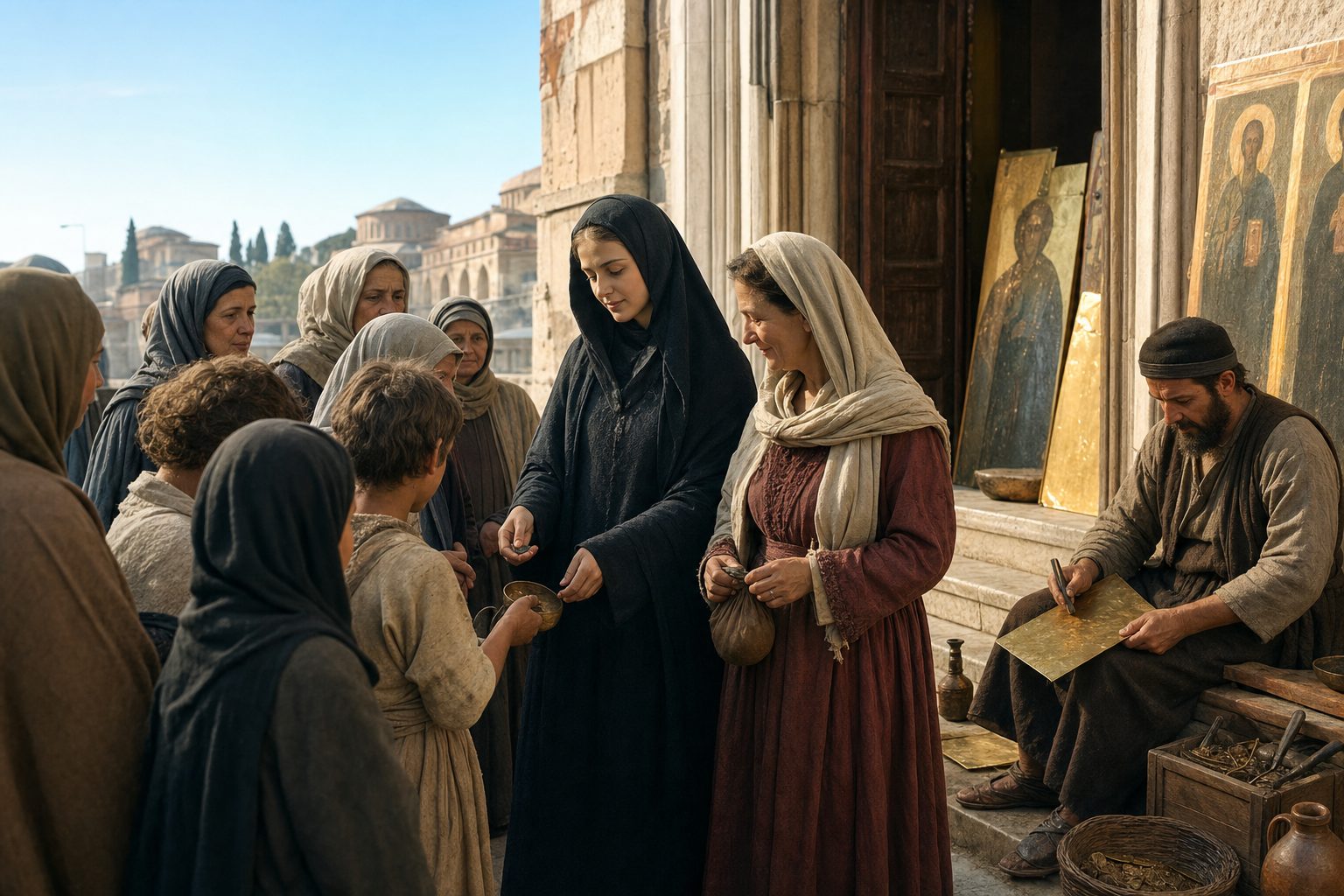
And when they had been barren for many years, and were sorrowful because of it, and fasted and prayed, and gave alms day and night,
One day, when they were in the temple built in honor of the holy martyr Anastasia [here probably understood St. Martyr Anastasia, whose memory is celebrated on October 29.] at the all-night vigil, the mother of St. Theodosia prayed more fervently than before for the resolution of her infertility; when she dozed a little, St. Anastasia the martyr appeared to her and said: "Do not be sad, woman, for you will conceive and give birth.
And she arose, and told her husband the vision, and said, As the Lord liveth, if thou wilt save us from our barrenness, and if thou wilt give us a son or a daughter, we will do it unto the Lord our God.
Forty days after the birth, the mother took her daughter in her arms and carried her to the temple of St. Anastasia, with joyful tears, giving thanks to God and the holy martyr, promising to consecrate her daughter to the rank of a pagan, so that she would be counted among the virgins and brides of Christ (it should be noted that there was also a monastery for virgins who dedicated themselves to the service of God).
After receiving God's blessing, the mother returned to her home and began to raise the child with great care, teaching Feodosia to read divine books and fear God and kindling in her heart the fire of divine love.
Three years later, Theodosius' mother died, leaving her entire estate to her daughter Hinochina.
But Theodosia, having reached full age, being full of understanding and love for God, did not want to accept the estate left to her by her mother, but gave it to God, to whom she offered herself as a sacrifice: calling to her the gold works of the master, she gave him enough gold and silver to bind three icons: Christ the Savior, the Most Holy Mother of God and the holy martyr Anastasia.
These icons had a size of three cubits [Lokot was equal to 8-10 verses]. Blessed Theodosia placed them in the temple, yet the rest of her property she gave to the poor, the needy, the orphans and widows, while she herself in pagan poverty continued to serve the Lord day and night, enriching herself from God in spiritual wealth.
Armed with prayer armor on an invisible suppost, she killed the flesh that was fighting the spirit, defeated the enemy of the fleshless, pierced the head of the hell snake, and brought down the proud Beliar [Velia or, more correctly, Belial - translated from the Hebrew meaning: wicked, wicked, evil].
The apostle Paul uses this name to describe the devil, the source of all evil (2 Corinthians 6:15).] with humility, meekness, godly love, purity, godliness, obedience and other pagan virtues.
And if thou art a traitor to me, I am also a traitor to thee, and not to thee only, but to all the saints; for I have found this man, by whom I can raise a bar to the church, and turn many away from the image of Christ, and many shall follow me, and do my will.
"Cursed be thou, devil, enemy of the Christians! and perish all thy schemes by the power of Christ, my God!" and the devil departed. And the most holy Theodosia, clothed herself with the honest sign of the cross, began to sing the psalm of David: "Let God arise, and let his enemies be scattered, and let those who hate him flee from his face" (Psalm 67:2).
"My daughter", the bishop replied, "all who wish to live a godly life in Christ Jesus will be persecuted". (2 Timothy 3:12) The flock of Christ has always been deceived by deceitful men, deceitful teachers, deceitful men, and deceived ones themselves.
"Continue in the things that you learned and were persuaded to believe, knowing from what persons you learned them and that from infancy you have known the holy writings, which are able to make you wise for salvation through the faith in connection with Christ Jesus". - 2 Tim. 3:13-15.
After some time, a voivode of the Orthodox king Theodosius, who was nicknamed Adramytinus [Feodosius III Adramytinus reigned from 715 to 716], rebelled against him, named Leo, who was called Conon, a native of Isauria [Isauria - a province of Asia Minor, bordering on the east with Lycaonia, on the north with Phrygia, and on the west with Pisidia and on the south with Cilicia].
At the beginning of his reign he showed himself to be a pious man, but soon he turned to the new Belshazzar [Belshazzar - one of the descendants of Nebuchadnezzar, king of Babylon - is known as a wicked and depraved man (see Daniel 5:1-4, 22-23). He defiled the sacred vessels of the Jews that Nebuchadnezzar had taken from Jerusalem (Daniel 5:3).] who defiled the sanctuary of the church and who did not worship Christ the Most High and His honest icon.
And he breathed into the church the poison of the asps of the Manichaean heresy; and this beastlike man, roaring as with a lion's voice, uttered blasphemous heretical words against holy icons, calling them idols, and calling idolaters those that worshipped them.
At this time the throne of Constantinople was occupied by St. Herman [German (1st) patriarched from 715 to 730 A.D. He is listed by the Orthodox Church among the Saints.
After our Lord and Savior was incarnated from the pure blood of the Most Holy Mother of God and fulfilled all the divine predestinations for our salvation, all idolatrous worship was destroyed and all idolatrous images were burned.
In these seven hundred years there have been many righteous and holy fathers, and not one of them has blasphemed the holy icons, and not one of them has heard of the wicked wisdom which you bring into the Church by rejecting the veneration of the holy icons, which is due to the saints from ancient times.
For the holy Church has been in the habit of venerating holy icons from the earliest times, beginning with that unmade image which the Saviour Himself sent on a towel to the prince of Edessa, and then the woman who was healed by touching the edge of Christ's garment, after the Lord's ascension into heaven, made of the stone a likeness of Jesus Christ.
Then St. Luke the Evangelist wrote an icon of the Blessed Virgin Mary, and from that time began the pious custom of writing holy icons and decorating them with the temples of God and Christian houses, and the six previous ecumenical councils did not repudiate this custom, but, on the contrary, ordered to worship the images of the saints, not to reject them.
Let it be known, O king, that for the sake of holy icons I am ready not only to suffer any evil, but to die, for the icon of Christ bears the name of Christ himself, who was incarnated of the Virgin Mary and lived on earth with men.
When the king heard this, he was filled with rage and rage; roaring like a lion, he began to roar with great cruelty, persecuting believers and putting to death all who opposed him. First of all, he sent his soldiers with weapons and ordered them to expel St. Herman from the patriarchate with dishonor and beatings; instead of Herman, Leo appointed the false patriarch Anastasius, a heretic and his like-minded.
Then the lion ordered all the books of the gods and the writings of the wise teachers to be burned. It should be noted that at the church of St. Sophia there was a library with about three hundred thousand books; at this library there were twelve schools and as many wise teachers; the head of these teachers was the wise gymnasium, who accepted this honor from the king and the patriarch.
All these teachers resisted the godless order of the wicked emperor; so the lawless tormentor, with his soldiers, surrounded the library and all the schools with teachers and students, set it on fire from all sides and burned it, so that none of those who were there escaped the fire, not one book escaped the fire.
At this time the whole city of Constantinople was in great mourning and sorrow; all wept and sighed; some lamented the unjust expulsion of the most holy patriarch Herman, others the burning of so many books and the death of wise teachers, others the great disgrace inflicted on the icons, for the icons were everywhere broken, thrown into the swamp and burned on the hearth.
The newly appointed patriarch-heretic, Anastasius, who stood in the holy place as an abomination of desolation (Matthew 24:15), was very pleasing to the king, as he was in every way to expedite him in his iconoclastic heresy.
In Constantinople there was a gate called the "copper gate", built in the time of Constantine the Great and leading to the royal palaces, over which was a copper statue of the Saviour, which hung for four hundred years and even more.
When the commander of the soldiers, a soldier of the rank of Sappha, had set up a ladder to the gate, and was about to go up on it with an axe in his hand, some pious women who happened to be passing by saw him, and also the monks, among whom was St. Theodosius. They were burning with zeal for the icon of Christ, and were encouraged by the blessed Theodosius, who was more zealous than all of them for the common icons and for the honorable.
And they ran to the ladder, and threw it down, and also the soldier, who fell from a height, and was severely bruised.
They dragged him along the ground and beat him until he died; then they hurried to Patriarch Anastasius and began to denounce his wickedness; they rebuked him as a wolf, a predator, a heretic and an enemy of the Church of Christ; then they began to throw stones at him.
And the king's anger was kindled, and he sent his men with open swords, and commanded them to avenge the shame of the patriarch, and the death of the patriarch.
And these holy women were rebuked for their zeal in their piety; and the blessed maid Theodosia, being more noble in her race, and professing piety with great boldness, and being guilty of all that was done, the king commanded that she should be taken, and imprisoned, and that she should be beaten daily with a hundred stripes; and thus the torment was holy seven days.
On the eighth day, the torturer ordered the saint to be led around the city and beaten without mercy. When the saint was brought to a place called the "Bull market" (where animals were sold and slaughtered) [According to some explanations, this place was called "Bull market" because there was a furnace in the form of an ox in which criminals were burned] , it happened that one of the soldiers accompanying the saint accidentally stepped on a large goat horn and injured his leg.
Angered, he took that horn and began to beat the holy martyr mercilessly on the head, then struck the holy martyr with that horn in the throat and pierced it; and at once the holy martyred virgin Theodosia, the holy bride of Christ, gave her honest soul into the hands of her immortal Bridegroom and departed to His heavenly home, being crowned with the double crown of virginity and martyrdom.
Her body, which had suffered much, was taken by the Christians with reverence and buried in a special place. From the honourable relics of St. Theodosius, healings were given to the sick for the glory of Christ, our God, glorified with the Father and the Holy Spirit, now and forever.
A young man from Phrygia, who had lost the use of his legs, was completely healed after being brought to the tomb of the holy martyr; another young man, who had fallen from his horse and lost his mind, was instantly healed after being brought to the tomb of St. Theodosius and anointed here with oil from a lamp; Constantine the Logophet himself says to himself that he suffered greatly from a disease in his feet, which the best doctors could not cure; but, having resorted to the holy martyr,
He was completely cured.
Constantine the Logophete in his narrative notes that the miracles wrought by St. Theodosius are innumerable, and that the relics of the holy martyr were placed in the monastery of Diocrates or Dexiocrates (the name of the patrician who built the monastery church), near the Golden Horn in Constantinople.]
For thou art a goodly martyr, a holy fellowship of Christ, and a beloved house of the Holy Ghost; thou hast not ashamed thyself, but hast fought against the race of men, and hast suffered well, and hast cut through the sword of faith to Capernaum, and hast rejoiced unto heaven.
By labor and toil you have reached your goal, by the blood of your martyr, you have strangled the blood of your martyr, you filthy enemy of the church of Christ, you most blessed Theodosius, and with the high rejoicing armies, the veneration of your memory covers.