The memory of the holy father of our Mitrofan, Patriarch of Constantinople
The memory of 4 June Our Holy Father Mitrophan lived in the time of Constantine the Great - the first Christian emperor [Emperor Constantine the Great reigned from 306 to 337 A.D.] He was the son of the Roman Domitian, a royal descendant.
And when he had seen that the Gentiles were full of impiety, and that the Christians were persecuted in Rome, he departed from the city with his two sons, Provas and Mitrofanus, and came to Byzantium.
Then in Byzantium was bishop a godly and holy husband Titus (called otherwise Tratus or Torat) [St. Titus occupied the Byzantine episcopal throne from 242 to 272]; he and his sons began to live with him, being taught the faith of Christ and the law of the Lord and instructed in virtuous life.
When Domitius died, Domitius took the episcopal throne after him, and after the death of the blessed bishop Domitius the holy throne was taken by his son Probus.
After Provo's conversion, Domitius' son and Provo's brother, St. Mitrophan, was elevated to the Byzantine archiepiscopal chair.
At this time, Emperor Constantine the Great arrived in the Thracian region [Thrakia was at the eastern end of the Balkan Peninsula and adjacent to the Black and Marble Seas.
He took him with him to Rome, and soon afterwards, Emperor Constantine wanted to move his capital from Rome to Byzantium, a city he liked for its beauty and convenient location, in the southeastern corner of the Balkan Peninsula on the Bosphorus, a strait that connects the Black Sea with the Mediterranean and the Marmara seas.
The most beautiful roads from land and sea led to this city, and the whole surrounding area abounded with various earthly fruits. All this pleased Constantine so much that he decided to move the capital of the empire here. The new capital was decorated by the emperor with beautiful buildings and named it New Rome.
After moving the capital of the empire to Byzantium, Constantine transferred Saint Mitrofanus from the Old Rome to this city, called him his father, and consulted with him at the first ecumenical council of bishops in Nicaea [The council took place in 325 and was convened to denounce the heresy of Arius, who taught that the Son of God is not one, but only a created Being, subordinated to the Father, who stood, however, above other creatures.
This council was attended by 318 bishops from various countries within the Roman Empire.] title of patriarch.
Instead he sent his own chorebishop, the husband of Alexander, a respected, holy and elderly man, who had done much for the church in Thrace and Illyricum.
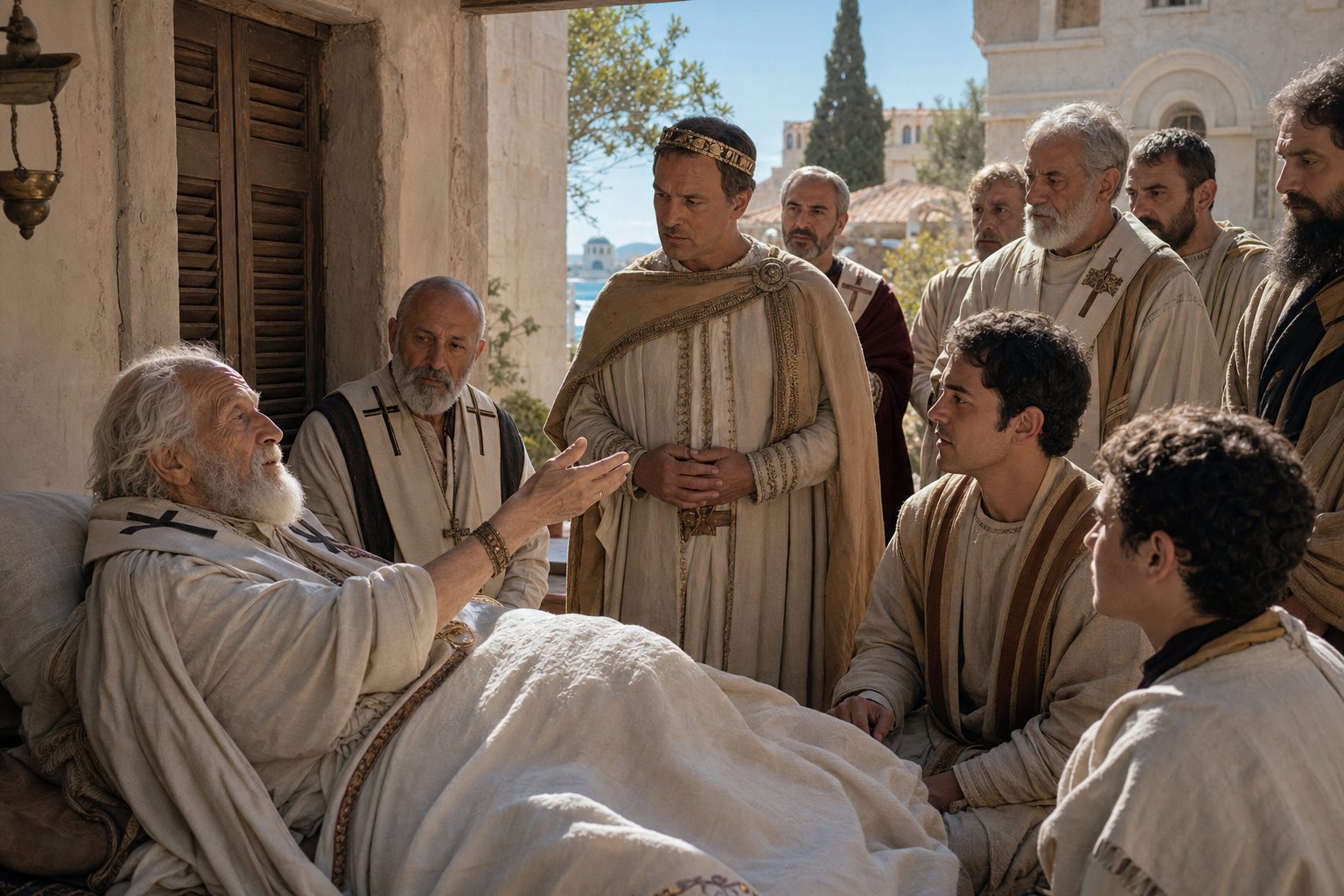
He took the place of his patriarch Mitrophan at the council and opposed Arius. After the end of this universal council, the pious emperor Constantine the Great asked all the saints who were at the council to go with him to Constantinople to visit the sick patriarch Mitrophan, who was lying on his deathbed.
"Dearest father, I see that you are weak from old age and infirmity, so I ask you to tell us who is worthy to be your successor. " At this St. Mithrophanes answered with joyful eyes to the emperor: "The Holy Spirit is speaking through your mouth now.
And when I am finished, let my fellow-servant Alexander, who is truly worthy of election and the gift of the Holy Spirit, come after me, and after him shall be Paul, who is now the reader.
Then, looking at the blessed Alexander, Patriarch of Alexandria, he said to him, "Brother, you will leave behind you a great heir". And taking his archdeacon Athanasius by the hand, he said, "Here is a valiant soldier of Christ; he will be your heir after you".
St. Athanasius, who was Patriarch of Alexandria from 326 to 373, suffered much persecution from Arians and other emperors. He escaped from the city several times, escaping to the West; sometimes he was expelled from Alexandria by Arians.
Paul, Patriarch of Constantinople.] , and not only will he stand firm, with my brother Alexander, against the Arian wickedness, but he will also succeed in great deeds, so that he, together with the courageous Paul, - await many sufferings.
The saint thus foretold the future, and ten days after the revelation of the Lord, he passed away peacefully on the fourth day of the month of June, having lived from the day of his birth only one hundred and seventeen years.
The faith of Christ, which thou hast clearly declared, and which thou hast observed in the multitude of truths, hath increased thy faithful flock: even with the angel Mithrophanes, praying continually for us all.