The life of the reverend father of our Zosima, bishop of Babylon
Monk Zosimus, nicknamed Cilicus (because he was a native of Cilicia [Cilicia - a region of Asia Minor, located in the southeastern part of it, on the borders with Syria and on the southern shore of the Mediterranean Sea.]) in his youth loved God.
It lies almost in the middle of the famous arms of the Red Sea, forming the Sinai Peninsula. It consists of three mountain ranges. The south-eastern peak of the middle ridge and was the place of the famous Sinai legislation.
In search of peace and quiet, Zosima retired from Mount Sinai in his youth to the desert of Libya.
And when he came to a place called Ammonihah, he saw there an old man in the wilderness, clothed in a robe of thorns, and he came to him, and bowed himself before him, and asked his blessing.
And the old man warned him, and said, Why art thou come, Zosima? go hence, for thou shouldest not be here. And Zosima thought that he knew him long ago, and bowed himself to him, and blessed him, and said, I pray thee, father, show me kindness, and tell me how thou knowest me. And the old man said,
"Two days ago a man with a vision appeared to me and said to me, 'Look, there comes to you a goddess from Mount Sinai named Zosima. Don't let her stay in the desert. I'm going to put her in charge of the church of Babylon, which is in Egypt.'
And when he had said this, he departed from her a stone's throw away, and lifted up his hands to God, and prayed for about two hours; and when he had prayed, the old man came again to Zosima, and embraced him pathetically, and smote his face, and said, My dear son, it is good that thou art come; for God hath brought thee to me, that thou mightest lay my body to the ground, for I go to the Lord.
And he said, How many years hast thou lived, my father? And he said, These forty-five years have I been in thy land. And when the man spoke, his face was as the fire of a flame. And he turned again to Zosimus, and said, Peace be unto thee, my son; pray for me. And he lay down on the ground, and departed quietly to the Lord God.
Blessed Zosima, after digging a grave, buried the decent body of the great hermit and, after staying there for two days, returned to Mount Sinai, praising God.
And the first monk, who had been put to the test by an experienced elder, said to him, 'Abba,' and he said, 'Let me be like a monk's haircut, that I may mourn in silence for my sins, for I have murdered many, and now I repent of my life of crime and sin, and I will spend the rest of my days in weeping and heartbreak for my many iniquities.'
The Reverend Zosima, having instructed the man, clothed him in the monastic habit; but after some time, calling the repentant robber to himself, he said to him:
"Chado, believe me, it is impossible for you to stay here. If any of the dignitaries find out that you are escaping from us, they will arrest you. Besides, some of those who are offended by you may recognize you and report you. So listen to me, and I will take you to a more distant monastery.
Before retreating to the desert for his monastic exploits, he spent much of his youth studying the sciences, and after becoming a monk, he devoted himself with the same love and relentlessness to the practice of virtue.
This monastery was a kind of dormitory monastery, in which the brothers not only received a table, but also clothes and so on from the monastery, according to the order of the abbot, and from their side all their labor and its fruits were necessarily presented to the general demand of the monastery.
[The city of Gaza is located on the eastern shore of the Mediterranean Sea, at the southernmost tip of Palestine, not far from Egypt; it was once the southern limit of the Canaanites.
But in the course of time this flourishing city lost all its significance, and now only the sandy hills and pitiful ruins serve as evidence that a great city existed here.] . Having placed it in this monastery, Zosima returned to Mount Sinai.
And the priest said unto him, I have been nine years in the wilderness, fasting, and abstaining from all things, working with meekness, silence, and the fear of God, and obeying all, hoping in the infinite mercy of God, and in the forgiveness of my many sins.
And yet, in spite of my constant exploits and labors, I always see before me a child who says to me, "Why did you kill me?" This vision I see not only in my dreams, but also in my life, when I stand in church, and when I begin the Divine Mysteries, and when I eat something with my brothers at the table.
I do not know rest for an hour: even when I walk, and then I see a child before me, always saying the same thing to me: "Why did you kill me?" So I decided, father, to go to the place where I committed my robberies, to be caught and brought to justice. I must die for the reckless killing of that child.
And when he came to the city of Diospol, he was taken, and the next day he was put to death by the sword; and he departed to the Lord God, washing his sins in his blood.
Shortly after this event, St. Zosimus, weary of his desire to live in the silence of the desert, again thought of leaving Mount Sinai, and taking with him his disciple John, he went with him into the desert called Porphyry.
As they traveled through the wilderness, they met two hermits, one of whom was a native of Galatia [a small mountainous but fertile province of Asia Minor that lay between Bithynia, Pontus, and Cappadocia].
The name was derived from the Galatians - warrior tribes of Gallic or Celtic origin.] and bore the name of Paul, and the other was from the Meletina region [0 Meletina - region in the northern part of Little Armenia, near the Euphrates river.
During the reign of Emperor Trajan (98-117), the village of the same name grew to the size of a large city, and was called Feodor, while the monk's hair was cut in the monastery of the abbot Euphemia the Great.
He gathered around him many famous hermits, some of whom laid the foundation for many monasteries. He died at the age of 97 years, in 473. His memory is on 20 January.] .
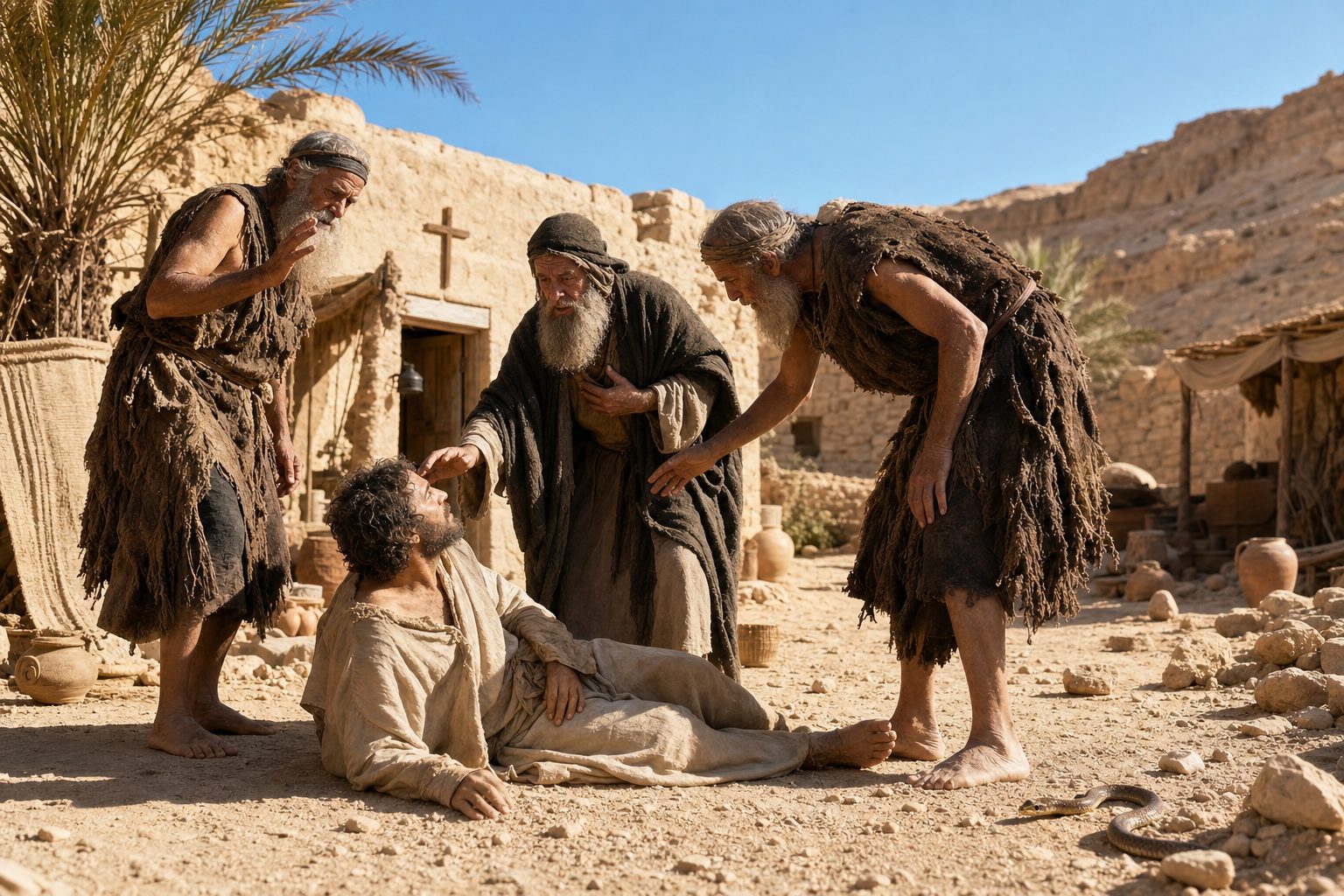
Two fields, therefore, make 1,380 sagensa or 2 versts.] , and lived there two years, but then a disciple of St. Zosima, John, was bitten by a snake: his whole body was imbued with snake venom, blood flowed from his eyes, nostrils, ears and from all the skin holes and pores, and John died.
Blessed Zosima was greatly saddened and went to the two desert men mentioned above. They saw him in great sorrow, and before Zosima could say anything to them, warning him, they said, "What, Abba Zosima, has your brother died?" Zosima, amazed at their foresight, told them about the circumstances of his disciple's death, which the elders already knew.
And the two disciples arose, and went with Zosimus to John his brother. And when they saw him lying dead on the ground, they said, Sorrow not, Zosimus, for God is with thee. And when they had said these things, they cried with a loud voice to the dead, saying, Brother John, arise, for thy father calleth thee. And the dead man rose up at once, and stood up from the ground.
"Abba, we do not tell you the will of God: go to Mount Sinai, for God wants to appoint you bishop in the church of Babylon, which is in Egypt". When he heard this, St. Zosima received the blessing of the holy deserts and, taking with him his disciple John, returned to Sinai again.
After some time, the abbot of Mount Sinai [The monasteries of Mount Sinai were under one general chief - the abbot of Mount Sinai.] sent blessed Zosimus, along with two other monks, to Alexandria for the needs of the Sinai monasteries [Alexandria was the main city of Egypt and the northern African provinces.
After Rome, Alexandria was considered the first city in the world and served as the center of trade, industry and especially pagan education, and in the first centuries of Christianity as the cradle of Christian education. From the V century, the bishop of Alexandria used the title of patriarch and all the churches of Egypt, Libya and North Africa were subordinate to him.
Currently, Alexandria (Turkish and Arabic Iskander) is one of the most important trading centers on the Mediterranean Sea, with a population of up to 230,000.]
The patriarch of Alexandria loved the blessed elders and, having kept them in the city, ordained them as bishops, one in Iliopolis [Iliyopol - a city in Africa; located on the right bank of the Nile, on one of its eastern arms, - in the south of Lower Egypt], the other in Leentopolis [6 Leontopolis - a city in the middle of Egypt] , and Zosimus in Babylon Egyptian.
For there were two Babylons in ancient times: the first, the most famous and ancient, was in the land of the Chaldeans [Chaldea was in Mesopotamia, on the Tigris and Euphrates rivers], and Nebuchadnezzar and all the Chaldean kings reigned in it, and the other, the lesser known and less populous, was in Egypt.
This city was founded on the banks of the Nile by settlers from ancient Babylon, who named their new settlement after their abandoned homeland. In this Babylon of Egypt, St. Zosima, by the will of God and according to the prophecy of the deserters, took the archiepiscopal throne and began to shepherd the flock of Christ.
When the saint reached old age and saw that his body was failing and that his death was near, he left the episcopal throne and returned to Mount Sinai, his former home.
Here, having lived a short time, the saint died in the Lord [Died at the end of the VI century.] and in the face of the holy hierarchs now stands before our Lord, the Lord Jesus Christ; to Him be the glory forever. Amen.
I 'm going to have to get back to you .