The memory of the holy martyr Markelin
Pope Marcellinus ascended the throne during the reigns of Diocletian and Maximian after the death of the most holy pope, Caius.
He was captured and brought to Diocletian and Pope Marcellinus for questioning.
But fearing cruel torment, he burned incense on an idol altar and offered sacrifices to Vesta and Isis [Vesta or Hestia, the goddess of the family hearth and the sacrificial fire in ancient Rome and Greece].
She was the goddess to whom sacrifices were usually offered at the beginning of every important work, which is why the pagan proverb is: "to begin with Vesta".
In this temple, an altar was placed on which a constantly burning fire was maintained by the priestesses of the goddess - the Vestal Virgins.
The emperor's desire to reward him was to clothe him in a precious robe and call him his friend. After this, returning home, Markelin wept bitterly and wept like the Apostle Peter, who once denied Christ (Matthew 26:75).
Markelin began to reproach himself, for though he had strengthened many others in the faith and encouraged them to martyrdom, he himself had fallen from the faith in the most shameful way.
At that time in the city of Sinuessa in Campania [Campania is a region in ancient Italy bounded on the west by Lazio, on the north by Samnium, on the east by Lucania, on the south by the Tyrrhenian Sea.
In this Italian region, the first bells were cast (from the 8th century), and a local church council was held [about 300], which was attended by many bishops and presbyters, a total of one hundred and eighty.
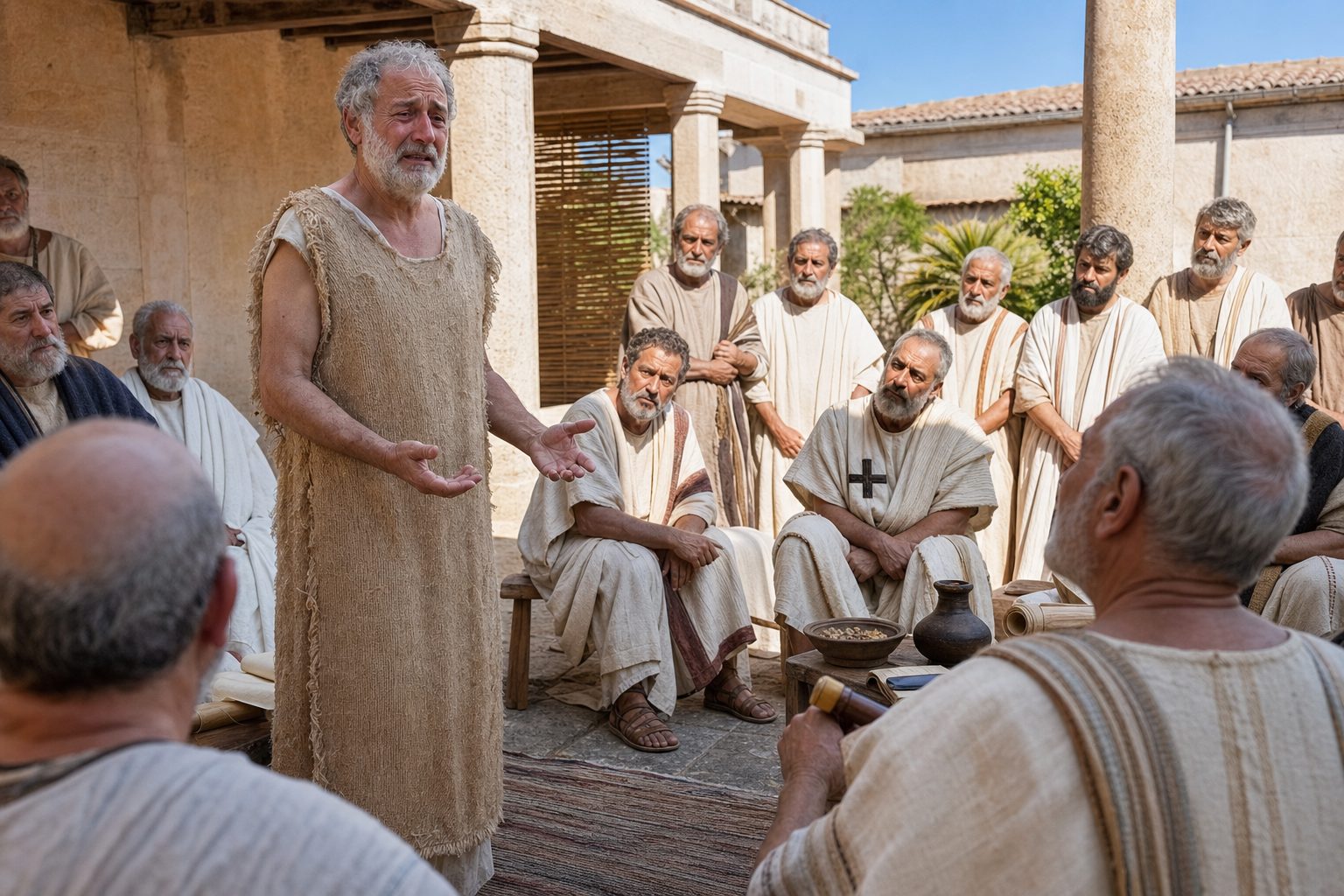
And Markellin came to the council, and clothed himself in a hair-gray robe, and poured ashes upon his head, and went in to his fathers, and stood before them as an accused, and openly confessed his sin, and with bitter tears he asked the honest fathers to judge him.
Let thy mouth condemn thyself, and let thine own mouth condemn thee. We know that St. Peter, in fear, denied Christ, but after he repented bitterly of his sin, he again found favor with his Lord.
Then Markelin pronounced the following sentence upon himself: "I declare myself deprived of the sacred rank which I am unworthy of. Therefore let my body after my death not be given a common burial, but let it be thrown to the dogs for food; cursed be he who dares to bury it.
Returning to Rome at the end of the council, Marcellinus took the precious garment he had received from Diocletian and went to the latter, throwing his clothes in front of him, denouncing him, his false gods, and calling himself a grave sinner, and bitterly weeping.
When the emperor was enraged, he sentenced him to death, and the three Christians, Claudius, Quirinus, and Antoninus, were led out of the city to be beheaded, followed by the presbyter Marcellus, who succeeded him as pope.
When he was summoned, the martyr Marcellinus urged him to remain steadfast in the faith, and concerning his body, he said that no one should dare bury him in the ground, but that it should be thrown to the dogs:
"I am not worthy to be buried", he said, "nor am I worthy to be taken up by the earth, for I have forsaken my Lord, the Maker of heaven and earth".
When they arrived at the place of execution, the holy martyr Marcellinus prayed fervently to the Lord Christ, who accepted repentant sinners, and willingly offered his wound to be cut and died for Christ, whom he had at first rejected out of fear of torture.
Along with him were beheaded three men named Claudius, Quirinius, and Antoninus, and their bodies were left unburied by the road.
But after a few days, the faithful took the bodies of Claudius, Cyrene, and Antoninus by night, and buried them; but the body of Marcellinus no one dared take and bury, because he had taken an oath not to give up his body for burial.
Thirty-six days.
After this time, the holy Apostle Peter appeared to the newly appointed Pope Marcellus and said, "Why have you not yet given the body of Marcellus to be buried?" "I am afraid of his oath", Marcellus replied, "for he has taken an oath not to bury his body".
"Do you not remember", said the Apostle, "that it is written, 'He who humbles himself will be exalted'?" (Luke 18:14) So go and bury him with honor.
Thus the holy martyr Pope Marcellinus passed away, leaving an example of repentance for many who had fallen into similar sin at that time (for then many had rejected Christ out of fear of torment).
On the same day, the memory of the holy martyr Feodotus of Ankiry, who was beheaded in 303 (see his life on May 18).