The sufferings of St. Markell, Pope of Rome, and others with him.
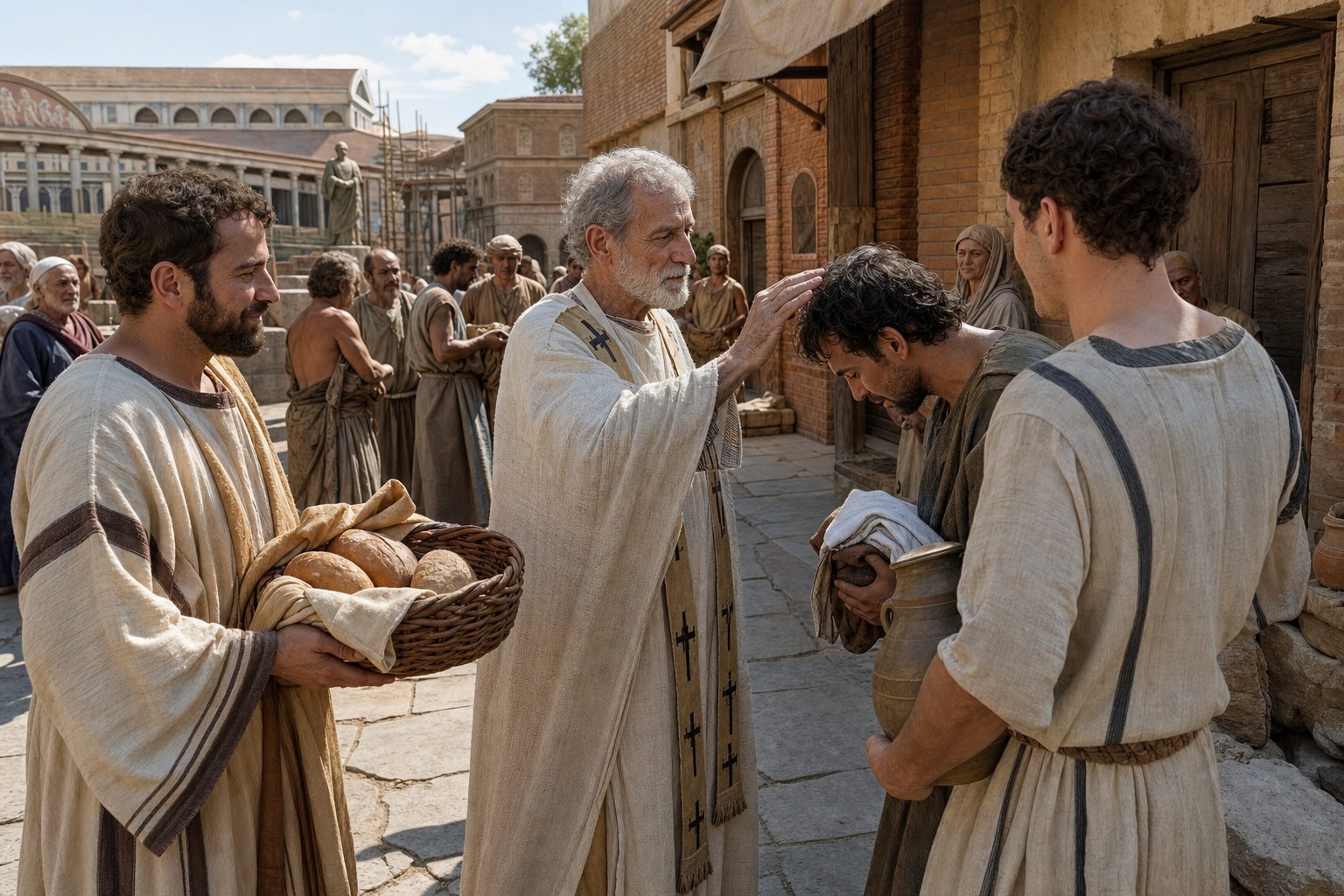
Saint Marcellus was a Roman by birth; his father was called Venedict, and he took the throne of the Roman Church after the holy martyr Marcellinus and sat on it during the reign of the wicked Roman emperors Diocletian [Emperor Diocletian ruled the eastern half of the Roman Empire from 284 to 285].
305 AD), Maximian Hercules [Maximian Hercules ruled the western half of the Roman Empire from 284 to 305 AD], another Maximian, named Galerius [Maximian Galerius ruled the East from 305 to 311 AD], and Maxentius [Maxentius ruled the West from 305 AD].
In those days, the following events took place in Rome: Emperor Maximian, surname Hercules, was appointed by Diocletian as co-ruler himself.
Maximian returned to Rome from the African provinces [Africa, Spain, and Italy were under Maximian's control] and, desiring to please Emperor Diocletian, who was slow in the east, Maximian began to build in his honor in Rome stone baths, or baths, that brought the heathen a disgusting coolness [Note that
The ancient Roman bathhouses of the pagans were not only baths, but also prostitution.]
Maximian, after finding among the Roman legions many soldiers who believed in Christ, stripped them of their military rank and appointed them to the same work that Pharaoh once gave to the Israelites in Egypt.
In a relatively short time (from Joseph's death until the Exodus from Egypt) the Israelites built three cities for the Epitim - Piphom, Raamses and Iliopolis (Ex.1:1-14).] , namely: he forced some to make bricks, others chalk, others to dig the ground and carry stones for the installation of the mentioned therms.
He feared the people, because he knew that many prominent men there were professing to be Christians.
Noticing that the Christians were weary from hard work and starvation, Frason secretly wanted to help them with his funds; he chose four God-fearing men to provide food, clothing, and other necessities through them.
These men were named Sisinius, Kyriak, Smaragd, and Largy.
When the blessed Pope Marcell heard of this, he rejoiced greatly at the charity being delivered to the Christians; having called the four men mentioned and learned from them all about Frazon's generosity, Marcell thanked the latter warmly, and appointed Cicinio and Ciriaco deacons.
The Roman Church.
One night, while the two deacons were carrying on their shoulders the food that Frason sent for the holy martyrs, they were seized by wicked pagans and brought before the Exupery tribune.
When they had been brought, the tribune ordered them to be confined in the common prison, and on the third day he reported them to Emperor Maximian.
The emperor ordered that they be assigned to the same work as other Christians and thus joined those who carried the sand for the building of the stone building.
Among those Christians was a man named Saturninus, who was too old to carry a heavy load.
Then the blessed deacons, Cisenus and Cyriacus, began to assist this elder, and not only did they their work, but also the work of others, while with their mouths they continually praised and praised God.
Then the emperor commanded to bring Cissinius to him, and when the latter came to him, he asked him, "What is your name?" "I am a sinner", answered the saint, "my name is Cissinius, a slave of the slaves of our Lord Jesus Christ". "What are these hymns that you sing?" asked Maximian.
"If you knew the meaning of the songs we sing", replied the saint, "you would know your Creator". To this the emperor said: "Who is our Creator but Hercules?
According to Greek mythology, Hercules was the son of Zeus and Alcmenes, the wife of the Tyrian king Amphitryon. Hercules had great physical strength, which is why he was considered the patron god of gymnasts and gladiators.]
"It is an abomination to us not only to mention him, but to hear of him". "Choose for yourself one of the two", continued the emperor: "offer a sacrifice to the god Hercules; otherwise I will burn your flesh in the fire".
And he said, I have longed to suffer for the Christ of my God, that I might receive the crown of martyrdom. Then the emperor was wroth, and delivered him to the governor of Laodicea to be punished.
The latter imprisoned the saint in the Mamertine Prison [The Mamertine prison was located in the northern part of the city of Rome and was intended mainly for state criminals, including Christians.
In this dungeon were imprisoned, according to tradition, the holy Apostles Peter and Paul (their memory on June 29).
This dungeon has been restored to the present day, and the part of the dungeon where the Apostles Peter and Paul were imprisoned, as a sacred place, is guarded by Catholics with special attention.
When the time had expired, the governor ordered that the deacon Sisinius be brought before him for questioning.
And the prisoner was first brought out of the dungeon unto Apollonius the keeper of the dungeon; and Apollonius looked upon him, and beheld that his face shone with a strange heavenly light, and heard a voice saying,
(Matthew 25:34) Then Apollonius fell at the feet of St. Cisenus in fear and trembling and said: "I command you by the Christ whom you confess, to baptize me immediately and make me a partaker of your crown.
At once water was brought here, and then the holy deacon Sisinius, having proclaimed the truths of the Orthodox faith, taught in the ancient Church to all who wished to undertake the sacrament of baptism.
Having the right to enter the temple to listen to the Holy Scriptures and teachings and even to attend the first and second parts of the liturgy (prosomidia and "liturgy of the lectured"), the lectured before the onset of the third, most important part of the liturgy ("liturgy of the faithful") had to immediately leave the temple, which and
It was announced by the deacon with a proclamation, and has been preserved in the Orthodox Church during the liturgy.
The duration of the announcement was not the same; many remained announcers for the rest of their lives, and if necessary the announcement was shortened to a few days or even hours (as in this case).
- The church rite of the proclamation is still performed in the Orthodox Church; it consists in the reading of prayers over the baptismal candidate and the uttering of a spell on the devil; at the same time, the baptismal candidate renounces Satan, combines with Christ and confesses his faith by reading the Symbol of Faith (this is done
And he blessed the water, and caused Apollonius to enter naked into a vessel full of water, and said unto him,
"Do you believe in God the Father and in the only Son, our Lord Jesus Christ, and in the Holy Spirit? "" Yes, " he said.
After this, Sisinius brought the newly baptized Appronius to St. Marcellus, who anointed him with holy oil and, after performing the sacred liturgy, taught them both - both Sisinius and Appronius - as well as all the Christians there, the pure Body and Blood of our Lord Jesus Christ.
At noon the governor of the province of Laodicea sent for Dionysius, a deacon, and Apollonius, a blessed man who had recently come to faith in Christ.
"Why has Satan so filled your hearts that you should persecute the saints? " The governor said to Paul", It is hard for you to persuade me that you are a Christian.
And he said, Woe unto me, blessed man! for I have wasted my days in wickedness, and have not known the true God. And the governor of the provinces cried, Thou shalt destroy thy days this day. And he cut off his head, saying, If this man perish not, many more shall perish.
After this, the soldiers led St. Apronian out of the city, and after they had gone away from the city two thousand miles, a stone pillar stood at the end of each mile.
Milliarium was equal to 8 stadia (stadia = 88 seedlings), which would be about 1.5 modern versts. Milestones were scattered throughout Italy; they were usually inscribed with the name of the builder or emperor under whom they were built.
The first milestone, which all the other stones had their beginning at and which connected all the roads, was at the temple of Saturn.
During excavations in Rome, the remains of this stone were found.] , the warriors cut off the head of St. Apollonius on the Salarian road [Salaria - one of the largest roads of ancient Rome.
The name of this road is due to the fact that the Sobenians carried salt (wai) from the shores of the sea to their country.]; thus the newly enlightened Apronian received the crown of martyrdom.
If you do not sacrifice to the gods, I will destroy you with many torments. During the time these saints were in prison, many Gentiles came and were baptized by them.
After forty days, the governor of Laodicea learned of this; having ordered to prepare a courtroom for himself in the temple of the goddess Tellura [Tellura or Gaia - the Greco-Roman goddess of earth and fertility] and having sat on it, Laodicea ordered the elder Saturnus and the deacon Sisinius to be brought before him.
When the prisoners were being led away with fetters, the governor asked them, "Do you want to leave the empty worship of Christ and serve the gods that our kings worship?
"We call on the name of our Lord Jesus Christ, and we never bow our heads to Satan and to the stone that has no life. " Then Laodiceans said, "Let there be three copper vessels with incense on them.
And the tormentors brought the coals of brass, and the tormentor began to make the saints burn incense to the idols. And the holy elder Saturninus said to the tormentor, Let the Lord make the idols of the heathen ashes. And immediately the coals of brass melted, and became as water.
When two of the soldiers, Pappius and Maurus, saw this, they shouted, "Truly the Lord Jesus Christ, who is worshipped by Cisenus and Saturnus, is the true God".
The governor of the province of Laodicea was furious and ordered that the two holy martyrs, Saturnus and Cycinius, be hanged on an obscene stake and brutally beaten with ropes and clubs.
We thank thee, Lord Jesus Christ, that thou hast made us partakers with thy servants in the sufferings of thy name. Then the soldiers of Paphia and Maurus, seeing the sufferings of the saints, cried out a second time, saying unto the governor,
"Why has Satan stirred you up against God's servants, teaching you to persecute the innocent without mercy?" Laodicea, enraged at the soldiers, ordered them to be stoned to death.
At the same time, he ordered his servants to light lamps on the sides of the martyrs who had been impaled on the shameful stake, while they joyfully praised God in the face of such suffering.
The same day the tormentor pronounced the death sentence against the saints, so they were taken down from the shameful stake, led out of the city along the road to Numantium [the road that went from Rome to the city of Numantium] and cut off with the sword.
The above-mentioned pious husband, Frason, took the bodies of the holy martyrs with the presbyter John and buried them on his land by the Salarian road.
And the prisoners, Pappius and Maurus, were desirous to receive the holy baptism, and praying to the Lord, they went out of the prison through the open doors, and no one noticed them.
When Paul and Silas had been baptized, they went to the governor and were interrogated. The governor said to them, "Now I know that you are Christians".
And the governor of Laodicea said unto them, Forget the vain Christian falsehood, and worship the gods, which our king worships.
"If you do not now offer sacrifices to our immortal gods, you will lose your souls. Listen to me and do what I say if you wish to live". "Sacrifice them", said the holy Pope, "if you wish to suffer eternally".
The governor ordered that all the saints be hanged, beaten and beaten. Then they turned back, crying out, "Lord Jesus, help your servants!"
And Laodicea commanded that the saints should be beaten with rods of lead; and after they had been beaten with rods of lead for a long time, they delivered their souls into the hands of God.
Presbyter John, having taken the bodies of the saints at night, buried them with honor at the tomb of the previously martyred saints Sisinius and Saturninus (he did this on the order of the holy pope Marcellus).
When Diocletian, the governor of Laodicea, had returned to Rome, he told Diocletian and Maximian all that had happened to the holy martyrs, and how he had cruelly tortured and put them to death.
Meanwhile, the above-mentioned Saint Kyriacus, appointed deacon by the most holy Pope Marcellus, was at that time with Saint Sisinus in the dungeon; here were imprisoned Smaragd and Largius, as well as other prisoners of Christ.
They were taken out to work during the day and locked up again at night.
God gave blessed Kyriakos the grace to heal diseases; many people came to him and brought their sick, whom Saint Kyriakos healed, after praying to God; so here the blind received sight, the lepers were made healthy, demons were driven out of people and by the prayers of the saint they were healed.
And those who are afflicted with various afflictions.
The Emperor Diocletian had a daughter named Artemis, who was possessed by an evil spirit. When Diocletian heard about it, he was very sad and did not eat for a day.
While she was in the room, the demon cried out at the girl's mouth: "I am not going to leave this place, and no one can expel me except the deacon Quiricus".
So Diocletian ordered that the deacon Kyriakos be sought out, and when he was found in the dungeon and brought before the emperor with two of his friends, Emerald and Largius, the emperor begged him to go into his daughter's room and heal her.
Then Cyril came and said to the evil spirit, "In the name of the Lord Jesus Christ I command you to come out of her!"
"If you wish me to come out of it, show me another dwelling where I may enter". "Here is my body for you", said St. Kyriacus, "if you can, enter into it". "I cannot enter into your body", continued the demon, "for it is closed and sealed from all sides".
"In the name of our Lord Jesus Christ, who was crucified, come out of this girl. Become a clean vessel for the Holy Spirit".
If you send me away, I will send you to Persia.
The demon came out of the girl, and she said to the priest, "I charge you by the God you worship, that you baptize me. I have seen the Lord from afar, the one you preach about".
The Empress Artemis was there, and the mother of the Empress, Cyrene, was there. She rejoiced greatly, both because her daughter was healed and because Christ's power was manifested in her.
The next day, the virgin Artemis was baptized in the name of the Father, and of the Son, and of the Holy Ghost, secretly from Diocletian.
From that time on, St. Kyriakos gained the favor of Emperor Diocletian, who granted him and his friends, Smaragd and Lagria, freedom and gave him a home near his baths in Rome, promising him a quiet life.
Meanwhile, Empress Cyrene taught her daughter to love Christ with all her heart and to obey his law constantly.
After a while a letter came to Diocletian from the king of Persia, asking him to send the deacon Kyriakos to see him, for his daughter was possessed, and the demon shouted through her mouth, saying, "No one can cast me out except the Roman deacon Kyriakos".
And the emperor said to his wife Cyrene, that she should call Cyril to her, and that she should send him to the mad queen of Persia.
"In the name of my Lord Jesus Christ, I go forth without hesitation. "Cyriacus, having supplied the Empress with everything she needs, went to Persia with his friends, Emerald and Largius.
- What, Kiriak, didn't I make you go to all the trouble to come here like I told you before?
"I command you, you evil spirit, in the name of the Lord Jesus Christ, come out of her and never enter her again".
"But you are tired, Kiryakh, and you must first rest from your journey", said the demon. "I am not tired, with the help of the all-powerful God", answered Kiryakh. "But here I am", continued the demon, "I have done what I wanted: I promised to make you come to Persia, and you have come.
"You cannot do what you want, you weak and weak one, you can only do what our Creator allows you". Then the demon tormented the maiden, and Saint Kyriakus, falling to the ground, began to pray to God with tears.
"If you cast me out, show me a resting-place. " But he said", You fool! You have no resting-place in all creation, for the glory and power of our Lord Jesus Christ will follow you.
And the devil went out of him, and shouted and said, What shall I do? And from that hour the child was baptized, and was healed.
Many of the royal family, about four hundred in all, believed and were baptized.
And when he was in Persia forty days, he departed thence, and returned from the king of Persia to the emperor of Rome with a letter of thanksgiving, which Diocletian received with honour.
A little later, Diocletian left Rome for the East, and Maximian Hercules went to Mediolanum, the most important city in northern Italy, in the Lombardy region; founded in ancient times, several centuries before the Common Era.
In the history of the Christian Church, Meдиолан is known as the place of the archpastoral activity of Archbishop Amвросий (from 374 to 397), who showed great diligence in the fight against the heresy of the Arians (his feast day is celebrated by the Church on December 7), where he and the other left their imperial dignity.
Then (another Maximian), named Galerius, whom Diocletian adopted and later married off to his daughter, Artemias' older sister Valeria, came to Rome and began persecuting and killing Christians.
And when he had taken Cyriacus the deacon, and the rest of the saints, because he was wroth with him for Artemis, whom Cyriacus had converted to the Christian faith, he cast him, and his friends Emerald and Largius, into prison; and the tormentor commanded that Cyriacus should be brought naked, and bound with iron fetters,
Everywhere he went.
One day, when the torturer was going to a town, he was met by St. Markell, who said to him, "Why do you kill the servants of God who pray for your kingdom?
Then the torturer, enraged, ordered the saint to be beaten with sticks without mercy and appointed him to the position of overseer of the animals.
But the emperor sent Saint Cyril and his friends to his governor Carpasus, saying, "Convince these sorcerers, who have turned the people to Christianity, to offer sacrifices; make them do it, at least by torture.
Carpassius, having taken the saint and the Christians with him, put them in prison, and then, sitting in his judgment seat in the temple of Tellura, summoned to interrogation the holy martyrs, - the deacon Kyriakos, his friends, Smaragd and Largius, and with them a fourth prisoner named Chrysentius, also imprisoned in
imprisoned for confessing the name of Christ.
"Why do you refuse to obey Caesar's decree and offer sacrifices to our immortal gods? " Cyril and his companions replied:" We offer ourselves as sacrifices to the living God and to our Lord Jesus Christ.
And he said unto Kirjath-jearim, Thy old age hath made thee gray; but behold, I will now make thy old age to thy youth. And he said, Let the tar be melted, and pour it upon the head of the holy one. And the holy one cried, saying,
"Praise be to you, Lord, who have granted us, your servants, to enter the gates of your heavenly kingdom.
And he hanged him naked on a shameful cross, and beat him with ropes and sticks, and put iron nails in his nails, and burned him with fire.
Then the martyr ordered his body to be taken and thrown to the dogs without a burial, and the other holy martyrs he put back in prison.
And it came to pass at the end of four days, that the tormentor called a man of Kirjath-jearim, and said unto him, Why wilt thou cast down the days of thy old age in the fierce torments of hell? sacrifice unto the gods, and live.
"I", replied the saint, "am very willing to be tortured for the sake of my God's Christ, but let those who have not known the true God, their Creator, sacrifice to your gods.
And Carpassian, in his anger, ordered that the saint should be hanged naked on the shameful stake, and that he should be tormented in the same manner as Saint Crisentius, beaten with ropes and sticks, and with stiff nails, and scorched with fire.
"Have mercy on me, a sinner, my Lord Jesus Christ.
And when Carpassius saw that he would not force them to sacrifice, he ordered that they should be put to death; and when he had told the emperor all that had happened to them, he commanded that they should be put to death, and all that were with him in prison.
In the same prison where Saint Cyril and his companions were held, there were twenty-one Christians of both sexes, all of whom were led out of the city and beheaded by pagans, along with Saint Cyril, Saint Emerald and Saint Largius.
At night the presbyter John came to this place with some Christians; he took the bodies of the holy martyrs and buried them in the same place where the bodies of other martyrs were buried.
At the same time, Diocletian's daughter, the blessed queen Artemis, who was in Rome at the time, was martyred and executed for the name of Christ by order of the same wicked torturer, Maximian.
Ocainianus did not spare even his own blood, for Artemia was the half-sister of his wife Valeria, and he himself, as Diocletian's adopted son, had her as his sister.
After the murder of Saint Kyriacus and the other Christians who were in prison with him, Karpas asked the emperor for the house of the Kyriacs, which was near the Diocletian baths.
Upon entering the house, Carpassius saw a beautiful fountain, built by St. Kyriakos and consecrated by Pope Marcellus, where many Gentiles who had converted to Christianity were baptized.
To insult and insult the Christians, Carpassius turned the house into a public bathhouse and a place of prostitution, where he often washed himself, or rather, defiled himself, for when he and his associates feasted there, they defiled themselves with the detestable sins of the flesh.
And he made himself a feast there, and there came to him nineteen of his companions to eat and drink and to bathe and to commit fornication, and behold, while they were in their abominations, they fell down dead in the sight of the Lord.
And all the inhabitants of the country were afraid, and they kicked the house, because no one dared to enter it. Meanwhile, the wicked emperor Maximian Galerius had departed from Rome to the East; and the imperial throne of Constantine was in Rome.
At the same time, the Roman clergy, having gathered at night, went to the courtyard where Saint Markell was kept feeding the cattle, and brought out his archpastor.
Having attained the predatory form of the Roman throne, Maxentius, like his predecessors, began to persecute Christians.
Priscilla and Lukienna, two distinguished senators, devoted themselves to the Lord and shared their wealth with the saints.
They had very fine tombs in their estates for the bodies of the holy martyrs, for countless Christians were then put to death for confessing the name of Christ.
Priscilla built a tomb three yards from the city on the Salarian road, and Lucina built a tomb seven yards from the road to Ostia, the harbor of Rome built at the mouth of the Tiber River.
The remains of this harbor are still visible; because of the sand of the coast it is removed from the shore at a distance of one hour's journey.] They secretly collected at night the bodies of the martyrs, who were thrown by the pagans to be eaten by dogs, beasts and birds, and buried them with honor in their tombs.
And it came to pass, when St. Markell had been brought forth with his clergy out of the court, where he fed the cattle, that he went with blessed Lucina to the place where the holy martyrs, Cyriac, and Emerald, and Largius, were cut down; and they dug up their holy relics out of the earth, and wrapped them with clean cloths of spices, and brought them to the sepulchre.
It belonged to Lucene, and they buried them with honor in stone tombs.
At this time, Blessed Lucina donated many of her properties to the church of Rome; she also donated her beautiful home in the center of Rome to the faithful so that they could convert it into a church.
The Pope consecrated the house according to the proper church order and performed the liturgy in it, offering bloodless sacrifices to God, praising God day and night, and thus Lucina's house became the house of God and the cathedral church in Rome.
The latter, angry at Lukina, sentenced her to be dishonorably expelled from the city as a great sinner, but ordered her property to be given for looting.
When he learned that St. Marcellus had been condemned to cattle work by his predecessor, Maximian, he made the same determination regarding the saint.
He wanted to disgrace not only the pope but also the church, so he turned the beautiful house of Lukinin, which had been consecrated for the church, into a cattle yard and ordered to keep a lot of cattle there.
So this most holy shepherd and guide of human souls did the work of caring for the cattle for nine months; the great servant of God, like a captive slave, was the object of abuse by wicked idolaters.
He was so busy with his work that he had absolutely no rest and rest and was very lacking in the essentials; he had neither enough food nor clothing, for the guard would not allow anyone to come to him and bring him anything.
His clothing consisted of a single hairpin on his body.
Because of such labors, sufferings, deprivation of the most necessary, as well as because of the stench of cattle, St. Marcellus was very weak in body, became ill and gave his suffering soul into the hands of God.
He ruled the Roman church for five years and six months (from 304 to 310). Other martyrs mentioned in the life of St. Pope Marcellus suffered a little earlier, in 305 and 306.
The same presbyter John, taking his body in the night, carried it to Priscilla's tomb and, having called the clergy, gave it here an honorable burial.
Thus ended the life of his most holy Roman Pontiff Marcellus, who, at first, by the martyrdom of his numerous children, presupposed to God, and then after them went himself with the holy hierarchs to appear before the throne of the great Archbishop, our Lord Jesus Christ, to whom be glory now and in the future.
It's going to last forever.
I'm sorry, but I have to go.