The memory of the reverend Dula Strastotolerc
The blessed servant of God Dula was a monk of one of the cinovies [Kinovia - (derives from the Greek κοίνος - common and βίος - life) the common name of all dormitory monasteries, i.e. - those where the brothers not only receive a table, but also all the necessary things for life in general from the monastery, by the order of the abbot, and on their part all their labor and payment for it are presented to the general monastery.] of Egypt.
He was always humble and gentle, but he was great and honorable in his mind. He was a man who pleased God, persecuted and reviled by all, always rejoicing and joyful in spirit. He considered those who humiliated him innocent, and prayed for them to God that the Lord would not put them in sin.
In such patience, the martyr of God endured for twenty years, unwavering in his meekness and humility.
And the devil, not knowing how to make the blessed man angry, spread such a deceitful lie against him; and in this case he attacked not only St. Dula, but also the whole brotherhood, grieving and confusing all the silent ones; and he taught a brother who had no fear of God to enter secretly into the church and steal all the church vessels.
When the time came for the morning service, the paraecclesiarch, entering the church to light the pannicilla, saw that all the church vessels had been stolen; he immediately went and told the abbot [Ava - the father, as the abbots of dormitory monasteries were called in the East].
Then, as was the custom, he struck the bellows [Bilo (from the word to beat) - a wooden or metal board struck or struck to summon the faithful to the temple for worship with sound or clapping.
And it came to pass at that time, that blessed Dula, because of sickness, came not to the morning rule; and some of the brethren said, No one could have stolen them, save the brother of Dula, who therefore must not have come to the church; for if he had not stolen, he would have come before midnight, as he was accustomed to do.
And they sent to him, and found him standing and praying. And they laid hands on him, and drew him into the church.
And he said unto them, O blasphemer, are not these years sufficient for thee to trouble us, that thou hast also taken away our souls? And he said unto them, Brothers, forgive me my trespass. And they brought him before the king and the elders.
I saw him eating vegetables, and I saw him stealing bread and distributing it outside the monastery, and I saw him secretly drinking wine.
When the abbot and the fathers who were with him heard all this, they believed the slanderers and asked the innocent Dulus whether all that was said about him was true, and especially about the theft, namely, where he had hidden the church vessels he had stolen.
And when they had stripped him of his monastic garments, he wept bitterly and looked up to heaven and said, "Lord Jesus Christ, Son of God, for your holy name's sake I have put on this garment, but now it is taken from me because of my sins".
And the steward stripped him naked, and smote him with oxen's horns, and asked him whether all that was said of him concerning the theft was true. And the steward, with tears in his eyes, yet smiling in his innocence, said, Forgive me, I have sinned.
And when the steward saw him smiling, and saying these words, he was even more wroth with him, and cast him into the dungeon, and bound his feet in the stocks; and he also wrote a letter to the governor of the city, telling him of the theft, and of brother Dul, and sent it forthwith.
When the ruler of the city read the letter, he immediately sent his rude servants to bring Dula as a thief. The soldiers seized the servant of God, put him on an unseated animal and, putting iron weights on his neck, drove him in disgrace through the city. When the blessed Dula was brought to court, the ruler of the city asked him: "Where do you come from, what is your name and why did you become a monk; how did you steal church vessels and where did you hide them?"
And the Christ-suffering man answered all these questions of the ruler only, He sinned, I forgive him. Then the ruler, being angry, commanded to lay the saint naked on the ground, and commanded four of his servants to beat him mercilessly with oxen's horns. While the blessed Dulus was beaten for a long time without any mercy, he finally said with a smiling face to the city elder:
And the king said to him, Strike me, strike me, and thou shalt make my silver purer than snow. And he said, Strike me, and thou shalt make my silver purer than snow. And immediately he commanded that coals of fire should be put under his belly, and vinegar mixed with salt should be put upon his wounds. And they that stood by wondered at his patience, and said to him, Tell us where thou hast hidden the holy vessels, and thou shalt be set free.
But the martyr of Christ answered, "I have neither silver nor lost vessels". Then the governor released the saint from torture and ordered him to be taken to the prison.
For the first time such monasteries were called laurels in Palestine, where the monks were forced to gather in as large a number as possible and to enclose their dwellings with walls, for fear of attacks from various nomads and especially from the Bedouins.] , ordering that their abbot should come to him with all the monks; and they the next day, having gathered all together, came to the ruler.
He said, 'I have indeed punished your brother, and I have found no fault in him.' They said, 'My lord!
They said, "Let him be punished according to the law". Then the governor brought him in and questioned him before them.
And he said unto him, Thou man of sorrows, and acquainted with grief, tell us the truth, and we will put thee to death. And he said, Shall I tell thee, O king, what I have not done? I will not lie to myself, for every lie is of the devil.
When the ruler saw that the blessed did not confess his guilt, and the monks demanded that he be judged according to the law, he ordered his hands to be cut off.
At that time the monk, who was actually guilty of theft and theft of sacred vessels, came to repentance and said to himself, "If only all my stolen goods were found now or later.
And he ran to the chief of the laundry, and said, Let us go down to the chief in the city, that we may not cut off the hands of our brother, lest he die of pain, for the vessels of the sanctuary have been found. And he sent to the chief, and he was let go before the execution.
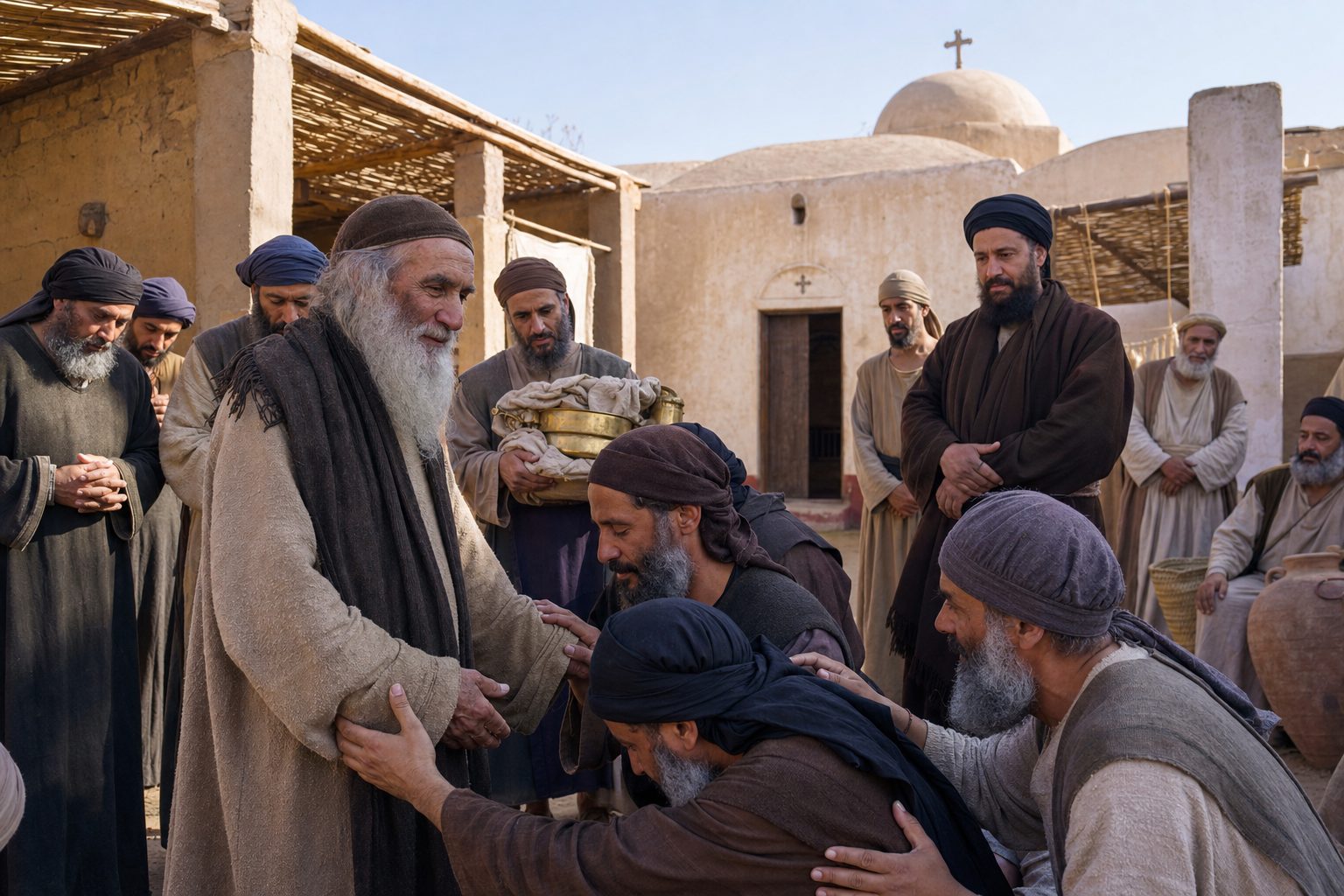
When he was brought to the latrine, his innocence was clearly revealed and it became clear to everyone that the theft was the work of another monk; and the brothers began to fall down to reverend Dul, begging him: "Forgive us, for we have sinned against you".
And he stood and said, Brothers, and fathers, forgive me, for I am thankful to you, that for a little time you have caused me to suffer, I am saved from eternal torment, and that by the mercy of God I am made equal to great blessings.
I rejoice now that I have suffered unjustly, for I know what God has prepared for the good of those who suffer for his sake. My only sorrow is for you. May the Lord not hold you guilty of what you have done to me unjustly, and I now ask the merciful God to forgive you".
After this, the monk Dula, having lived another three days, retired to the Lord, but no one knew of his death.
And he knocked the second time, and the third time, and received no answer; and he went and called another brother; and they took a candle, and opened the door, and entered into the cell, and found the saint standing on his knees, as if he worshipped; and his soul was gone to God, for he had delivered his soul to the Lord in prayer and kneeling.
When the morning service was over, the abbot himself came and, seeing the blessed dead, ordered his body to be wrapped and brought to the church for burial.
When his body was ready for burial and brought to the church, they beat him with a whip, so that all the nuns would know of their brother's death, and all gathered and touched the holy body as a martyr.
The monks, clinging to the deceased, interfered and pushed each other; therefore, the abbot of the monastery soon ordered the body of the blessed to be brought into the temple and locked its doors, waiting until the abbot of another monastery came with his nuns and thus the monks of both laurels would gather.
At about nine o'clock, when the abbot of the neighbouring monastery had already arrived with his nuns and all had gathered, they ordered to open the temple and place the body in the middle of the cathedral, so that all could see it and that the body could be given a decent burial with proper songs.
They were made of velvet, leather, cork, and even wood, and were like our shoes; but they were distinguished by a girdle which covered the sole of the foot, and a girdle between the thumb and the index finger.
And the presidents of the two laurels said unto the brethren, Behold, brethren, how long-suffering, and meekness, and kindness, and humility, are in you: behold now our brother departed from us, not only in spirit, but also in body, and was carried away by the hands of an angel into another place, for we were not worthy to touch his holy body; and he received this honour from the Lord, because of his long-suffering, which he bore in meekness and kindness,
He was made holy and worthy of heavenly life, and now he is the bridegroom of Christ the Lord.
Let us therefore learn patience and humility, meekness and gentleness, having before us the image of this long-suffering man". When the overseers of the two laurels said these things, all the nuns wept bitterly, and decided to commemorate the holy and worthy sufferer Dulles here every year - for the benefit of their souls to the glory of Christ God, the Father, and our Holy Spirit, glorious now and pleasing, and forever. Amen.
I 'm going to have to get back to you .