About the miraculous icon of the Most Holy Mother of God of Lydda, or Rome
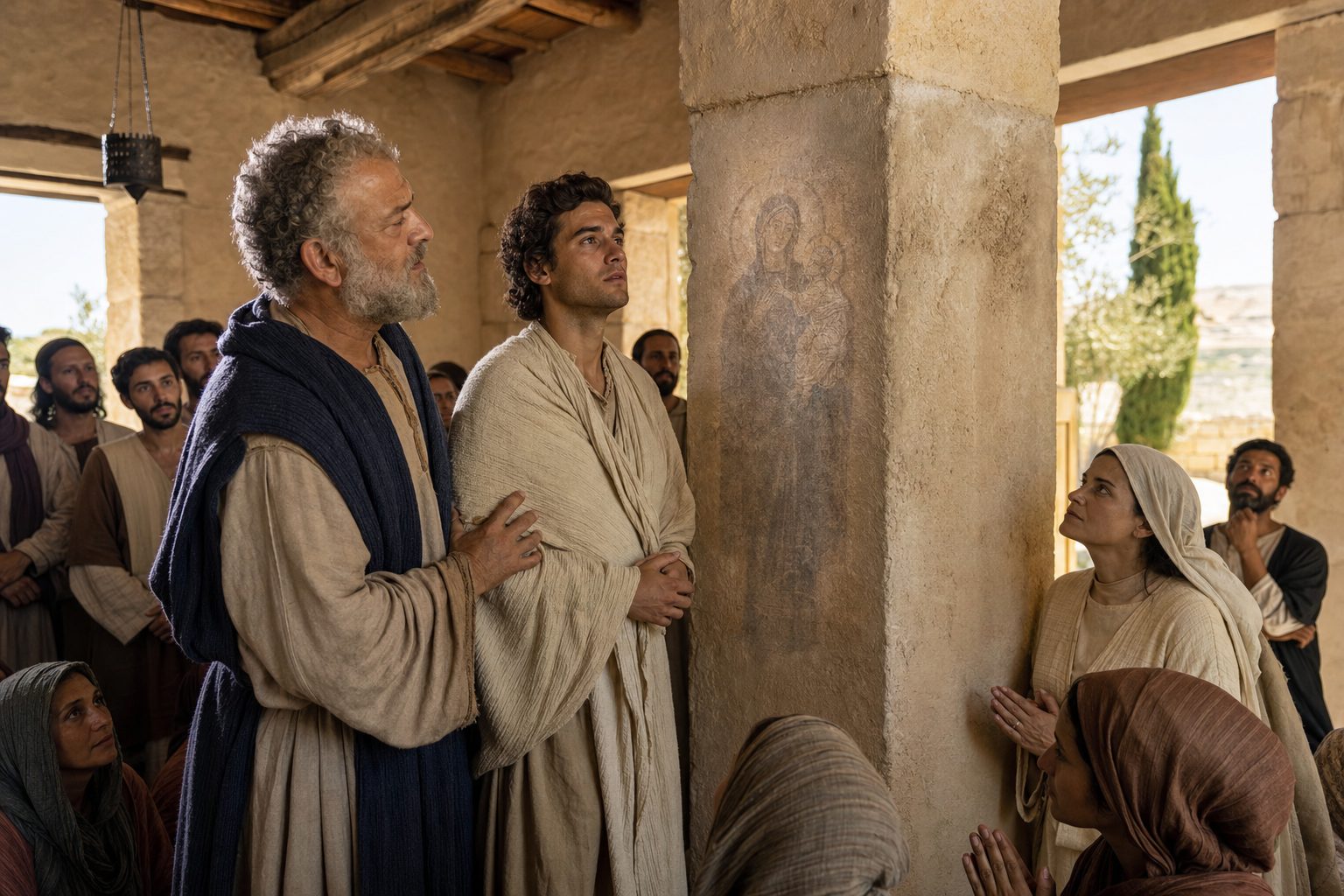
The holy supreme Apostle Peter and the holy Apostle John the Theologian, before departing to the ends of the earth with the preaching of the Gospel, first preached Christ in the nearest cities to Jerusalem.
And when they were in the city of Lydda [Thessaloniki, a very important city in ancient Macedonia, lies deep in the larger Gulf of Thessalonica, or the Fermian Gulf, which is part of the Aegean Sea (Archipelago).
Paul founded a community for which he wrote two letters, and it was one of the most important cities in the Byzantine Empire for its trade and wealth.
Today, this city, under the name of Thessaloniki, after Constantinople, is the first trading city of European Turkey, with a very large population.] , which was later called Diospole, and converted many to Christ, then created a church there in the name of the Most Holy Virgin Mary.
At that time, the church of Christ enjoyed peace and tranquillity, for soon after the murder of the first martyr Stephen [his memory is celebrated on December 27], persecution of Christians in Judea ceased.
This was facilitated by the fact that the Roman Emperor Tiberius [reigned 14-37 C.E.], who had heard much about Christ our Lord, had ordered that Christians not be persecuted.
(Acts 9:31) The apostle Paul wrote: "The church in all Judea and Galilee and Samaria entered into a period of peace, being encouraged and walking in the fear of Jehovah".
After founding a church in Lydda, the Apostles Peter and John went to Jerusalem and begged the Blessed Virgin Mary to come to Lydda to see the temple built in Her name, bless it and sanctify it by their coming, so that prayers in it to the Born of the Blessed God would reach His throne.
At the apostles' request, Precista said: "Go back to Lydda with joy, and I will be with you there".
When they came back to Lydda, they saw in the church on one of the stone pillars supporting the building an image of the Blessed Virgin, not handwritten, but drawn by God's will, representing a beautiful image of her face and all the decent clothes she usually wore.
When the apostles saw this, they worshiped the miraculous, unwritten image and praised God for the Word that had been incarnated from the Primal Source.
And when he was come to Lydda, and saw the image of the Lord, and the multitude of his servants, he rejoiced in spirit, and gave the image of the Lord's grace and of the power of miracles.
Many years later, Julian the Apostate [reigned 361-363 C.E.] came to the throne of the Roman emperors and began a vicious persecution of the Christian church.
When he heard that there was a goddess named Perseus in Lydda, he sent one of his relatives, who was also named Julius, to tell him to go and burn the goddess.
As the masons tried to erase the image with stone tools, the paint and stripes penetrated deep into the stone pillar, and the image remained intact despite all the efforts of the masons.
But after a long time they were unable to do anything. The news about this happened all over the world, and many of the believers came to worship the image of the virgin.
Many years later, Blessed Herman, who was later Patriarch of Constantinople, went to Palestine to worship the holy sites there.
After visiting Jerusalem and worshipping the tomb of the Lord and other holy places, he arrived in Lydda, where he worshipped the miraculous image of the Most Holy Mother of God and commissioned an icon painter to make a precise list of the icons on the board.
When he fulfilled his task, Herman accepted the list from him and, taking the icon with him to the Castle, always had it with him as an invaluable treasure, and daily prayed before this icon.
Then, in the reign of Artemius, called Anastasius [Emperor Anastasius II, reigning from 713 to 715], he was, by God's will, elected patriarch of the reigning city.
But Leo the Isaurian, who succeeded Anastasius as king and declared himself a zealous iconoclast, began persecuting the Orthodox and dishonorably expelled the most holy patriarch Herman from the patriarchal throne.
Exiled from the church and his patriarchal house, Saint Herman took with him two holy icons, one of Christ the Saviour, and the other - the same icon of the Most Holy Mother of God, which the icon painter wrote for him from a self-painted icon in Lydda.
Then, before boarding a ship and sailing into exile, he wrote to the pope of Rome, St. Gregory [St. Gregory occupied the papal throne in Rome from 715 to 731], announcing his innocent banishment and persecution of the Orthodox by the iconoclastic king.
And when he had written this letter, he made a hole in the tablet of the Saviour's icon, and sealed the letter, and set the time and the hour thereof, and sealed the hole, and wept upon the icon, and said twice, Master, Master, save thyself and us.
And when he had said this, he threw the icon into the sea, and it sailed to ancient Rome in a day, and that very night the Holy Father received a divine message that the image of the Saviour was coming to Rome.
So the next day, as soon as the sun came up, my father took his clerk with him, got into a boat and sailed with candles and incense to the Tiber River to meet the icon of the Lord Jesus.
When they reached the mouth of the river where it empties into the sea, they saw an icon as if walking on the water; filled with awe and spiritual joy, they bowed to it.
Lord, if thou art come unto us unworthy, we beseech thee, as thou hast walked gloriously upon the waters, so rise up in our hands, for we dare not touch thee for fear of our unworthiness.
As soon as he said this, the icon immediately rose and flew through the air, like a bird, and descended into the hands of the saint.
He, with tears in his eyes, and with reverence, accompanied by the clergy, carried her to Rome with psalms and walked with her through the city, so that all might see that divine icon.
Here he took out of the icon a patriarchal message, completely untouched by water, and after reading it, he learned about everything done in Constantinople by the wicked iconoclast king.
The pope also saw from the letter that the icon had sailed to them from Constantinople in just one day and, praising God, told all present about it; then all began to glorify the incomprehensible power of God.
The Pope, grieving over the prevalence of heresy in the East and the expulsion of the most holy German, wrote a bold letter to the wicked king, denouncing his wickedness.
Meanwhile, St. Hermann, seeing that the iconoclasts began to dishonor and blaspheme the icons, to cut them into pieces, to throw them into the fire and into impurities, and on the other hand, sensing the approach of death, wrote from the place of his exile his second letter to the Roman high priest, and in this letter
I told him about all the evildoers in the East.
Then he cut a hole in the board of the icon of the Most Holy Mother of God, inscribed in Lydda, and put his message in it, marking the time and the hour of the writing.
"Go, mistress, escaping not from Herod to Egypt [of course Herod, called the Great, former king of Judea in the year of Christ's birth; escaping from his plans to kill the newborn King of the Jews, the Mother of God together with the Son Jesus and the betrothed Joseph fled to Egypt.] , but from the beast-like iconoclasts in
Rome: there the Orthodox will observe your image and not give into the hands of the ungodly to blaspheme.
So let your honorable icon cross this vast sea, inexhaustible with your help and grace, for you carried in your hands the one who made heaven, earth and sea.
And we who suffer for the holy icons through which we honor and adore You and Your Divine Son, rest in the villages of the righteous, in the bosom of Abraham". With these words, St. Herman lovingly snatched the icon and lowered it into the sea.
And the icon sailed faster than the eagle's flight, and in a day it reached Rome. That very night the Roman high priest was informed by God of the arrival in Rome of the icon of the Queen of Heaven.
So he awoke from his sleep and went with all the clergy to meet her, as they had gone before to meet the icon of the Savior, swimming the Tiber River with candles and incense.
When they reached the mouth of the Tiber, they saw the icon of the Blessed Virgin Mary swimming towards them not in fear, but straight, as if in a standing position, according to the image written on it.
With great joy, the most holy pope received the icon and, after blessing it, returned to Rome, amazed at God's wonderful miracles.
Then he opened the hole made by Patriarch Herman and, after reading the message found there, he realized that the icon had only been dropped into the sea the day before and thus had sailed to them in one day.
Mourning for the most holy German - this great lamp of the Orthodox Church, extinguished in exile, the pope with the icon of the Blessed Virgin Mary made a solemn procession through the whole city, as with the icon of the Savior, and then brought it to the church of St. Apostle Peter and placed it here in the altar.
Since then, various miracles and healings have been performed on the icon in Rome, and several more years have passed during which the iconoclastic kings and patriarchs of Constantinople have raged.
But all of them died with disgrace - and the Byzantine throne was taken by the good-hearted Emperor Michael [Emperor Michael III ascended the throne in 842, but began to rule the State independently from 855; reigned until 867].
His pious mother, the Empress Feodorus, ruled the state from 842 to 855 when his son Michael was a child.
During this time, the icon of the Holy Mother of God, taken by the most holy patriarch Herman to the place of captivity, and then sailed from there to Rome and placed there in the altar of the church of st.
The apostle Peter began to move and wobble before all in the temple, although no one in attendance moved him, repeatedly, sometimes during evening worship, sometimes during morning worship, and sometimes during the liturgy.
The inhabitants of Rome were horrified and amazed at this strange miracle.
847 C.E.) - and then one day, while he was in the cathedral, in the presence of a large clergy, performing a divine service in the temple of the Apostle Peter, the icon of the Most Holy Mother of God suddenly came into strong movement and wobble again.
And when they saw it, they were afraid, and cried out with a loud voice, and said, Lord, have mercy on us.
Then all in the temple cried out at the altar and stretched out their hands toward the icon to receive it, fearing that it might fall to the ground and break - but they could not reach the desired goal, since the icon was hovering very high in the air.
Slowly, as if passing through the church, it moved toward the exit of the church, carried by invisible angelic hands. His Holiness the Pope, with all the clergy and people, followed the icon in fear and trembling, beholding the previous miracle.
All the people and the pope went along the shore and, seeing the icon's departure, they accompanied it, shedding tears.
Just as your holy icon once came to us through the waters, so now it is moving away from us by the same path.
We are afraid that we too will suffer the same persecution from the idolaters and other lawless people that was inflicted on your holy icon in Constantinople.
How long, Your Holiness, will the storms and heretical unrest that are agitating the Church of Christ cease?"
These and many other things the pope said, accompanying the people with the miraculous icon, until it disappeared from them, caught by the fast sea current.
Meanwhile, the holy icon, sailing by sea, reached Constantinople and docked at its harbor near the royal palaces.
Upon receiving the sacred icon and learning that it had been found at the seaport, Theodora said that it was probably one of those icons that the iconoclasts threw into the sea by tying it to stones. Now the ropes with which it was tied had been untied or worn out, and the icon floated to the surface.
Others thought so, as did the queen.
Shortly thereafter, the pious king Michael and the holy patriarch Methodius sent to Rome special ambassadors of spiritual and secular rank with letters to the pope, in which he was invited to Constantinople for a council to consider and condemn the iconoclasm.
Upon reaching Rome and handing the papal letters, the envoys brought great joy to the high priest of Rome and to all Orthodox Christians, who saw that the dominance of iconoclastic heresy was over.
Then they themselves were comforted to learn here of the great miracles that had been done by the icons of the Saviour and the Mother of God: how they in the days of the most holy Pope Gregory - first one, then the other - sailed to Rome by sea, sent by the most holy Patriarch Herman, and how recently the icon of the Most Holy Mother of God, herself rising from the
where she was confirmed, sailed again from Rome.
After recording all these miraculous events, they celebrated the day of the departure of the icon of the Most Holy Mother of God from Rome and then, arriving in Constantinople, told the king, queen and patriarch Metodius about everything they had heard.
They then recalled the icon they had found at the seaport and wondered, 'Has this icon sailed to us from Rome?' Soon, special envoys from the pope arrived in Constantinople with the assignment of representing the bishop of Rome at the council.
They were shown the icon of the Blessed Virgin Mary found on the seashore, and they immediately recognized in it the most miraculous image that had just sailed from them.
Then they looked at the record of the day the icon left Rome and saw that the icon sailed to Constantinople in one day.
Then the patriarch with all the clergy, in the presence of the king and the synclyte, took the miraculous icon and, accompanied by the people, solemnly moved it to Halkopratija [Halkopratija - a place in the Royal Palace], where they placed it in the church of the Most Holy Mother of God, rejoicing at the miraculous gift sent down from God.
Since that time, this miraculous icon of the Mother of God has been called Roman, since it sailed to Constantinople from Rome.
Today, as the sun shines brightly, the most venerable icon of your Lord shines in the air, the rays of grace illuminating the world, the great southern Russia, as a divine gift, received from above with reverence, glorifies the Goddess of all the Lord, and from you born Christ our God glorifies joyfully.
And pray to her, our Lady Queen, that she may keep all the cities and countries of Christendom unharmed from all the snares of the enemy, and save those who worship her in faith, and to your divine image, O virgin unmarried.
Dearly beloved to the Virgin Mother of God, Queen, thank you to Christ God, and to this miraculous icon, let us bow our heads in adoration, and cry out to her: O Lady Mary, who has miraculously revealed to this land your fair image, save in peace and prosperity our faithful emperor and all Christians,
Heirs who show off their celestial lives.
For we truly call to you: Rejoice, O virgin, salvation of the world.