The life, deeds and sufferings of the holy glorious and all-powerful supreme Apostle Paul
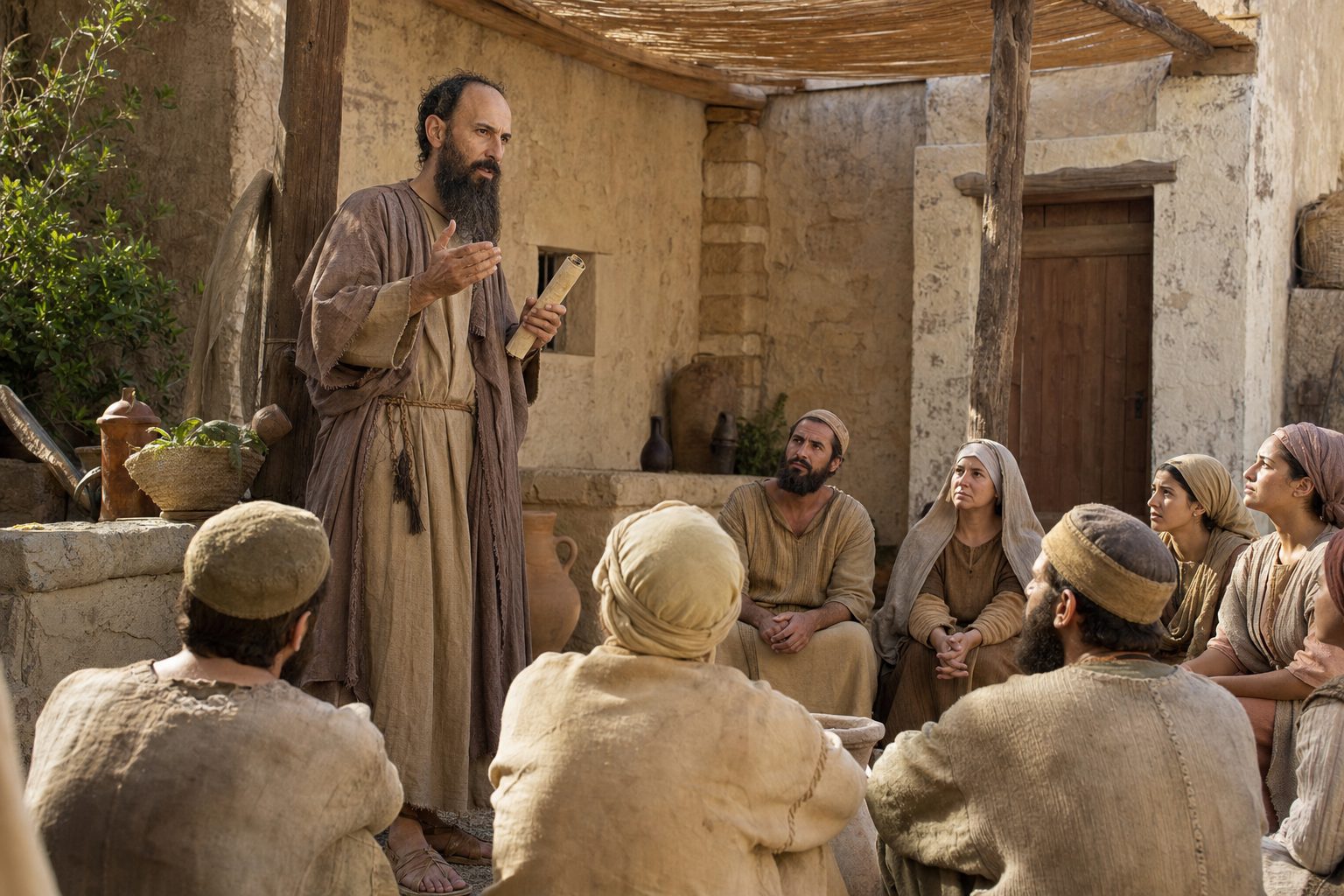
St. Paul, before his apostleship called Saul [Saul <unk> Hebrew name, meaning "desired"; "begged"; Paul <unk> Roman name, meaning "little one". Some scholars think he was the long-awaited, firstborn son and received both names at birth, as a Roman citizen, from his father.
And Saint Demetrius of Rostov, following the opinion of St. Zlatoust, Ambrose, etc., thinks that Saul was renamed Paul at his baptism.
The Acts of the Apostles does not say when or why this change of name occurred.] , was a Jew, of the tribe of Benjamin; he was born in Tarsus of Cilicia, of noble parents who had lived first in Rome, then moved to Tarsus of Cilicia [Tars <unk> some time
a large and populated city in the south-east of Asia Minor, the main city in the province of Cilicia, at the mouth of the river
And now it's a big city and a trading city with 40,000 inhabitants.] , with the honorary title of Roman citizens, so Paul was called a Roman citizen.
He was a relative of the first martyr Stephen, and was sent by his parents to Jerusalem (probably with him) to study the law of Moses; there he was among the disciples of the famous teacher Gamaliel.
Saul thoroughly studied the Law of the fathers, became a great adherent of it, and joined the party of the Pharisees (strict zealots of all domestic and outwardly godly people).
The apostles traveled from town to town, preaching the gospel of Christ, and they had many discussions with the Pharisees and Sadducees, the teachers of the law, who say that the soul does not die.
The preachers of Christ were constantly hated and persecuted.
He hated the holy apostles and Saul and would not even listen to the preaching about Christ, persecuting Barnabas, who had already become an apostle of Christ, and speaking blasphemously of the Lord Christ.
And when the holy first-born Stephen was stoned to death by the Jews, Saul not only regretted his own innocent blood but also approved of the murder and guarded the outer garments of the Jews who had slain Stephen.
Having obtained authority from the chief priests and the elders, he began to destroy the church. Going from house to house, he dragged off men and women and put them in prison.
Not content with persecuting the faithful in Jerusalem and breathing out threats and murder against the disciples of the Lord, he went to Damascus [Damascus <unk> one of the oldest cities in the world].
In the time of King David, it was the capital of an independent state; before the birth of Christ, it came under the rule of the Romans.
The synagogue of Damascus was under the authority of the high priest of Jerusalem; the civil authorities did not interfere in the religious affairs of the Jews.
Damascus was annexed by the Turkish Empire, and is now a very commercial and wealthy city, with 200,000 inhabitants.
He was in Syria, at the foot of Antilivanus, about two hundred yards northeast of Jerusalem, with letters from the high priest to the synagogues, that if he found any of those who believed in Christ, both men and women, he might bring them bound to Jerusalem.
This occurred during the reign of Tiberius [Tiberius <unk> Roman emperor, from 14 to 37 C.E. C.E. Jesus Christ was crucified there.]
As he neared Damascus on his journey, suddenly a bright light from heaven flashed around him, and he fell to the ground.
"Who are you, Lord? " he asked". I am Jesus, whom you are persecuting, " the Lord answered.
The Lord said: "Get up and go into the city, and there you will be told what you ought to do". - Acts 9:4-6.
The men traveling with Saul stood there speechless; they heard the voice, but did not see anyone.
When Saul got up from the ground, although his eyes were open, he could see nothing. His physical eyes were dim, but his spiritual eyes began to see.
So they led him by the hand into Damascus, where for three days he was blind; he neither ate nor drank.
In Damascus there was a holy Apostle Ananias [Ananias <unk> was a Christian from the Jews, later appointed bishop in Damascus and died a martyr <unk> stoned in Elevferopolis (between Jerusalem and Gaza).
The Lord appeared to him in a vision and told him to go and find Saul, who was living in the house of a man named Judas, and to cleanse his physical eyes by touching them, and his spiritual eyes by being baptized.
I have heard many reports about this man and all the harm he has done to your saints [as Christians were called at the time] in Jerusalem. And he has come here with authority from the chief priests to arrest all who call on your name".
But the Lord said to Ananias, "Go! This man is my chosen instrument to carry my name before the Gentiles and their kings and before the people of Israel.
For I myself will show him how much he must suffer in behalf of my name".
And the word of the Lord came unto Ananias, saying, Go, fear not; for from henceforth none of the disciples shall suffer evil by him, but he must suffer many things for my name's sake.
Then Ananias went to see Saul and placed his hands on him. At once Saul's sight returned, and he was filled with the Holy Spirit.
and he went into the synagogues, preaching that Jesus is the Son of God by laying on his hands.
<unk> "A scallop fell off" - this was just Paul's inner feeling; it seemed as if a scallop had fallen from his eyes.
All those who heard him were astonished and asked, "Isn't this the man who raised havoc in Jerusalem among those who call on this name? And hasn't he come here to take them as prisoners to the chief priests?"
But Saul grew more and more powerful and baffled the Jews living in Damascus by proving that Jesus is the Christ. Day and night they kept watch on the city gates in order to kill him.
But the disciples in Damascus, including Ananias, learned of their plot against Paul. So they took him by night and lowered him in a basket through a window in the wall.
But he left Damascus and did not immediately go up to Jerusalem, but first went into Arabia [The details of his stay in Arabia are not entirely known.
He was probably busy studying the Scriptures and preparing for the new work that the Lord was directing him to do.] As he wrote to the Galatians: "I did not consult with flesh and blood, nor did I go up to Jerusalem to those who were apostles before me, but I went off into Arabia, and then I returned again to Judea.
I'm going to Damascus.
Then after three years I went up to Jerusalem to see Peter". (Gal. 1:16-18) When Paul came to Jerusalem, he tried to join the disciples, but they were all afraid of him, not believing that he was a disciple.
When Barnabas saw him, he took him and brought him to the apostles. He told them how Saul on his journey had seen the Lord and that the Lord had spoken to him, and how in Damascus he had preached fearlessly in the name of Jesus.
The holy apostles were filled with joy and praised the Lord Jesus Christ.
Traveled from place to place, he reasoned with Jews and Greeks, proving that the Lord Jesus was the Christ.
One day, while Paul was praying in church, he suddenly and involuntarily fell into a trance, an unusual state of being in which the outer world is closed to his bodily senses and the inner world is closed to his senses.
The apostle Peter was in Joppa praying on a rooftop, and he saw the Lord.
and saw the Lord speaking. 'Quick!' he said to me. 'Leave Jerusalem immediately, because they will not accept your witness about me.'
And when the blood of Stephen, your martyr, was shed, I stood there giving my approval and guarding the clothes of those who were killing him. 'The Lord said,' Go; I will send you far away to the Gentiles. '
After Paul had seen this vision, he decided to stay on in Jerusalem for some time.
When the Christians in Jerusalem learned of this, they sent him down to Caesarea.
Here we understand Caesarea in Palestine, built by Straton in honor of Caesar Octavian Augustus, by the Mediterranean Sea, about 100 yards from Jerusalem, to the northwest, the former residence of the Roman rulers of Judea; it was fortified and decorated by Herod, once with an excellent harbor; now <unk> heap
It's in ruins.
Now there was another city in Palestine called Caesarea Philippi, built by the tetrarch Philip the Galilean at the foot of Mount Lebanon in honor of Tiberius Caesar.
God's word to my countrymen.
When they came to Antioch, Barnabas and Saul, guided by the Holy Spirit, took Paul and went with him. For a whole year Paul and Barnabas spoke in the synagogue there and won a large number of people to believe. The name "Christian " was given to them.
The Lords, who usually called each other brothers, disciples, believers; it was first used outside the Church and most likely given to the followers of the Lord by the Gentiles of Antioch, who, meeting a very significant number of believers, ceased to consider them a Jewish sect and added
It's not a Christian thing.]
When a year had passed, the two holy apostles, Barnabas and Paul, returned to Jerusalem and reported to the holy apostles all that had been accomplished by God's grace in Antioch.
The buildings, they came later.
The Holy Apostles Jason and Sosipater were the first to erect a beautiful church in the name of the first martyr Stephen on the island of Kerkireia (now Corfu, one of the Ionian Islands, near Albania).
And they sent to Antioch a large sum of money for the poor brethren who were in Judea.
God's grace is working in the church of the Gentiles.] , because at that time, during the reign of Claudius [Claudius Caesar, Caligula's successor, occupied the Roman throne from 41 AD
By 54 A.D., the famine raged in various parts of the Roman Empire.] , was a great famine foretold by a special revelation of the Holy Spirit, by St. Agabus, one of the 70 Apostles.
They left for Antioch, where they spent time in prayer and fasting. The Holy Spirit had decided to send them to preach to the Gentiles.
While the church in Antioch was celebrating the Lord's Supper, the Holy Spirit directed some of them to send for Barnabas and Saul to preach to the Gentiles.
This is the beginning of Paul's first apostolic journey, which was prepared for him by an extraordinary revelation <unk> being caught up to the third heaven. - 2 Corinthians 12:1-5.
For the omnipotence of God, of course, it meant nothing for a time to completely excite the soul of Pavlov from the body; but it is difficult (notes St. Zlatoust) to see the need for such an unprecedented for the most holy people separation of the soul from the body in a living man.
"The spiritual world, which Paul admired as beyond space, is everywhere; and therefore it is only necessary that the human spirit should be enabled to communicate with it, and that, remaining in the body without any change of place, it may be in heaven <unk> in the company of angels and blessed souls (Inocent).
I'm going to have to go to the hospital.
The holy spirit told the elders of the congregation in Antioch: "Set Barnabas and Saul apart for me to the work to which I have called them". - Acts 13:2.
Then the presbyter, after fasting and praying and laying on their hands, sent them away [The fulfillment of this special fast and prayer showed that the Jerusalem church recognized the special importance of Paul and Barnabas' mission to preach to the Gentiles.] . . .
The two of them, sent on their way by the Holy Spirit, went down to Seleucia and sailed from there to Cyprus, the native land of the apostle Barnabas.
When they arrived at Salamis, they proclaimed the word of God in the synagogues of the Jews. They traveled throughout the island and came as far as Paphos, which was on the coast opposite Salamis.
They traveled throughout the whole island. There they met a Jewish sorcerer and false prophet named Bar - Jesus, who was a fellow servant of the district attorney, whose name was Sergius Paulus.
The proconsul, having sent for Barnabas and Saul, desired to hear the word of God. But Elymas the sorcerer opposed them and tried to turn the proconsul from the faith.
Then Paul, full of the Holy Spirit, looked straight at him and said, "You are a child of the devil! You are full of all kinds of deceit and trickery, you an enemy of everything that is right! Will you never stop perverting the right ways of the Lord?
And now, look! the hand of Jehovah is upon you, and you will be blind, not seeing the sun for a time". And suddenly darkness and gloom fell upon him, and he kept going back and forth, seeking someone to lead him".
When the proconsul saw what had happened, he believed, for he was amazed at the teaching about the Lord. And many people believed and turned to the Lord.
From Paphos, Paul and his companions sailed to Perga in Pamphylia, and from there to Antioch in Pisidia [Antioch of Pisidia, Roman colony; where Paul and Barnabas first preached the Gospel to the Gentiles.
The latter was founded 300 years before the Common Era by Seleucus Nicator, founder of the Seleucid Kingdom, near the Orontes River, 30 kilometers from the sea, as one of the numerous Greek colonies; it quickly became one of the largest and most famous cities in Syria and its capital.
In the Christian Church, it occupied the second place in the field of Jerusalem; its primates received the title of patriarch, now their residence in Damascus.
But the Jews were jealous; so they stirred up the Gentile leaders and drove them out of the region.
So they shook the dust from their feet in protest against them and went to Iconium. There they stayed for a while, speaking boldly and persuading a large number of Jews.
And the Gentiles were amazed, not only by their preaching, but also by the signs and wonders that were done by their hands. There they converted even the holy virgin Thecla [Memorial of her September 24] and proclaimed her to Christ.
Then the Gentiles and the Jews who had refused to believe stirred up their leaders to attack the apostles and to stone them.
When the apostles learned of this, they fled to the Lycaonian cities of Lystra and Derbe and the surrounding area.
While they were preaching in Lystra, they healed a man who was lame from his mother's womb and had never walked.
When the crowds saw this, they shouted in the Lycaonian language, "The gods have come down to us in human form!"
Barnabas they called Zeus, and Paul they called Hermes. They brought bulls and wreaths and were ready to offer sacrifices to the apostles.
But when the apostles Barnabas and Paul heard this, they tore their clothes and rushed out into the crowd, shouting: "Men, why are you doing this? We too are only men".
And they say, 'Who created the heavens and the earth and the sea and what is in them, and sent down from the sky the rain and the seasons and made them rejoice with it, and they are not at all certain.'
Then some Jews came down from Antioch and Iconium and won the crowd over. They said nothing was true, and they turned the unbelievers against them.
They dragged him out of town, thinking he was dead.
The next day Paul and Barnabas left Derbe. They preached the gospel in that city and won a large number of disciples. Then they returned to Lystra, Iconium and Antioch, strengthening the disciples and encouraging them to remain true to the faith.
Paul and Barnabas appointed elders for them in each church and, with prayer and fasting, committed them to the Lord, in whom they had put their faith.
After they had preached the word in Perga, they went down to Attalia and sailed to Syrian Antioch.
But the Holy Spirit sent them to preach the word of God to the Gentiles.
On arriving there, they gathered the church together and reported all that God had done through them and how he had converted the Gentiles.
There arose a dispute between the Greeks and the Christians over the matter of circumcision. Some said that they could not be saved unless they were circumcised, but others said, "No!
They decided to go to Jerusalem to see the apostles and elders there. They told them how God had opened the door of faith to the Gentiles also, and this brought great joy to the brothers.
When the holy apostles and elders met in Jerusalem, they decided to abolish circumcision altogether, saying that it was not necessary for the new grace. They only ordered that they should abstain from eating food offered to idols, from sexual immorality, and from harming their neighbors in any way.
Paul and Barnabas went to Antioch, and Judas and Silas accompanied them.
Barnabas took Mark and sailed for Cyprus, but Paul chose Silas and went through Syria and Cilicia, encouraging the people.
The faithful.
When Paul came to Derbe and Lystra, he took Timothy and circumcised him, because of a dispute between the Jews and the believers there.
But Paul and Barnabas were not willing to listen to him, because his father was a Gentile.
From there he passed through Phrygia and the country of Galatia, and then came to Mysia, and thought to go into Bithynia [Prygia and Galatia <unk> the interior regions of Asia Minor; Mysia and Bithynia <unk> the north-western regions in it.] , but this was not pleasing to the Holy Spirit [Acts of the Spirit are not indicated by the deist, whether they were external or
The apostles clearly recognized them as the direct action of the Holy Spirit.
For when Paul was with his companions in Troas [Troas <unk> a seaport city near where the sea crossing to Europe was made], he was in the city of Thessalonica.
During the night Paul had a vision of a man of Macedonia standing and begging him, "Come over to Macedonia and help us".
After Paul had this vision, he sailed from Troas to Macedonia, landed at Samothrace, and the next day went to Neapolis [a port city in Thrace, the first European city, now Kavanah]. From there he went to Philippi, a former Roman colony in the vicinity.
In Philippi, he first taught the faith of Christ and baptized a woman named Lydia, a purple-colored cloth merchant.
One day as Paul was going to the place of prayer, he was met by a slave girl who had a spirit by which she predicted the future. She earned a great deal of money for her owners by fortune - telling.
This woman followed Paul and the others and kept shouting, "These men are servants of the Most High God, who are telling you the way to be saved".
(Mark 1:24-25, 34; 3:11-12, etc.) Paul addressed her and, after rebuking the spirit in the name of Jesus Christ, expelled it from the area.
I'm going to kill her.
When the owners of the slave girl realized that their hope of gaining money was gone, they seized Paul and Silas and brought them before the magistrates. "These men are Jews, " they said", and are throwing our city into an uproar. They are teaching customs that we are not allowed to accept or practice, since we are Romans".
After the magistrates ordered them to be beaten and thrown into prison, they pulled out their clothes. About midnight Paul and Silas were praying, and immediately all the doors opened and the chains came loose.
At that, the jailer believed and took them into his house and washed their wounds. He was baptized at once, along with his whole household. Then he offered them food and returned to the prison.
When it was daylight, the magistrates ordered that the men be beaten. Then they sent the officers to the jail with the order to let the apostles go.
But Paul said to them: "They flogged us publicly without a trial, we men who are Roman citizens, and threw us into prison, and are they now going out secretly? No, but let them themselves come and lead us out". - Acts 16:37.
The officers reported this to the magistrates, and when they realized that Paul and Silas were Roman citizens, they were afraid. They also asked Paul and Silas to leave the city.
After Paul and Silas came out of the prison, they went to Lydia's house, where they greeted the brothers.
After taking leave of them, we put out to sea at Amphipolis and Apollonia and sailed from there to Thessalonica [Amphipolis <unk> the chief city in the 1st district of Macedonia, southwest of Philippi; Apollonia <unk> (now the town of Erissos) southwest of Amphipolis, north of the Athenian peninsula; Thessalonica <unk> the chief city in the 2nd district]
Macedonia, near the Gulf of the Aegean Sea, now an important trading city in Turkey, a staging area for Macedonian trade.]
When they had preached the word to a large crowd, jealous Jews gathered some worthless men and stormed into the house of Jason, where the apostles were staying.
But when they did not find them, they dragged Jason and some other brothers before the city officials, shouting: "They are speaking against Caesar, saying that there is another king, one called Jesus!"
But when the Jews of Thessalonica learned that Paul was preaching the word of God at Berea, they went there also,
They stirred up the crowd and began to speak against Paul.
The holy apostle was compelled to leave, not fearing personal death, but at the insistence of the brothers, to save his life, so that many might be saved, and the brothers let him go to sea.
But when he saw that they were all looking for him, he left them there and sailed for Athens.
According to legend, it was founded around 1550 B.C. It was the capital of a kingdom, a republic, a duchy, in the 15th century it was conquered by the Turks, in the 19th century it was liberated from them and became the capital of the Greek kingdom.]
While he was in Athens, Paul was greatly distressed to see that the city was full of idols. He discussed with the Jews in the synagogue and, on the marketplace, with the philosophers every day.
Then they took him to the Areopagus, the place where the judgment seat was,
They brought him there partly to hear from him in the former assembly something new, and partly also to hand him over to trial, torment and death, if they heard anything worthy of punishment from him.
Paul had previously seen an altar in the city with an inscription: TO AN UNKNOWN GOD. So he began to preach to them about the unknown God, saying: "What you worship unknownly, this I am declaring to you as good news". - Acts 17:23.
When they heard about the resurrection of the dead, some of them sneered, but others said more earnestly.
But some men joined him and became believers. Among them were Dionysius, a member of the Areopagus, and a woman named Damaris, who was a member of the Jewish theological community.
and many others were baptized.
Leaving Athens, Paul came to Corinth [Corinth <unk> to the west of Athens, on the headland, famous in antiquity for its extensive trade, then the seat of the Roman ruler.]
We had no one to eat our food for free, but we worked night and day, laboring and toiling so that none of you would eat our bread.
" Let us not be burdensome to any of you . " - 2 Thess . 3: 8
And again: "These hands have ministered to my own needs and to the needs of those with me". - Acts 20:34.
Every Sabbath he reasoned with the Jews, proving that Jesus was the Christ. But as they continued to oppose and blaspheme, he shook out his clothes in protest and said to them, "Your blood be on your own heads! I am clear of my responsibility. From now on I will go to the Gentiles".
When Paul was about to leave Corinth, the Lord appeared to him in a vision by night and said: "Do not be afraid, but keep on speaking, and do not be silent; for I am with you, and no one is going to attack you to do you harm; for I have many people in this city". - Acts 18:9-10.
So Paul stayed there a year and a half, teaching both Jews and Greeks the word of God. A great number of people believed and were baptized. Even Crispus, the synagogue ruler, believed in the Lord with all his household.
But some of the unbelieving Jews joined the crowd against Paul and brought him before the governor Gallio, who was the brother of Seneca the philosopher.
Seneca found blood and thus executed the sentence of death.] ), but he refused to judge Paul, saying: "If there is in him any injustice, or evil intent, I will take care of it.
But if there are disputes about your law, I will not be a judge of them".
Paul stayed on in Corinth for some time. Then he left the brothers and sailed for Syria.
He was followed by Aquila and Priscilla, and on the way they all stopped at Ephesus [Ephesus <unk> a seaside trading town and the chief city of the province of Ionia in Asia Minor, it was later the center of the activities of Apostle John the Theologian; here was the 3rd ecumenical council in 431; now Ephesus <unk> a poor Turkish village of Аясалук.]
The holy apostle Paul did many miraculous signs there, preaching the word of the Lord. Not only did his hands perform miraculous healings, but even the handkerchiefs and headbands that were worn on his body were healed.
and to heal the sick and to cast out evil spirits.
Some Jews who went around driving out evil spirits tried to invoke the name of the Lord Jesus over those who were demon - possessed. They would say, "In the name of Jesus, whom Paul preaches, I command you to come out. " But the evil spirit answered", Jesus I know, and I too know about Paul, but who are you?"
Then the man who had the evil spirit jumped on them and overpowered them all. He gave them such a beating that they barely escaped naked and wounded.
When this became known to the Jews and Greeks living in Ephesus, they were all seized with fear, and the name of the Lord Jesus was held in high honor.
And even of those who practiced magic, very many, by adopting the sacred faith, gathered their books of magic, and having counted their prices, found that they were worth 50,000 drachmas [Drachma <unk> about 20 kopecks, hence the books burned were worth up to 10,000 rubles.
So the word of the Lord spread rapidly and grew in authority. "After I have been there, " he said", I must visit Rome also".
When the silversmiths caused a disturbance in the temple of Artemis, Paul went down to Troas and stayed there seven days.
On the first day of the week we came together to break bread. Paul spoke to the people and, because he intended to leave the next day, kept on talking until midnight.
"A young man named Eutychus was sitting in a window, and he was sinking into a deep sleep. When he was sound asleep, he fell to the ground from the third story and was picked up. Then Paul went down and fell on him, clasped him in his arms and said", Do not be alarmed, for he is still alive. " (Acts 20:10)
So they took him and brought him in alive. He was greatly encouraged, and for a long time Paul talked with them until daylight. Then he left them.
When Paul landed at Miletus, he sent to Ephesus for the elders of the church. He did not want to be late, because he was in a hurry to get there on the day of Pentecost.
to be in Jerusalem.
(Acts 20:28) The apostle Paul, for example, urged the elders in Ephesus: "Pay attention to yourselves and to all the flock, among which the holy spirit has appointed you overseers, to shepherd the congregation of God, which he purchased with his own blood".
"And now, compelled by the Spirit, I am going to Jerusalem, not knowing what will happen to me there.
(Acts 20:22-24) Then he said: "And now, look! I know that none of you will see my face any more". (Acts 20:25) There was much weeping among them.
What grieved them most was his statement that they would never see him again. Then they accompanied him to the ship and said good - by.
He traveled through many towns and countries, visiting and encouraging the believers. Then he landed at Ptolemais, and from there went to Caesarea.
Stratonov [Cesaria, see also
[Apostle Philip, one of the seven deacons (chosen along with the first martyr Stephen), preached in Samaria, baptized the eunuch of the Ethiopian queen on the way, had his house and family in Caesarea.
When the prophet Agabus came down there, he took Paul's belt, tied his hands and feet with it and said, "The Holy Spirit says,' In this way the people of Jerusalem will bind the owner of this belt and will hand him over to the Gentiles. '"
When the brothers heard this, they began to plead with him with tears not to go up to Jerusalem, but he replied: "What are you doing, weeping and breaking my heart? I am ready not only to be bound but also to die in Jerusalem for the name of the Lord Jesus". - Acts 21:13.
And they were silent, saying, The will of the Lord be done.
After this, the holy Apostle Paul went up to Jerusalem with his disciples (among whom was Trophimus the Ephesian, a Gentile convert to Christ) and was warmly received by the holy Apostle James, the brother of the Lord, and the whole church of the faithful [James, the brother of the Lord, the eldest son of Joseph manuscript, from the first of his
He accompanied Joseph and the Blessed Virgin Mary with the infant Jesus in their flight to Egypt; after his resurrection, the Lord honored him with a special personal appearance (1 Cor. 15:7); after Christ's ascension, he was appointed by the chief Apostles the first bishop of the church of Jerusalem, having been
And he went into Jerusalem, and came thither, and was called Righteous by the Gentiles.
At that time there came men from Asia, from Asia Minor, from Asia Minor, from Asia Minor, from Asia Minor, from Asia Minor, from Asia Minor, from Asia Minor, from Asia Minor.
When the Jews came to Jerusalem for the Feast of Pentecost, they stirred up a riot against Paul.
For they had seen Trophimus the Ephesian in the city with Paul, and they complained against him, saying that he preached everywhere the crucified Jesus.
When they saw Paul in the temple area at the festival, they suddenly tried to slander him and stir up the whole crowd.
This is the man who teaches all men everywhere against the people and the law and this place. And he has brought Greeks into the temple area and defiled this holy place".
The whole city was aroused, and the people came running from all directions. Seizing Paul, they dragged him from the temple, and immediately the doors were shut.
When the news reached the commander that all Jerusalem was in an uproar, he called his troops and their officers and rushed into the temple area. When the people saw the commander and his soldiers, they stopped beating Paul.
Then the commander took Paul and ordered him to be bound with two chains. Then he asked who he was and what he had done. The people began to cry out, "Okay, let's kill him!"
The people shouted at the same time, "Away with him! " Because the commander could not get at Paul's case for sure because of the uproar, he ordered him to be taken into the barracks.
When Paul came to the steps leading into the barracks, he asked if he could say a few words to the people. With his permission, he stood up and addressed them in Aramaic:
(Acts 22:1) He told them how he had previously been zealous for the law, and how on the road to Damascus a light from heaven had shone on him, and how the Lord had sent him to the Gentiles.
The crowd did not listen to Paul, but raised their voices and shouted, "Rid the earth of him! He is not fit to live!"
the commander ordered Paul to be taken into the barracks. He directed that he be flogged and questioned in order to find out why the people were shouting at him like this.
When he heard this, the centurion went to the commander and reported it. "What are you about to do? " he asked". Tell me, are you a Roman citizen?"
"Yes, it is. " The commander said". I had to pay a large sum for my citizenship, " and he released him at once. The next day he ordered the chief priests and all the Sanhedrin to assemble. Then he brought Paul and had him stand before them.
"Brothers, I have lived in all good conscience before God to this day. " Then the high priest Ananias ordered those standing near Paul to strike him on the mouth.
Thou sittest to judge according to the law, and commandest me to be smitten contrary to the law.
In exposing his open and unfounded insolence, Paul acted in imitation of Jesus Christ, who also exposed the injustice of the man who had struck him before his condemnation.
Paul, indeed, had a sickness that he often complained about, a "thorn in the flesh" (2 Cor. 12:7) that he suffered from.
As Paul was on his way to Damascus, he was seized by the Lord. The glory of that light blinded him, so that he could see no one. When he opened his eyes, he was blind.
The midday journey under the scorching Syrian sun, the brilliance of a light exceeding even this midday light, and the blindness that overtook the Apostle <unk> could have produced inflammation and weakening of his eyes; his stay in the desert and Damascus, where many suffer from blindness, could have sustained this
I've had my vision impaired, and sometimes it's worsened.
Paul's words to the Galatians: "You did not despise or loathe my tribulation in my flesh. . . .
For I bear you witness that, if it had been possible, you would have plucked out your own eyes and given them to me". (Gal. 4:14-15) This is a clear indication of the damage to his vision, which was accompanied by occasional seizures and headaches.
When Paul saw that some of them were Sadducees and the others Pharisees, he stood up before the Sanhedrin and said,
"Brothers, I am a Pharisee, the son of a Pharisee. I stand on trial because of my hope in the resurrection of the dead".
After he said this, a dispute broke out between the Pharisees and the Sadducees. The Sadducees say that there is no resurrection, and that there are neither angels nor spirits, but the Pharisees acknowledge them all. The Pharisees protested, "We find no fault in this man".
When the Sadducees became so hostile that they began to quarrel among themselves, the commander was afraid Paul would be torn to pieces by them. He ordered the troops to take him away from them and bring him into the barracks.
The next day the Jews formed a conspiracy and bound themselves with an oath not to eat or drink until they had killed Paul.
When the commander learned of this, he sent Paul and the soldiers to Caesarea.
At this the high priest Ananias went with some of the leaders of the Sanhedrin. They presented their case against Paul to the governor and asked that he be put to death. But they could not, because there was nothing he had done that deserved death.
But because the governor wanted to grant a favor to the Jews, he left Paul in prison. When two years had passed, Porcius Festus took his place. They asked for Paul to be sent to Jerusalem, for they were preparing an ambush to kill him along the way.
Festus asked Paul, "Do you want to go up to Jerusalem and stand trial before Caesar? " Paul replied", I am standing here before Caesar's court, where I ought to be tried. I have not done any wrong to the Jews, as you well know.
If, however, I am guilty of doing anything deserving death, I do not refuse to die. But if the charges brought against me by these Jews are not true, no one has the right to hand me over to them. I appeal to Caesar!"
A few days later King Agrippa arrived at Caesarea to pay his respects to Festus.
Meanwhile, Paul was in the audience and explained to Festus the faith of the Lord Jesus. "Do you think that in such a short time you can persuade me to be a Christian? " Paul replied".
God would have it so, whether in a short time or a long time, that not only you but also all who are listening to me today might become like me, except for these chains.
I found this man had done nothing deserving of death or imprisonment. "This man could have been set free, " Agrippa said to Festus", if he had not appealed to Caesar".
When it was decided that Paul and some other prisoners should be taken to Caesar, they handed Paul over to a centurion named Julius, who belonged to the Imperial Regiment.
When the voyage was too dangerous because the winds were against them, they sailed to the lee of Crete, where they reached Good Harbor. The centurion, however, listened more to the pilot and to the owner of the ship than to Paul.
When the storm came, the storm continued raging and the cloud was so great that for fourteen days they could neither see the sun nor the stars, and the waves carried them about in utter despair.
I'm going to die.
Paul then stood up in the midst of them and said: "Men, you should have taken my advice not to sail from Crete; then you would have escaped this loss and damage. Not one of us would perish, but only the ship.
For this very night an angel of the God to whom I belong and whom I render sacred service stood beside me and said: 'Do not be afraid, Paul; you must stand before Caesar, and, look! God has granted you all those who are sailing with you.
Then he urged them all to eat some food. "This will save you, " he said". Not one of you will lose a hair from his head".
When daylight came, the men did not recognize the land, but they put the ship in motion and ran aground on a sandbar. The bow stuck fast and would not move, and the stern was broken to pieces by the pounding of the surf.
The centurion wanted to spare Paul's life, so he kept the prisoners from swimming away. He ordered those who could swim to jump overboard first and get to land.
the cargoes of the ship, and they all went ashore safely.
Once safely on shore, we found out that the island was called Malta.
The islanders showed them unusual kindness. They built a fire and warmed themselves because of the pouring rain and the cold.
When the islanders saw the snake hanging from his hand, they said to each other, "This man must be a murderer; for though he escaped from the sea, Justice has not allowed him to live".
He shook the snake off into the fire and suffered no ill effects. They expected him to swell up or suddenly fall dead, but after waiting a long time and seeing that nothing unusual had happened to him, they changed their minds and said he was a god.
His father was sick in bed, suffering from fever and dysentery. Paul went in to see him and, after prayer, placed his hands on him and healed him.
When this had happened, the rest of the sick on the island came and were cured.
After three months, all those who had escaped from the sea with the Apostle sailed from there, already in another ship, and sailed to Syracuse [Syracuse <unk> a seaside town on the southeastern coast of Sicily, 18 miles from Malta]. From there to Rhegium, then to Puteoli [Rige <unk> now Reggio, in southern Italy, opposite Messina, on the
And finally they reached Rome.
The brothers there had heard that Paul was coming, so they traveled as far as the Forum of Appius and the Three Taverns to meet him. At the sight of these men Paul thanked God and was encouraged.
When we got to Rome, Paul was allowed to live in privacy with a soldier to guard him.
For two whole years he preached the kingdom of God and taught about the Lord Jesus Christ with great boldness and without hindrance.
So far about the life and works of Pavlov from the book of Acts of the Apostles, written by St. Luke; about other works and sufferings he himself tells in 2 Corinthians as follows (in comparison with others, he was): "more in labors, in immeasurable wounds, more in prisons, and often near death.
Five times I received from the Jews forty stripes without a stripe, three times I was beaten with rods, once I was stoned, three times I experienced shipwreck, I spent a night and a day in the deep [of the sea], more than once I was in the sea". - 2 Cor. 11:23-26.
After measuring the breadth and length of the earth by walking and the seas by swimming, the apostle Paul measured the height of the heavens by being caught up to the third heaven.
For the Lord, comforting his Apostle in the sorrowful labors he endured for his holy name, showed him heavenly bliss, which no eye had ever seen, and he heard there unspeakable words, which no man can utter.
How the holy Apostle accomplished other feats of his life and activity is related by Eusebius Pamphilus, bishop of Caesarea Palestine, historian of church events [Eusebius Pamphilus <unk> bishop of Caesarea Palestine (268-340), church historian close to many great events of his time.] .
After two years' imprisonment in Rome, St. Paul was set free as innocent, and preached the word of God in Rome and in other western countries.
940 C.E.) writes that after the Roman captivity, the Apostle labored for several more years in the gospel of Christ: having left Rome, he traveled through Spain, Gaul and all Italy, educating the Gentiles with the light of faith and turning them from the charm of idolatry to Christ.
While he was in Spain, a noble and wealthy woman, having heard of the apostle's preaching about Christ, desired to see the apostle himself and persuaded her husband Probus to beg the holy apostle to come to their house so that they could welcome him.
And when St. Paul entered their house, she looked at his face and saw on his forehead the words written in gold: "Paul, Apostle of Christ". And seeing this "which no one else could see", she fell at the Apostle's feet with joy and fear, confessing Christ as the true God and asking for holy baptism.
She was baptized first, and then her husband Probus and all their household.
Having passed through all these lands in the West, illuminating them with the light of the holy faith, and seeing his approaching agonizing death, the holy apostle again returned to Rome, from where he wrote to his disciple Timothy, saying: "For I am already being poured out as a sacrifice, and the hour of my departure has come.
From this time on there is reserved for me the crown of righteousness, which the Lord, the righteous Judge, will give me as a reward in that day". (2 Tim. 9:6-8) Church historians have different accounts of the time when the apostle Paul suffered.
Nicéphore Callistus [Nicéphore Callistus <unk> Greek church historian; especially remarkable his "Church History" in 23 books, of which the first 18 have come down to us, and of the rest only fragments; died in 1350] in the 2nd book of his history, in chapter 36, writes that St. Paul suffered in one year and in one
The day with the holy Apostle Peter, for Simon the sorcerer, whom he had helped Peter defeat.
Others say that Paul suffered a year after Peter's death, on the same 29th of June that Saint Peter was crucified the year before.
However, there is no great disagreement in this story, for in the life of St. Peter (Simeon Metaphras) it is said that St. Peter suffered not immediately after the death of Simon the Magician, but a few years later, because of the two concubines beloved by Nero, whom the Apostle Peter converted to Christ and taught to live.
I'm going to be chaste.
And since Saint Paul lived in Rome and the surrounding countries at the same time as Peter, which could easily be both, i.e.
That St. Peter and Simon the sorcerer were assisted by St. Paul during his first stay in Rome, and that when he came to Rome a second time, he again served with St. Peter in unison to save people, instructing men and women to live chaste lives.
Thus the holy Apostles aroused the wrath of the wicked and licentious Emperor Nero, who stained himself with cruelty even toward his closest relatives and especially toward Christians.
At the same time, he was a patron of scientists, poets, singers and himself participated in the Olympic Games.
He was proud, wicked, and uncontrollable. He had a plot against himself and was forced to kill himself.] He condemned both of them to death. Peter, a foreigner, was crucified, and Paul, a Roman citizen (who was not allowed to die in disgrace), was beheaded, if not in one hand and in the other.
Same year, same day.
When Paul's right head was cut off, blood and milk came out of the wound. The faithful carried his body away and buried him with St. Peter.
Thus passed away the chosen vessel of Christ, teacher of nations, world preacher, visionary of heavenly heights and heavenly goodness, object of wonderment to angels and men, great martyr and sufferer, who suffered the wounds of his Lord in his flesh, the holy supreme apostle Paul, and secondly, except
He was taken up to the third heaven, and appeared to the Triune God, with his friend and fellow-worker, the holy Apostle Peter.
The apostle Paul left us in his letters the names of some of his fellow workers, who had given him such loving help that he was so pleased with them that he should mention at least a few of them in his biography, whom he himself remembers with gratitude.
For example, he refers to Luke, who is commended by all the churches for preaching the gospel and who was chosen by the churches to accompany Paul in this work of charity (2 Cor. 8:18-19), Timothy, who like the apostle worked hard for the Lord, and Paul had no one as zealous.
To Timothy, his dear brother and faithful fellow worker in the Lord; to Priscilla and Aquila, his fellow workers in Christ Jesus;
To Aristarchus, Mark, and Justus, my dear fellow workers for the kingdom of God, and my fellow workers in the faith,
(Titus 1:4-5; 2 Corinthians 7:6, 13; 8:23); Sosthenes, who later became bishop of Colossae (1 Corinthians 1:1)
(Acts 17:13-15) The apostle Paul, however, did not hesitate to speak to the brothers in Beroea.
And many of them were not even named, and only by the deeds of love of their memorable.], having passed from the church of war to the church of triumph, with joyful thanksgiving, the voice and shouts of the celebrants, and now they glorify the Father and the Son and the Holy Spirit, one God in the Trinity, to whom and from us sinners
to him be glory, honor, honor, and thanks, now and forever and ever. Amen.
Amen. and to our souls great mercy.
The steadfast and God-fearing preachers, the chief of the apostles of thy Lord, accepted them into the enjoyment of thy goodness and peace; for their sickness and death accepted them rather than all fruit, the only whole hearted.
Appius Square is a small town about 60 yards from Rome, three hotels 15 yards from Rome.