A story about the position of the Blessed Virgin Mary in the Vlachern Church
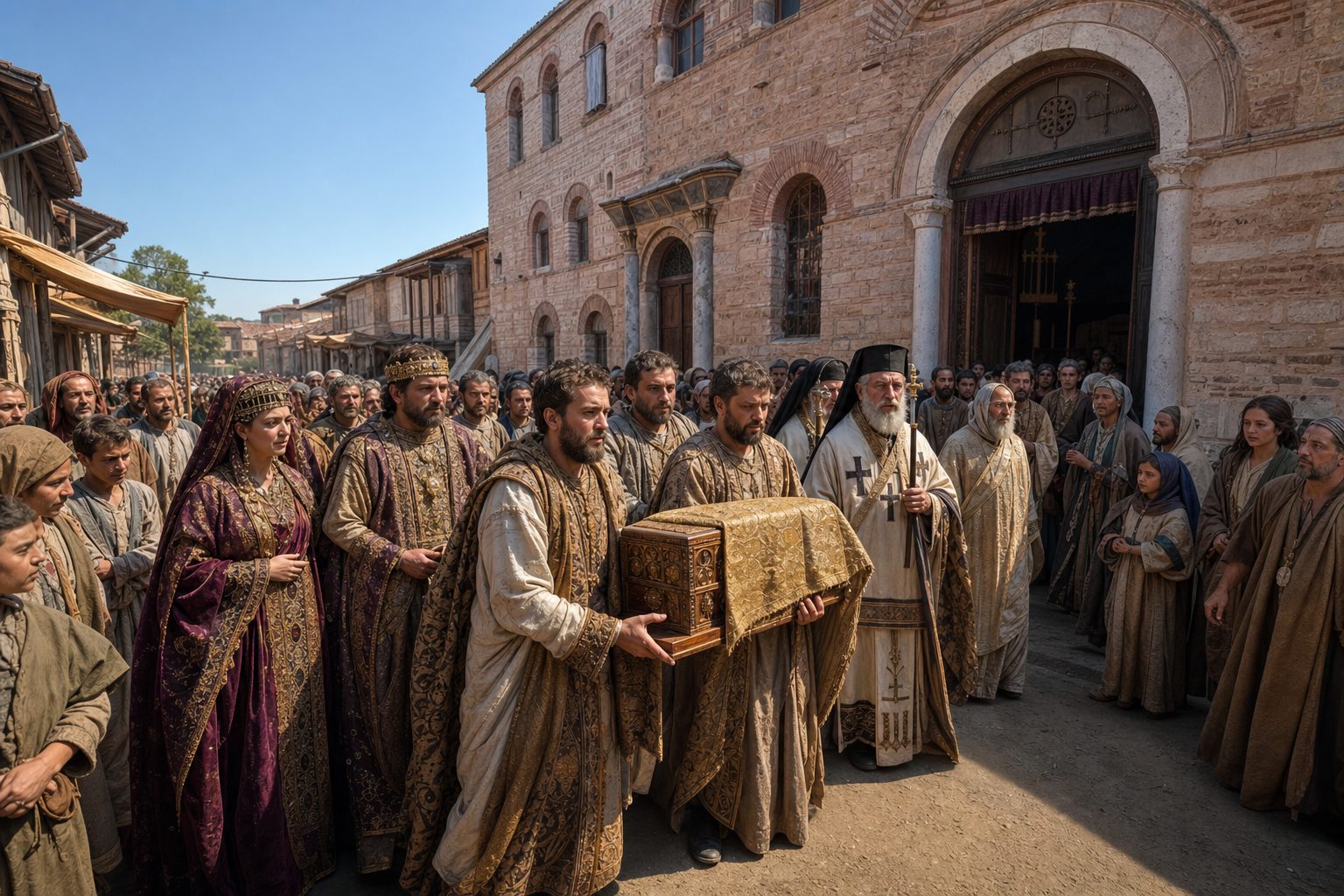
In the reign of the pious Byzantine emperor Leo the Great and his wife Verina, two pious senators, brothers Galvin and Candide, lived in Constantinople. After consulting with each other, they asked the emperor to let them go to Jerusalem to worship the holy places and, having received leave, set off on their way.
When they reached Palestine, they went to Galilee, wishing to visit Nazareth [Nazareth <unk> a small town in Galilee, dear to Christians for sacred memories (in this city our Lord Jesus Christ spent His childhood).] , to see the holy house of the Most Pure Virgin Mary, in which She, <unk> by the archangel's gospel and the prompting of the Holy Spirit, <unk> inexpressibly conceived God-Word.
And they came to a village, and they lodged in the house of an old unmarried woman, a Jewess, and she was chaste.
While the evening meal was being prepared for them, they noticed a separate room inside the dwelling in which many candles were lit, incense was burning, and fragrant fragrance was coming out (for there was hidden the chaste robe of the Most Holy Mother of God).
When they asked the pious woman to share a meal with them, they asked her what was in the room lit with candles and fragrant incense, and why the sick were lying around her.
"Men, " they said", here are many sick people lying in bed waiting to be healed. The blind receive sight, the lame walk, the demons are driven out, the deaf hear, the mute speak, and every sort of disease and infirmity is cured.
And the woman said unto him, We have a tradition among the Jews, that the Lord appeared unto one of our fathers in this place, and that miracles have been wrought in it since the days of Noah.
Hearing the woman's words, Galvinus and Candide became more ardent in their heart's desire to know the truth, like the ancient Luke [Luke <unk> Apostle and Evangelist, companion and collaborator of St. Paul the Apostle. <unk> His memory is celebrated by the Holy Church on October 18 and January 4.] and Cleopas [The memory of St. Cleopas the Apostle is celebrated on January 4.], who said: "Is not our heart burning within us" (Luke 24:32), and said to the woman: <unk> Godly woman!
We beseech thee by the God of the living, that thou shouldest declare unto us the truth; for we have not come this far from Constantinople, but to see all the holy places that are in Palestine, and to offer our prayers unto God.
And as we have heard that there is a holy and miraculous place in your house, we would like to know more about it, how it has been sanctified and why miracles are performed there.
For as I have not yet known the mystery of God, yet as I see that you are godly and godly, I will tell you the mystery, so that what you hear from me may be kept in your hearts. Here I am saved by the grace of God from the Virgin Mary.
When she went from the earth to the heavens, at her burial was one of my ancestors <unk> a widow; she, by the will of the Most Holy Mother of God, was given that honest shirt; she, having received that rose, kept it with reverence all the days of her life; dying, she gave the rose for storage to one of her kind, ordering her with an oath to keep in purity of honor for the sake of the Mother of God herself not only the honest rose of the Most Holy Mother of God.
Our Lady, but also a virgin.
And this maid kept the shirt in great honour all her life, and when she was about to die, she gave it to another maid of her kind, pure and upright; and so for many years the holy shirt passed from one maid to another, and it came to my humble hands, and to me, who was old and pure in unmarried life.
And as there is none of my kindred that is worthy of this mystery, I will speak concerning her unto you, that ye may know that for the sake of this mystery, which is kept in the inner chamber, I have wrought a miracle here, and in Jerusalem, and in the rest of the places where ye are.
When Galvin and Candide heard of the Rosary, they were filled with horror and joy; they promised to keep the secret of the Rosary a secret, and she did not forbid them.
And when they saw the ark of the covenant, and the lamps burning, and the sweet odour of the incense, they bowed down and worshipped the Lord, and wept.
And when they had measured it, they said, "O our Lord!
And when they came to her, they said, 'Our Lord!
And when they were in Jerusalem, and had worshipped the living Cross and the Lord's sepulchre, and had visited all the holy places round about Jerusalem, Galvin and Candide called a carpenter, and commanded him to make an ark out of an old wood, according to the exact form and size which they had shown him.
And when they came to the house of the woman, they presented her with an ornament of gold, and they went on their way to her; and when they came to the house of the woman, they said to her, "Put on the ark of Allah's Mercy, and let us stand before it".
And when they had received leave, they fell down before the ark, and watered the earth with tears, and prayed earnestly to the Virgin Mary that she would not forbid them to touch the ark with the rice, in order to take it with them.
And they took the ark, which they had made of the old wood, and set it in its place, and overlaid it with gold, and remained in prayer until the morning. And when it was day, they thanked the godly woman, and said farewell to her, and gave alms, and went on their way.
When they reached Constantinople, they first told no one about the rice brought to the Most Holy Mother of God, wishing to hide that priceless treasure in themselves.
But when they saw that they could not hide the ark with the holy rose, because of the miracles that came from it, they went to the emperor Leo the Great and his wife, the queen Verena, and announced to him, as well as to the most holy patriarch of Constantinople, Gennadius.
And they went to the house of Galvinus and Candide, and to their church, and opened the holy ark, and saw the holy image of the Most Holy Mother of God in it, which had not corrupted for so many years, and touched it with reverence and fear, and touched it with their lips and their hearts.
Then they took it from there, and carried it with glory in a public ceremony to the Church of the Blessed Virgin Mary in Vlachern and placed it there in a chest decorated with gold, silver and precious stones.
Amen [According to the witness of the Byzantine historian Nicéphore (lived from 1295 to 1360), in the church of Vlachern in the gold-plated ark was stored not only the clothes of the Mother of God, but also the omophore and part of Her belt.
The same is confirmed by the deacon Alexander and the deacon Ignatius, who lived in the second half of the XIV century. <unk> The Vlahern temple burned down on January 19, 1434.
Dionysius, archbishop of Suzdal; in addition, part of the relic of the Virgin Mary is displayed in the Lateran Cathedral in Rome.
Celebration in honor of the position of the Blessed Virgin Mary in Vlahern was established, as noted in the story, in the time of Emperor Leo I, therefore in the half of the V century, but was intensified in 860, under Patriarch Fotius (857-867; 877-886) and Emperor Michael III (855-867) due to the conclusion of peace with Ascalod and Dir and the retreat of the Russians from Constantinople.
They withdrew from Constantinople on 25 June, and on 2 July, after the solemn service in Vlahern, the patriarch and the emperor decided to celebrate the same day in honor of the position of the Blessed Virgin Mary; at the same time, the honorary robe of the Mother of God was moved from their temple, built by Emperor Markian and restored by Emperor Leo I, to the so-called Great Church.]
Our Lady of the Rosary, the veil of men, the veil and the girdle of your pure body, the mighty hail to your imposition you gave us, your seedless birth, the immortal abiding; for you nature renews itself and time.
The garment of all the faithful without blemish, thankful pure, gave thee thy holy robe, and thy holy body covered thee, the covering of all men.