The memory of our holy father Andrew, Archbishop of Crete
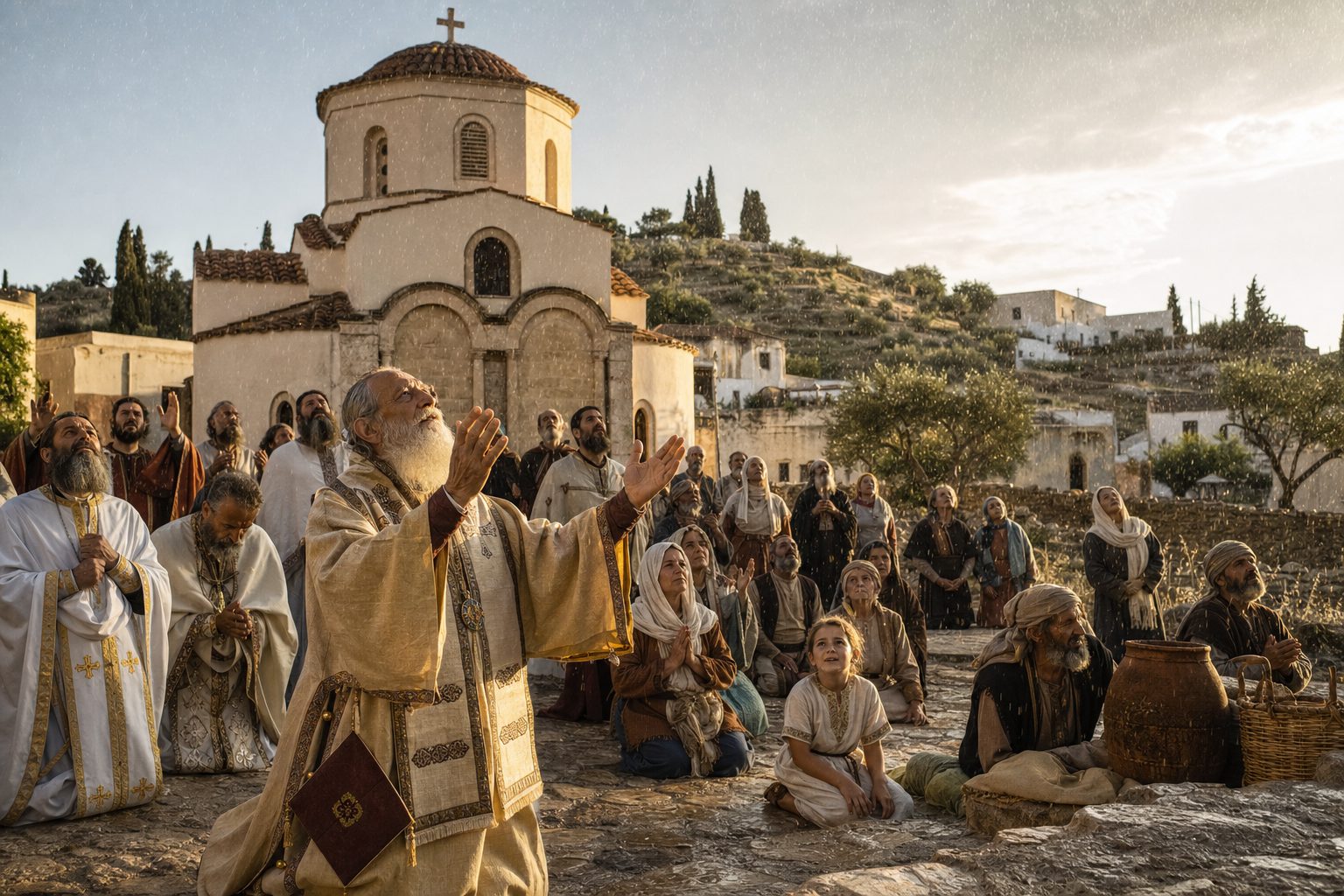
St. Andrew was born on July 4 in the city of Damascus (Damascus - the oldest Syrian city mentioned in the Bible in the history of Abraham (Gen. 14:15)); it was located to the north-east of Palestine, in a beautiful and fertile plain at the eastern foot of Anti-Lebanon. - In the history of the Christian Church, Damascus is remarkable as a place of miraculous conversion to Christ Saul (Acts 9:1-22).
He was mute from birth until he was seven years old, but when he and his parents received communion in the Church of the Sacraments, his speech was restored.
Christ, the true Son of God, who praised Himself with the mouth of this uncircumcised boy, showed how great power is hidden in the pure mysteries Having received through Holy Communion the gift of speech, blessed Andrew was given to the teaching of divine books, and at the fourteenth year of his life was brought to the holy city of Jerusalem to serve God.
And when he had received him, the most holy patriarch of Jerusalem made him a member of the clergy, and appointed him, as a man of understanding, a notary. And Andrew lived a very virtuous life, being chaste, self-controlled, and meek, so that even the patriarch himself marveled at him, and he was pleasing to God and loved by all.
After many years, the sixth ecumenical council of the holy fathers was convened in Constantinople [in 680], during the reign of Emperor Constantine the Brave [Constantine IV (Pogonatus) reigned from 668].
685), against the evil heresy of the monophilous monophilous monophilous monophilous monophilous monophilous monophilous monophilous monophilous monophilous monophilous monophilous monophilous monophilous monophilous monophilous monophilous monophilous monophilous monophilous monophilous monophilous monophilous monophilous monophilous monophilous monophilous monophilous monophilous monophilous monophilous monophilous monophilous monophilous monophilous monophilous monophilous monophilous monophilous monophilous monophilous monophilous monophilous monophilous monophilous monophilous monophilous monophilous monophilous monophilous monophilous monophilous monophilous monophilous monophilous monophilous monophilous monophilous monophilous monophilous monophilous monophilous monophilous monophilous monophilous monophilous monophilous monophilous monophilous monophilous monophilous monophilous monophilous monophilous monophilous monophilous monophilous monophilous monophilous monophilous monophilous monophilous monophilous monophilous monophilous monophilous monophilous monophilous monophilous monophilous monophilous monophilous monophilous monophilous monophilous monophilous monophilous monophilous monophilous monophilous monophilous monophilous monophilous monophilous monophilous monophilous monophilous monophilous monophilous monophilous monophilous monophilous monophilous monophilous monophilous monophilous monophilous monophilous monophilous monophilous monophilous monophilous monophilous monophilous monophilous monophilous monophilous monophilous monophilous monophilous monophilous monophilous monophilous monophilous monophilous monophilous monophilous monophilous monophilous monophilous monophilous monophilous monophilous monophilous monophilous monophilous monophilous monophilous monophilous monophilous monophilous monophilous monophilous monophilous monophilous monophilous monophilous monophilous monophilous monophilous monophilous monophilous monophilous monophilous monophilous monophilous monophilous monophilous monophilous monophilous monophilous monophilous monophilous monophilous monophilous monophilous monophilous monophilous monophilous monophilous monophilous monophilus monophilous monophilous monophilus monophilus monophilus monophilous monophilus mon
The then most holy patriarch of Jerusalem, Feodor, also sent this blessed Andrew, who was then in the rank of archdeacon, because the patriarch himself could not go to the cathedral in Constantinople, as Jerusalem was then under Muslim rule.
They noted in him not only the literary prowess and profound knowledge of the dogmas of the Orthodox Church, but also a holy God-pleasing life.
After the end of the council, St. Andrew returned to Jerusalem and continued his usual divine duties, caring for the orphans, feeding the travellers, serving the sick, as if he were serving Christ Himself.
Here he was a beacon to the world, illuminating the Church of Christ with his divinely inspired teaching and his virtuous life. As an invincible warrior, feared by demons (because he drove them out), Andrew was a menace to heretics.
But the Saracens fought unsuccessfully and with shame retreated, being driven away not by weapons, but by the much more powerful prayers of the saint, which he poured out to God with tears and with them, like arrows, wounded the enemies.
Saint Andrew of Christ wrote many inspired writings and a great canon, which is sung on the fourth of the fifth week of the Great Lent and other canons. He decorated the church with hymns and honored the Virgin Mary with many praises [St. Andrew, Archbishop of Crete, belongs to 20 words of church-doctrinal character.
Among the church hymns he wrote, the most important is the great penitential canon, which is sung in parts on the meratories of the 1st week of the Great Lent, and the full one on the morning of Thursday in the 5th week.]
And when he was come from Constantinople to Crete, the saint saw his death, and said to his dear friends concerning Christ, that he would see Crete no more. And he said good-bye to them, and kissed them, and went forth. And when he was come to Mitylene, he fell sick, and delivered his soul into the hands of God in a place called Iris.
Andrei, archbishop of Crete, succeeded him in 712.] The blessed Andrei with honor shepherds the flock of the word sheep entrusted to him and is counted among the faces of the holy hierarchs who stand before the throne of the Father, the Son and the Holy Spirit, the One God in the Trinity, to Him also be the glory forever.
The most glorious lamp of the world, the brightest of the three, St. Andrew, has come to us, and we cry out to you, pray for us all.
Kondack, voice two.
2 Damascus is the oldest Syrian city mentioned in the Bible in the history of Abraham (c.14:15); it was located to the northeast of Palestine, in a beautiful and fertile plain lying east of Antioch-Livan. - In the history of the Christian Church, it was the site of the Roman Empire (Constantine IV from 685 BC to 680 BC) and was the site of the Roman Empire's 6th Dynasty (see 6th century BC).
6 The heresy of the monophytes consisted in the fact that although they recognized two natures in Jesus Christ, they admitted only one will in Him. 7 His memory is commemorated by the Holy Church on April 21. 8 Justinian II reigned from 685 to 695. 9 St. Andrew, Archbishop of Crete, belongs to up to 20 words of a church-teaching nature.