The memory of our reverend Father Anton Pechersky
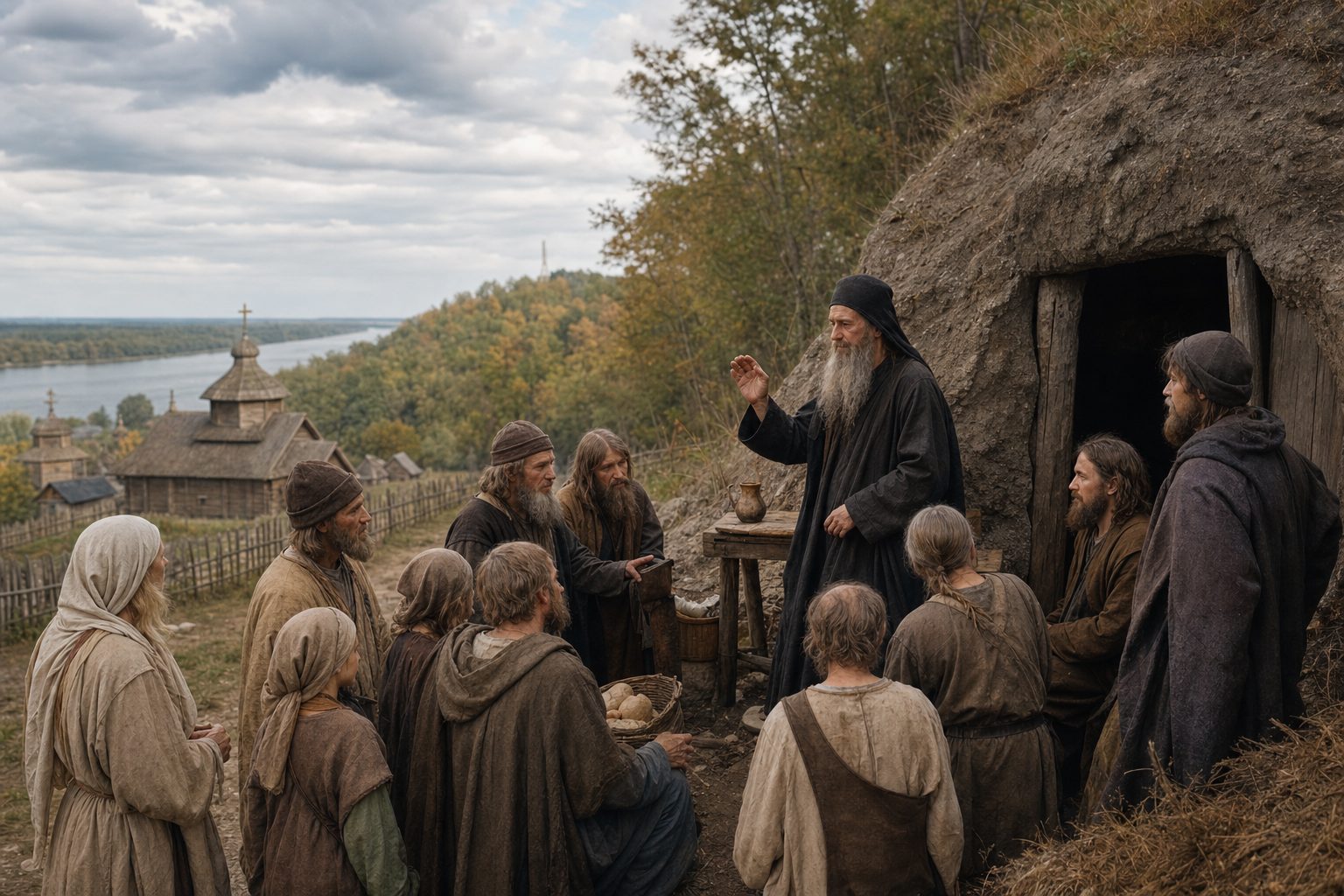
Memory 10 July In the days of the holy and faithful prince Vladimir [understood St. Vladimir the Equal Apostle, enlightener and baptizer of Russia; prince 978 <unk> 1015 g.
The Lord has been pleased to present to the Church a lamp and a mentor for the faithful, a remarkable husband, the reverend and pious Father Antony.
Monsignor Antony was born in the city of Lübech [Lübech, located in the Chernihiv region, <unk> one of the prehistoric cities of Ancient Russia, which existed even before the arrival of the Varangians.
During Oleg's reign, it was among the main cities where his "great princes" sat; then Lübech lost its important political importance.
At present, Lübech <unk> is a city or town in the Chernihiv province on the left side of the Dnieper River, 120 kilometers from Kiev.]
When the God of human kindness put it into his heart to go to Greece and have his hair cut, Anthony immediately carried out his plan, traveling in imitation of the Lord who traveled and worked for our salvation.
Reaching Constantinople, St. Antony headed for the holy mountain of Athos, a narrow mountainous peninsula jutting into the Aegean Sea, known as the center of pagan life in the Greek East.
For the Russian church, almost from the very beginning of Christianity in Russia until the 17th century, Athos had a greater significance: the father of the Russian monasticism, Fr.
Antony; here in the large monastery libraries received the most extensive religious education at that time our monks, who went to Athos (e.g. Prp. Nil Sorski +1508).
There were special translators and census takers, who supplied the Orthodox Rus' with translation manuscripts of church-instructional character.
<unk> As one of the most venerated holy places in the Orthodox East, Athos is visited annually by thousands of male worshippers (women are forbidden to enter the monastery) from Russia, the Balkan Peninsula and the Asian possessions of Turkey.]
who, while in the flesh, were not subject to their natural nature, but were likened to the angels.
And the love of Antony for Christ was more intense than ever, and he went to one of the monasteries of Athos, desiring to be like the above-mentioned fathers, and begged the abbot to place upon him the image of an angel.
Seeing in the future the monastic life of the monk, the abbot did not refuse his request and cut him [With the name of Antony, perhaps expressing the desire that Antony be the same for Russia as Antony the Great, the father of eastern monasticism, for Egypt.
There is, however, a not entirely reliable tradition, according to which Antony bore the name of Antipas in the world.]
The newly ordained nun pleased God in all things, pursuing the path of virtue; but especially St. Anthony excelled in obedience and obedience, so that all rejoiced, looking at his life.
St. Anthony had been on the holy mountain, where he had been shaved, for a long time, being a mentor to save many and reaching great perfection himself, when the abbot received the inspiration from God to let the monk go to Russian land.
<unk> Antony! go back to the Russian land, <unk> may those who live there prosper through you and be firm in the Christian faith; may the blessing of the holy mountain be with you!
Antony stayed in Kiev and did not go to his hometown in Lübeck, probably because in Kiev, "the most successful in Christianity and already had monks", he could rather find competitors in the feat of hermitage.] , he thought about where he would settle, and began to go around the monasteries that had begun
The monastery was founded by Greek monks who came with Metropolitan Michael to baptize Russia; however, these monasteries did not contain the rank and charter of a complete dormitory.
In the eyes of God, none of the monasteries was pleasing to St. Anthony to live in, so he began to walk around Kiev, through forests and mountains, and even reached Brestov.
Finding here a cave, once dug by the Varangians [One can imagine, the great princes kept a detachment of Varangians in their village of Berestovo; the latter dug the caves to store in them, as in a safe place, the war booty.] , the monk Antony, having made a prayer, settled in it, spending his life in great prosperity
I'm going to abstain.
In the name of the good-hearted prince Vladimir, the power was seized by the godless and wicked Sviatopolk [Third son of St. Vladimir], who sat on the grand-duke's throne in Kiev.
Wishing to exterminate his brothers from the face of the earth [The chronicler puts such words in the mouth of the criminal prince: "I will kill all the brothers, and I will take all the power in Russia"] , he killed Boris and Gleb, who thus accepted the martyrdom [Memory of St.
The martyrdom of the martyrs is commemorated by the Orthodox Russian Church twice: on May 2 and July 24.] Seeing such bloodshed, the monk Antony again retreated to the holy mountain.
Yaroslav loved Berestovo [It is difficult to determine in the present cavernous part of Kiev, where exactly the village of Berestovo was located; it can be assumed that it was at a distance from the Cavernous Monastery in the direction of the west.] with its church in the name of the holy Apostles; there was a presbyter, named
Hilarion, a pious man, a great fasting man and a scholar of the divine Book.
(After many years, Yaroslav, who loved to surround himself with spiritual rites, [According to the chronicle, Yaroslav loved church statutes, loved priests and especially monks.
He read the books day and night; he gathered many scribes who copied the already ready Slavic translations, and he also found translators who translated the books from Greek into Slavic.
About this church-educational activity of Yaroslav, the chronicler notes: "As its bo one ravages the earth, another inhabits it, so this one (Yaroslav): his father bo Volodymyr softened the eyes and softened, educated the river by baptism, sowing the same book words in the hearts of faithful people by the will and consent of God".
The bishop of St. Petersburg, who had gathered bishops, elected Ilarion metropolitan, in which he was placed in the Kiev church of St. Sophia [In 1051 A.D.
One work by Metropolitan Ilarion has been preserved, which is a brilliant oratorical work in the full and exact sense of the word.
This work bears the following title: "About the law given by Moses and the grace and truth by Jesus Christ the former, and as the law will depart, grace and truth will fill the whole earth and faith in all languages will spread and to our Russian language, and praise to the kagan our Vladimir, from him also baptized with a bull, and
The prayer to God from all the earth is ours".
Presbyter Ilarion moved from time to time from Brest to the Dnieper, to a hill covered with a centuries-old forest, where now are the distant or Feodosian caves of the monastery; in this hill Ilarion dug himself a cave in two, where he prayed in secret to God, singing psalms and making prostrations.
At that time, the monk Anthony was on the holy mountain, in the monastery of his shaving, and again the monk had a revelation from God: "Let us go", said the Lord, "Anthony again to the land of Russia, for I need him there".
Antony, by the will of God, go again to the land of Russia, and may the blessing of the holy mountain be with you. At the same time, the abbot predicted to the monk that in the land of Russia he would be the father of many blacks.
With this blessing, St. Anthony returned to Kiev, and after climbing the hill where Hilarion had dug the small cave, St. Anthony fell in love with the place and prayed to God in tears.
Lord, let the blessing of the holy Mount Athos be upon this place, and the prayer of my father, who shaved me; and establish, O God, my habitation here. And he chose the cave for his dwelling.
And here lived the monk in unceasing prayer, eating dry bread and satisfying his thirst with a moderate quantity of water, sometimes in a day, sometimes in two; and sometimes he ate nothing for a whole week, being day and night in prayerful vigil and diligently digging a large cave with his hands.
On learning of the saint's residence in the cave, some Christ-lovers came to him here, bringing the necessities for the maintenance of the body and asking for his blessing; there were also visitors who expressed a desire to live with the saint; among the last was blessed Nikon.
Later, the blessed Nikon was the abbot of the cave monastery, the second in the order of Theodosia.]
It was at this time [About 1055-1056] that he came to St. Anthony and St. Theodosius, being a young man of twenty years.
The Feodosia of the Cave is celebrated on May 3 and 31, August 14 and January 11.]: the monk Antony ordered the beard of Feodosia to be cut off by blessed Nikon, a hierarch and an experienced blackbeard.
After many years, when the good-hearted Prince Yaroslav [in 1054] assumed power, his eldest son Izyaslav, sitting at the grand duke's table in Kiev [Grand Prince 1054-1068].
At this time, the monk Antony of the Caves was already famous in all the Russian lands for his many virtues, just as Antony the Great was famous in ancient Egypt.
When he heard of the life of St. Anthony, the Christ-loving Prince Izeslav came to him with his company to ask for prayers and blessings, and the fame of the venerated Saint grew even more.
Among these Christ-lovers came to the Monsignor Antony: first the blessed Barlaam, son of the noble Kiev boyar John, and then Ephraim, the prince eunuch.
He lived in one of the monasteries in Constantinople, from which he was elevated to the chair of Pereyaslav.
It is not known when he died; the last mention of him in the chronicle is dated 1091.
According to their wishes, St. Anthony ordered Blessed Nikon to cut off both of their hair, which caused him and his brothers much trouble.
Not only the angry boyar John, who came to the cave with many of his children and scattered the chosen flock of our holy father Antony, dragged out of the caves his son, the blessed Barlaam, and, having changed his monastic clothes for bright boyars, forced him to his home, but also the great prince Isyaslav himself.
When he heard of the beheadings of the boyar's son and of his beloved eunuch, he too was very angry with the flock gathered together in the name of Christ by St. Anthony; he ordered the arrest of blessed Nicon, who had been bearing the monks' hair, feeding him for this particular malaise; he ordered Nicon to persuade Barlaam and Ephraim
to live in peace again, threatening him with imprisonment with his mentor Antony and all who were in the cave, the very cave the prince intended to dig.
The prince's great anger, aroused by the schemes of the "prince of darkness", compelled St. Anthony and his remaining brothers to withdraw from the cave to another country.
But when the princess heard of this, she earnestly begged the prince not to drive out the servants of God from her region, lest she should incur the same wrath of God that befell her homeland, the land of Leah, by the expulsion of the Negroes.
(The princess, the daughter of the Polish king Bolesław the Brave, was of Polish origin; she reminded the prince of the following incident in the life of her father: for the shaving of St. Moses Ugrin.)
The latter died suddenly, and many bishops and boyars were killed in the ensuing brawl).
The prince finally came to his senses and feared God. He sent a request to the elder to return to the abandoned place; after three days of searching, they barely found St. Anthony and begged him to return.
He kept begging God to give him the strength to endure the scourges of the enemy, the hater of good, and not to give up the souls of his loyal ones to the wild beasts, not to forget his afflicted ones forever.
The Lord heard the prayer of the saint: not only did the scattered sheep return in peace to their shepherd, but many others came to him in the cave, begging him to save them from the darkness of the path that leads to destruction, and to turn to the light of the path of salvation.
Reverend Antony received all with love. After being instructed how to follow Christ, he ordered Blessed Nikon to cut the hair of those who wished.
And twelve men were gathered about the holy brotherhood, and by common effort a great cave was dug, and in it a church and cells were erected, which still exist.
God has gathered you, brothers, and I have shaved you for the blessing of the holy mountain, by which I myself have been shaved by its abbot.
Live alone, and I will appoint an abbot for you; but I will live alone, as I have been accustomed to do in former years. And I have appointed over them the blessed Balaam.
He himself, avoiding revolt and gossip, first locked himself in one cell, here in a cave, and then moved to another hill, where he began to dig a new cave, which is under the present great cave monastery.
The hill of this cave is separated from the hill by the first deep gorge, currently from the nearby to the distant caves by the gallery, thrown through the mentioned gorge, 91 seedlings.
Antony withdrew to the second cave with a small number of disciples who wished to devote themselves to a strict heresy, and afterwards he received to himself those who wished to venture with him.] The blessed igumen Barlaam and the brothers, having received the blessing of St. Antony, remained to dwell in the former cave.
When the number of the brethren had grown so great that the cave could not accommodate them all during the church prayer, it was decided to build a small temple outside the cave.
Father, the brothers are multiplying, and we can no longer place ourselves in the cave during the church prayer. By the command of the Lord and the Most Holy Virgin, and also by your holy prayer of blessing, therefore, to set up a small church outside the cave.
The monk gave his blessing, and they bowed down to the ground and began to build a small church in the name of the Assumption of the Blessed Virgin.
After the construction of the small church above the cave, Prince Izyaslav, in the holy baptism of Demetrius, created a stone temple in honor of the saint, whose Christian name he bore, that is, in honor of the great martyr Demetrius, he built a monastery near the temple.
Prince Izyaslav took the blessed Barlaam <unk>, the brotherhood's abbot, to be the abbot of this monastery: hoping for wealth, he wanted to build his monastery in front of the cave monastery.
But though there be many monasteries built by the riches of kings and boyars, they cannot be compared with those built by the prayers of saints, by tears, by fasting and vigilance.
However, Blessed Barlaam was taken to the monastery of the holy great martyr Demetrius at a time when the Cave Monastery was just being built.
"Father", they said, "send for us an abbot". "Who is it you want?" the abbot asked. "God, the Holy Mother of God, and you, the honorable father", they answered.
"The one of you", decided St. Anthony, "who distinguishes himself by obedience, meekness and humility, let him be your abbot.
To the brothers who had asked to appoint an abbot, Antony gave the following answer, pointing directly to St. Theodosius: "Whoever is sick among you, as Theodosius, obedient, gentle, humble, let him be your abbot".
Then the brethren began to ask St. Anthony to bless St. Theodosius as an equal to him and skilled in all good works; and St. Anthony blessed him.
And all the brethren, twelve in number, bowed themselves to the face of the earth before St. Anthony, rejoicing that they had received such a teacher.
Having become an abbot, the monk Theodosius began to care for the monastery with increased care, adding to these concerns great fasting and tearful prayers; great assistance was given to him by the prayers and blessing of his superior, the monk our father Antony, who was silent alone.
And the Lord began to multiply the black-haired, so that soon there were about a hundred men under the leadership of the holy Theodius. The holy Theodius, seeing this increase of the brethren, came, after consulting with her, to the purpose of erecting a monastery.
Father, the brothers are increasing in number, and we want to build a monastery. Monsignor Antony rejoiced greatly. "God be praised", he said.
And he sent one of his brethren to the king of Israel, saying, O king, Christ-loving, God has multiplied brethren, and the place where we dwell is strait: give us, we pray thee, the mountain that is over the cave.
When Prince Izyaslav heard this, he was very happy; he sent his coward to give the monks the mountain above the cave.
The monk Theodosius and his brothers built a large wooden church on it and, after rebuilding it, they decorated it with icons; they also placed celli, and the monastery itself was surrounded by columns, and they moved here from the cave.
From that time on, the monastery, begun with the blessing of the holy mountain, began to be called Cave Monastery, because the blackheads lived in the cave before [According to the chronicler, the monastery was built not by Theodosius himself, but by his predecessor in the hierarchy, Varlaam.
However, it can be said that the monastery was built no later than 1062. After 11 or 12 years, Theodosius began to build a new, more extensive monastery on a new site across a ravine from the first monastery near the second cave on Antony Street.
Feodosia did not finish building the new monastery - it was his successors in the hierarchy: Stephen, Nikon and John.
The old or worn-out monastery, after the transfer of the brotherhood to a new one, was not destroyed: the cave where it was located was turned into a burial ground for the brotherhood; for its burial in the old monastery there were several men of the brotherhood, including their presbyter and deacon for daily performance in the church.
The monastery of the funeral liturgy "for a dying brother".
After this, the monk Theodosius decided to establish his monastery with a mental enclosure, that is, a charter defining the life of the monks not in prison, but in the monastery: he began to search for a suitable monastery charter for this purpose.
And in this case he was hastened by the prayer and blessing of our holy father Antony: by his blessing and prayer the Lord arranged that just at this time there was only an honest nun of the Studium monastery, named Michael, who came from Greece with Metropolitan George [Chronicle]
He mentions it as 1072-1073.]
He had a statute of the Studio Monastery [The statute was strictly dormitory, not allowing the monk to have anything of his own even needles.
Theodosius indicates another source for the latter's receipt of the Studio Charter: Theodosius, <unk> he writes, <unk> sent one of his brothers to Constantinople to the cobbler Ephraim (see above, ap.
21), and all the statutes of the monastery of Studium (which was in Constantinople) he wrote down and sent to him; he immediately carried out the command of our father and the whole monastery charter by writing an ambassador to our blessed father Theodosius.] .
Having written this statute, of course, in a translation from the Greek, the monk Theodosius, deciding to introduce it into his monastery, laid down the whole "church order" <unk> how to perform liturgical singing and reading, and bow down to them; how to stand in the church and spend time at the table; what to taste at it and on what days.
From the Cave Monastery, all other monasteries adopted the Studio Charter; thanks to this, the Cave Monastery has the advantage of primacy and honor before all other Russian monasteries.
In the days of the abbotship of St. Theodosius, who directed by means of the new charter and with the prayers and blessings of St. Anthony, the life of the Cave Monastery along the path of virtue, came to the monastery, being a seventeen-year-old boy, and St. Nestor, the scribe of our life.
St. Theodosius, who received with love those who came to him, willingly received him, on the advice and blessing of St. Antony.
Asking why exactly the monastery is called Caves, Nestor briefly, for the sake of the believers, in his chronicle reported on the feats of the original head of the monastery, the monk Antony.
Nestor, and some other nun of the Cave Monastery, probably Silvestre, later the abbot of St. Michael's Monastery in Kiev.]
But let us say something about the miracles, though not all, as well as <unk> about the honourable death of St. Anthony, borrowed the information from the blessed bishop Simon and the close to him monk of the cave Polycarp [Simon <unk> the barber of the cave monastery; from here he was taken the veil.
He was appointed the first bishop of the diocese of Vladimir, which was separated from Rostov in 1214. Simon died in 1226 after a twelve-year reign.
Polycarp, also a Cave monastery priest, from where he was twice elevated to the position of abbot and twice returned from there to the Cave monastery; later he was abbot of the Cave monastery (see his life on the 24th of this month).
From the letters of the latter to Aquinas, the archimandrite of the cave, which contain a number of tales about the cave miracle workers and the miracles that took place in the monastery itself during the construction of its great church, the famous cave paterick was composed (the father, the father's book,
I mean,
The book of the fathers or about the fathers).] and leaving for now the testimony of the chronicler about the most feats and misfortunes endured by the monk.
Our reverend Father Anthony, isolated in another cave, seeing the multiplication and goodness of the chosen flock, sent thanks to God, prospering himself in virtue from strength to strength.
For this, the Lord glorified him, because the name of St. Anthony shone in the land of Russia with various miracles and especially with the gift of healing and prophecy.
The old man himself ministered to the sick and healed them by his prayer; but, covering these healings with humility by his prayer, he blessed the sick with the herbs that he ate as medicine; the sick, tasting it, became healthy, whatever disease they were possessed by.
Later, the blessed Agapit became an imitator of St. Anthony, healing diseases in the same way. The gift of the foreknowledge of St. Anthony, besides other examples, is attested by the following.
Three princes Yaroslavovich, <unk> Izyaslav, prince of Kiev, Sviatoslav of Chernygov, Vsevolod of Pereyaslav, going to war with the Polovtsians [Polovtsians or Kumans <unk> a Turkic nomadic tribe, living in the X-XIII centuries.
And when they saw that they were in the wilderness, and that they were in the land of the Chaldeans, and that they were in the land of the Chaldeans, and that they were in the land of the Chaldeans, and that they were in the land of the Chaldeans, and that they were in the land of the Chaldeans, and that they were in the land of the Chaldeans, and that they were in the land of the Chaldeans, and that they were in the land of the Chaldeans, and that they were in the land of the Chaldeans, and that they were in the land of the Chaldeans, and that they were in the land of the Chaldeans, and that they were in the land of the Chaldeans, and that they were in the land of the Chaldeans, and that they were in the land of the Chaldeans, and that they were in the land of the Chaldeans, and that they were in the land of the Chaldeans, and that they were in the land of the Chaldeans, and that they were in the land of the Chaldeans.
Because of your sins, you will be defeated by the barbarians and forced to flee, and many of your soldiers will drown in the river, some will be taken captive, and the rest will fall by the sword.
At this time, the princes, barely saving their lives, fled: Izyaslav and Vsevolod to Kiev, Sviatoslav to Chernygov; the Polish were scattered across the south-eastern outskirts of the Russian land, capturing and killing its inhabitants.
Along with this prophecy to the princes, St. Anthony predicted to Simon, the son of a Varangian African prince, that Simon, by the grace of God, in the mentioned battle, would not only avoid death, already among the corpses, but, after many years, would be the first to be laid in the stone cave church, which, according to the legend, was built in the 16th century.
The Reverend also foretold that it would be miraculous.
Simon himself, returning from the battle, told St. Anthony: "I was lying wounded among the slain, and some divine power snatched me out of their midst and healed my wounds; all my relatives and soldiers I found also unharmed.
I have seen the likeness of the church that is to be built, which will be my resting place, twice in the air once by the river Alta, being among the slain, and the other <unk> earlier at sea, when I fled to the Russian land to Prince Yaroslav from my uncle Yakun, who had driven me from the Varangian principality.
Then Simeon confirmed his words about God's favor to him for the foundation of the church foretold by St. Anthony. Simon handed him a belt and a golden crown with the words: <unk> This I took from the icon <unk> the crucifixion of Christ the Saviour when I left my homeland.
Thou didst foretell that I should be buried here, but I had the voice of God instructing me that with this girdle the foundation of the church should be measured, where I should be laid, and the likeness of which I was shown in the air; and the crown should, according to the same divine command, be fixed upon the altar.
Thus it was clear that St. Anthony's prediction was in harmony with God's will; this was later confirmed by the fact that many years after the above, Simon was the first to be laid in the god-given cave church.
Now, returning to the chronicle, let us tell of the next great plague suffered by St. Anthony.
The prince of darkness <unk> the devil, not bearing the light of good deeds, tried again through Prince Izyaslav to deprive the table Kiev of the great lamp, the revered father of our Antony, shining in the dark cave, just below, miracles and virtues.
After the victory of the half-breeds in the above-mentioned battle, according to the prophecy of St. Anthony, the people of Kiev forced Prince Izeslav to go out again with them to the enemies scattered over Russian land.
In 1068, a revolt broke out, during which the Polotsky prince, who had been in captivity in Kiev, was released.
After seven months, he returned from there to Kiev with Boleslav the Brave.
He began, at the devil's instigation, to be angry at St. Anthony, whom someone had slandered before him, <unk> that as if Antony loved Alloslav, giving him advice, that he was even the main culprit of all the confusion that took place in Kiev [Alloslav was captured by violating the cross kiss.
Perhaps Antony openly denounced Izyaslav for this, and the latter could see in these denunciations the reason for the indignation of the Kievans.]
St. Anthony was at that time serving in the cave to the sick recluse Isaiah, who was seduced by the devil, appearing in the image of Jesus Christ, and barely left alive, getting involved in a dance with the demons.
This service of St. Antony was especially hated by the deceiver, who feared that Isaac would soon be healed of the satanic temptation, so the devil did everything in his power to provoke the anger of Prince Izyaslav, so that he would expel St. Antony from the borders of Kiev.
Prince Sviatoslav of Chernihiv, learning that his brother Izyaslav was very angry with St. Antony, sent for the saint at night and secretly took him to Chernihiv.
St. Antony liked one place near Chernygov in the Boldy mountains: here he dug a cave for himself and lived in it; subsequently, a monastery was founded on this site [Uspensky on Boldy mountains or Boldy, currently Uspensky Yeltsky.
It is thought that the monastery was built by the monk's disciples near his cave.] Prince Izyaslav, having examined the case carefully and impartially, soon became convinced of the saint's goodwill and learned of the tempter's schemes.
Regretting what had happened, he sent a message to the Chernihiv area to the monk Antony, begging him to return to the Kiev region to his chosen flock.
St. Anthony, a meek and humble-hearted hermit, yielded to these requests and returned to his cave brothers, who were in confusion and oblivion like sheep without a shepherd.
God did not want such a lamp, the bright sun of the Russian land, our reverend father Antony to lay the foundation of a pious pagan life in any other city than the God-saving capital of Kiev: but where did the light of the Orthodox faith shine through the good prince Vladimir into the whole Russian land,
And from thence the Lord was pleased to send forth through St. Anthony the ray of the perfected law of the martyrdom.
And after such tribulations, our reverend father Antony did not weaken, but, climbing the ladder of greater and greater feats, he labored in the cave until he gained complete victory over the weakness of the devil's power before him.
According to the Gospel account, he drove out this kind of hypocrites by prayer and fasting [Mark 9:29] as well as by other hard-working feats: watchfulness, standing, and countless kneeling in prayer.
And until his death he never left his dark cave, although his life there was a constant struggle with the peacemakers of this dark age.
He took great care to take care of the stone cave church, which he had predicted would be built, having also received a certificate of God's favor from Simon.
May he bless with his own hands and help to build the house of his most pure Mother, the Lord of our Goddess, for, as David said, "Unless the Lord builds the house, it is in vain that its builders labor" (Ps. 126:1).
When St. Antony prayed, a wonderful miracle happened: without leaving the Cave Monastery, as a once famous miracle worker, St. Nicholas of Myra, he and his one-eyed friend, St. Theodosius, appeared in Constantinople, presenting the Queen of Heaven, the Most Holy Mother of God.
He received the gold from her with the holy Theodosius and gave it to the masters-stonecutters, so that, by the order of the Heavenly Queen, they would go to Russian land to build a cave church.
The stonemasons came from Greece and reported this miracle, and our venerable ancestor Anthony did many other miracles like the ancient prophets Gideon and Elijah.
When the stonemasons began to ask St. Anthony where he wanted to build the temple ordered by the Most Holy Mother of God, St. Anthony prayed for three days that the Triune God would show him a sign from heaven, a place worthy of the heavenly Queen's residence.
When they were assembled to choose a place, according to the divine inspiration, Prince Svyatoslav came and gave the church his field adjacent to the cave, but that was not enough.
"Antiochus", the Lord said, "you have found favor in my sight.
When St. Anthony heard this, he asked the Lord that on that night there should be dew over all the land, and on the supposed place for the church dry land; on the other night he asked the Lord for dry land, and on the place pleasing to Him for the temple, dew.
Antonia was similar to the prayer of the Israelite judge Gideon (Judges 6:36-40).]
On the third day, the holy father blessed the place and ordered it to be measured with a golden belt, taken from the icon of the Savior and received from Simon, <unk> in thirty belts in length and twenty in width, as was commanded to Simon from above.
Then St. Anthony lowered his fire with his prayer.
3Ki 18:36-39).] who destroyed the growth of the place, which, after being surrounded by a ditch, was already completely ready; here was placed a miraculous cave church, "like heaven" according to the expression of the tale about it [This saying is placed in Minii-Chetia under the 14th day of August.] .
Thus, by such great miracles, St. Anthony prepared a place for the temple of his abbey and blessed the very beginning of its construction.
Then he began to prepare himself for the departure to the eternal Church, not made with hands in the heavenly places, of which the holy apostle John writes in Revelation: "I saw no temple in it [i.e., no temple of God] . . .
(Revelation 21:10, 22) This is what the Queen of Heaven foretold when she appeared in the Vlahern [the place in the Kingdom] and revealed to the church builders:
<unk> This Antony will only bless you for the work, for he himself goes to eternal rest; in the second summer, Theodosius will follow him.
But what preparation for an honorable death did St. Anthony need, who, living a virtuous life in a cave, could say with the Apostle: I die every day (1 Cor. 16:31)? who did not falsely apply to himself all the days of the prophet's words: (I hastened and did not delay to keep your commandments (Ps. 118:50)?
St. Anthony was ready in his heart, and was troubled not for himself, but for his chosen flock, lest he should be troubled.
For I am torn between the two: I desire to depart and be with Christ, which is far better; but to remain in the flesh is more necessary for your sake.
Seeing that the time of his departure from the body was at hand, St. Anthony comforted his children by promising that, after his departure, he would not leave that holy place where he had made his home, but, caring for the monastery, would always visit and watch over it, helping those who lived in it and those who came to it.
I believe in it.
But most precious of all legacies is the following beneficent promise of St. Anthony about the place of his exploits: he promised by his prayers to intercede that as he himself departed from the body with repentance and confidence in forgiveness, so would the rest who are here be like him.
and those who love him, so that they too may die in repentance and receive mercy.
When he entered the second cave, St. Anthony stayed there for 14-16 years, ending his temporary life there on the 10th day of July, from the creation of the world in 6581, from the birth of Christ in 1073, and from his ninetieth birthday, to the reign of Sviatoslav Yaroslav.
[Prince of Kiev 1073-1075] and in the days of the Greek king Roman Diogenes [Probably during his successor Michael VII Duke, whose reign falls on 1074-1078] .
The relics of the monk were then placed in the cave where he lay, that is, in the cave under the great monastery.
But as the reverend father himself during his life withdrew from the sight of men, secretly praying to God in solitude, so he asked his dead for the same gift, <unk> let them be removed from the sight of men: it was fitting for our Russian legislator to have the same fate as the Israeli.
The Israelites could not look at the face of Moses because of the great radiance emanating from him since he brought them the law from Mount Sinai [Ex. 34:29-35]; nor could they see our revered father Antony, in the light of the good deeds of the one who lived in the cave, after he brought the Russian law to the land from the mountain
I'm here to see you.
The body of the Israelite lawgiver <unk> Moses was hidden from view [Deut. 34: 6], and the body of St. Anthony, the Russian lawgiver, God, marvelous in His saints, still miraculously forbids us to see: many who dared to dig the place where the honest remains of St. Anthony are laid punished
They will be scorched by the fire, and they will be tormented by the most terrible torment.
But though the relics of St. Anthony are removed from our sight, yet they are always with us and near to all who earnestly call upon the will of God: they work miracles without ceasing, helping all who come with faith to the honorable coffin of St. Anthony.
Like a light shining in the darkness of a dark tomb, they drive away the devil's darkness from men with a special power; this darkness cannot embrace this light, but usually disappears from its brilliance.
St. John the Sufferer understood this well: after three years' struggle with unclean passions, which had caused him much torment by the fire of fleshly lust, he came to the tomb of St. Anthony and there he spent day and night in prayer.
John, John, you must be confined to this cave, so that, by God's grace, the battle won by solitude and silence may end.
And by the grace of God through the prayers of our holy father Antony, he was saved: the unclean passions of the flesh, although armed against him with unclean spirits for almost thirty years, however, as we see from his life, did not overcome him.
Reverend Anthony did not leave his saint's place, as he promised.
Taking care of him, he, according to his pretence, as before during his life, appeared together with the monk Theodosius in Constantinople and here agreed with the Greek icon painters regarding their making of honest icons for the cave church; at the same time he handed them quite a lot of gold, as before.
To the temple builders with the same reverend Theodosius.
Monsignor Antony sent the icon painters to Kiev to the Cave Monastery to the blessed Nikon, who was then the abbot; this is reported in the story about the decoration of the cave church [See this story in Minneia-Chetia under the 14th day of August.] .
Our reverend Father Anthony was not a liar in his good promise to help those who loved him after his passing, so that they would end their lives spent in his holy place in repentance and obtain the mercy of the Lord.
This word of his promise was miraculously fulfilled in the case of Blessed Erasmus, a black-bearded Caveworker, lamenting the waste of gold he had spent on decorating the cave church.
And he lay there in a terrible sickness seven days, unconscious, and apparently about to die, but he could not lie down, for the Lord would not have him die on that day.
A holy place without repentance.
And it came to pass on the eighth day, that St. Anthony came to blessed Erasmus, with St. Theodosius, and said, We have prayed to God for thee, and he hath given thee time to repent.
Erasmus was immediately healed, repented of his sins, and died on the third day in God's mercy.
Let us praise the all-powerful Man-Lover for the gift of such a great miracle worker as St. Anthony, the originator of the Russian paganism in our land.
No man can describe all his deeds, especially those done before the performance, for he lived in secret, in the silence of cave solitude; this is accessible only to the Knower of Hearts, who knows the unknown and secret; He whose tongue is the scribe's staff (Ps. 44:2), He Himself
I have written the vast life of our reverend Father Anthony in the books of the eternal life.
But we, who have not found many books, who have been lost in many battles, who have gathered only a part of the information, ought to pray earnestly to this wondrous originator, that we, having received his good promise, may, by his intercession, reach the end of life in repentance and faith.
Forgive us from God, <unk> let us make our names written in the book of eternal life with the name of St. Anthony, as the names of children and fathers, by the grace and humanity of the supreme head of our salvation, our Lord Jesus Christ, to whom belongs honor and glory with his eternal Father and the One-Existent Spirit,
Glory and power now and forever and ever.
Amen, footman, fourth voice.
He came out of the rebellion of the world, but by rejecting the world of the gospel, he followed Christ, and after living an angelic life, he reached the quiet sanctuary of the holy mountains of Athos: from there, with the blessing of the fathers, he came to the mountain of Kiev and there, having lived a hard life, he enlightened his homeland, and many
The monks have seen the way to the kingdom of heaven, and Christ has led us there. And he prayed, St. Anthony, save us.
And when he had given himself up to God, to the beloved of his youth, he was devoted to him, and his love followed him with all his soul. And when he had found the world, he made a cave in the earth, and there he made a stronghold against the invisible enemy, as the bright sun shone upon the ends of the earth.
From thence, rejoicing, thou art gone to the heavenly palace, and now with the angel of the Lord before thee, remember us who honor thy memory, and we cry unto thee: Rejoice, Antony, our father.