A remembrance of the miracle of St. Euphemia the Great Martyr
The memory of July 11
Saint Euphemia was born, raised and martyred in Chalcedon, the city of Viennese, which lies at the mouth of the Black Sea, opposite the city of Constantinople, on the other side of the Thracian Bosphorus.
half of the Roman Empire from 284 .
On the sixteenth day of September, when her memory is celebrated, we remember the miracle which was wrought by her honourable relics at the fourth ecumenical council of the holy fathers, which took place at Chalcedon, and by which the Orthodox creed was revealed and confirmed.
A sign to the holy fathers not to be joined with the ungodly, and this happened.
Patriarch Dioscorus of Alexandria and Eutychius, archimandrite of Constantinople, were martyred during the lifetime of the Orthodox king Feodosius [Feodosius II ruled from 408 onwards.
In 450 A.D. , they raised a blasphemous heresy against our Lord Jesus Christ, fusing His two natures, divine and human, into one nature.
taught that humanity in Jesus Christ was completely absorbed by divinity and therefore in the Person of Jesus Christ there should be only one nature <unk> divine.
This heresy was condemned at the Fourth Ecumenical Council.]; they seduced many clergy and laymen with their mistrust, led many noble courtiers into heresy and widely enjoyed their support.
When a local council met in Ephesus [449 C.E.] (a few years after the third ecumenical council held there in 431 C.E.) it was convened by Emperor Theodosius II over the heresy of Nestorius, the patriarch of Constantinople, who taught that the incarnation of the Word
God was simply His dwelling in the man Christ, and not the union of divinity and humanity in one Person.] ), or, to put it more accurately, a robbery gathering at which the most holy Flavian, patriarch of Constantinople [Flavian (I) patriarchated from 447 onwards.
He was martyred in 449 A.D. He is commemorated as a saint. <unk> His feast day is 18 February.], a devout confessor, was killed by his fellow believers Dioscorus and Eutychius, <unk> then the heresy became even stronger and began to be accepted as a belief, but the true Orthodox faith was rejected as some kind of superstition.
It was necessary to convene the fourth ecumenical council of the holy fathers to stamp out this heresy and to establish the Orthodox faith.
At this time the pious king Theodosius passed from this life to the Lord, and after him the virtuous and God-pleasing Markian [Emperor Markian ruled the East from 450 to 457 A.D.] took the kingdom with the holy Pulcheria.
These zealots of orthodoxy and piety, seeing how heretics were troubling the Church, and what dissensions there were, commanded the holy fathers of the whole universe to assemble in the glorious city of Chalcedon, to consider and discuss the questions of faith.
<unk> It was the Ecumenical Council, among them the most holy Anatoly, patriarch of Constantinople, the most holy Juvenaly, patriarch of Jerusalem and the envoys of the most holy Leo, pope of Rome; there were also the evil believers led by Dioscoro, patriarch of Alexandria, Maximus <unk> of Antioch, to whom Dioscoro
And Eutychus, and his fellows, and a great multitude of heretics; and they gathered together with the holy fathers, to a council in the church of the holy great-martyr Euphemia, which was in the suburbs of the city, about
The Bosphorus.
It was the throne church of the metropolitan city of Chalcedon, very spacious, able to accommodate a large crowd of people; it contained the powers of this great martyr, who performed wonderful and glorious miracles, to name a few.
On the holy day of her memory, on which she suffered for Christ, every year her blood flowed from her honest relics, as if freshly drained from the wounds; it was collected as follows.
The coffin was a large marble, covered with a marble board, and inside it was a wooden coffin with the relics of the saint; in this marble coffin, on the left side, there was a small hole, into which the hand passed and which was closed tightly, and at the right time opened; through it the bishop himself
At the end of the night, before the holy liturgy, he would draw the blood by means of a sponge tied to a long iron handle; he would put a dry sponge in it, draw its whole blood out of it, and squeeze the blood out of the sponge into a vessel specially prepared for that purpose.
When the people saw this, they praised God and his holy martyr.
The blood of the Lamb had a sweet odor, like that of myrrh, the most precious perfume in the world. This perfume was superior to perfume and had the power to heal every disease.
And not only during the annual celebration of her holy martyr did she pour such fragrant peace and healing blood from her honest relics, but sometimes at other times, especially if the saint of that church was pleasing to God by his virtuous life.
There were also many apparitions; often the saint appeared praying to her with faith, or lying in sickness, or coming to the church to her coffin, or being in various troubles and calling her for help.
And the people came with great faith to worship her at Chalcedon from all parts, from all cities, and especially from the vicinity of the royal city.
And there was much contention and strife between the saints and the heretics, because the heretics would not consent to the teaching of the church.
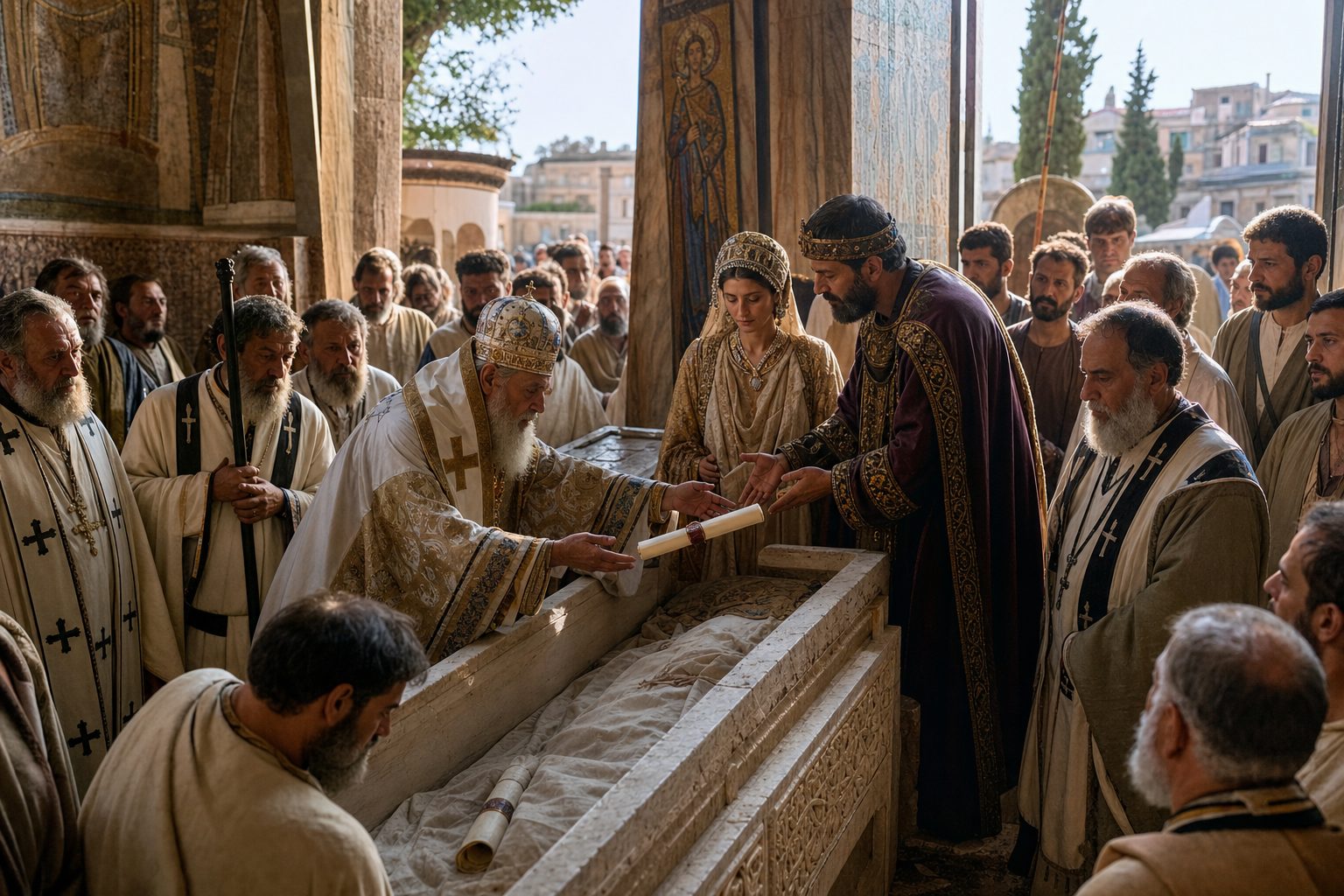
Write the confession of your faith, and we will write our confession, and the two scrolls, sealed, we will put in the coffin to the honourable relics of the holy great martyr Euphemia. Let us fast and pray together to God, that he may reveal to us by his grace what is the right confession.
After these words of the most holy Anatolian, all approved his counsel, and wrote two scrolls: the righteous theirs, and the wicked theirs, sealed with their seals, opened the sacred coffin, placed both scrolls in her chest, closed the coffin again, put the royal seal, put in custody and fasted and prayed for three days.
On the fourth day the king and all the council came to the holy coffin, and when the king's seal was removed, the coffin was opened, and the scroll of the faithful was in the right hand of the holy high priestess, and the scroll of the wicked lay at her feet.
But the most amazing thing was that she, stretching out her hand as if alive, gave the king and the patriarch the scroll with the right confession.
And immediately they declared the Orthodox faith to be established by God and miraculously proclaimed a holy great martyr, and the heretical disbelief was condemned.
From that time on, the iconographers began to depict the holy great martyr Euphemia with a scroll in her right hand, in the unforgettable memory of this glorious miracle during the council.
Many years passed; the throne was taken by Mauritius, a pious king, but he, in his disbelief, dared to doubt the miracles of the saint and the blood flowing from her relics was considered fake, not real.
Long before the anniversary of the holy martyr, he sealed the coffin and the hole in it with his royal seal.
And when the day of her feast came, he himself came from the palace to Chalcedon, and unsealed and opened the opening; and immediately the sweet fragrance spread and filled the whole church; and blood, or rather, a world like blood, flowed from the holy relics more than usual;
I have not spent so much time in this, as to shame the king's unbelief and to strengthen faith in the power of God, by whom all supernatural things can be accomplished.
The Lord, who in ancient times could bring out of the bone of an animal, from the jawbone of an ass, for Samson [Samson <unk> Judge of Israel, God-given extraordinary strength and former instrument of God against the Philistines.
The story of his life and activities is told in the book of Judges (chapters 13-16).] the source of the spring water (Judges 15:18-19), could he not then spill blood and myrrh from the incorrupt remains of his concubine?
Later, during the reign of Heraclius, with God's permission, the Persians invaded the country of Viennese and the vicinity of Chalcedon, so that the whole suburb, according to the barbarian custom, was desolated.
The enemies entered the church of the Holy Great Martyr and took everything they could find; they wanted to open the holy coffin, but they could not do it and, no matter how hard they worked, they did not achieve anything: not only the upper marble board remained stationary, but even a small hole in the coffin could not be made.
And the Persians brought wood and stubble, and covered the coffin, and set a mountain of fuel upon it, and kindled a fire upon it, that the marble might crack; but they were not able to do so; for the coffin was burned with fire, but the coffin was not broken.
When the Persians left, the king consulted with the patriarch about the relics of the holy great martyr Euphemia, and they decided to move them from Chalcedon to the Castle, fearing a second invasion of the barbarians on Chalcedon.
In the city, near the hippodrome, they built a church in the name of the saint, like the Chalcedonian one, large and beautiful, moved into it with honors the holy relics with a stone coffin; they determined to be a metropolitan of Chalcedon for the sake of greater honor to the relics.
The grave was placed on the altar instead of the divine altar, and an unbloody sacrifice was made on the grave; inside were the honourable relics of the great martyr; from them miracles were performed in the palace, as at Chalcedon, and blood, fragrant with peace and healing, was shed at the usual time.
Many years passed, many kings changed, the ecumenical councils of the holy fathers <unk> the fifth and sixth [V Ecumenical Council took place in Constantinople in 553.
It was convened by Emperor Justinian I (527-565) to settle the issue of the orthodoxy of three bishops: Feodor of Mopsuet, Feodor of Cyrene, and Iva of Edessa, who expressed Nestorian views in their writings.
In Constantinople, under Emperor Constantine IV Pogonat (668-685), his immediate task was to denounce and condemn the heresy of the monophysite, which recognized only one (divine) will in Christ.]
The Isaurian reigned from 716 onwards.
He was the first to confuse the Church of God with an anti-iconic heresy, calling holy icons idols and reasoning with his fellow believers as follows: <unk> These are the ones about whom the prophet says: "They have mouths, but they do not speak; they have eyes, but they do not see; they have ears, but they do not hear" (Ps. 113:13-14).
He was opposed by the most holy patriarch, Herman.
730 C.E.) ; the king dishonourably deposed him, and in his place appointed a heretic, his co-thinker; similarly, he dishonourably banished other Orthodox bishops who opposed his heresy.
And when he saw and heard of the miracles of the holy great martyr Euphemia, he was troubled in his soul with envy, but he dared not do them any harm, for fear of the people's rebellion.
He devised this insidious scheme, and he went with his companions secretly by night to the church of St. Euphemia, and opened her coffin, which the Persians could not open: Christ God allowed the hands of the wicked Christians to touch the honourable remains of his bride, which he had preserved untouched by the infidel pagans.
The Persians sinned in ignorance, and the Christians dared to do evil, knowing what they were doing; God permitted them, to their greater condemnation, to commit sacrilege.
And the wicked king opened the coffin, and with the wooden coffin he brought forth the miraculous and incorruptible relics of St. Euthymias, and put in their stead some rotten, stinking bones, which he had purposely prepared for this purpose, and again he covered them with a board, and went away, taking with him in the form of a thief those honourable relics, and laid them in one
From the rooms of the royal palace.
And his sisters and his daughters went in secret to the holy shrines, and burned incense, and lit candles, and worshipped them, and worshipped them.
In the morning, he gathered a mob of evildoers and began to mock the righteous people, mocking and rebuking the power of the holy great martyr: "Go, fools, see the deception with which you are deceived, calling the power of the glorious Euphemia incorruptible and miraculous, open the coffin and see if it is true.
And he sent his servants with his people to open the sepulchre, and they went and opened it, and behold, all the bones were rotten, and they stank.
Then many thought all the holy wonders to be a fraud, and spat on the rotten bones, and cast them out, and also that marble coffin was taken out of the church, and the temple of God was made an abomination of desolation; it was greatly blasphemed, and the church was as an empty shrine, or
or worse, because there was a place for all kinds of filth and uncleanness.
Then within the church the blacksmiths set up blacksmith furnaces and began to do their trade there; and where formerly the singing of divine praises was heard, from there began the sound of hammers striking the iron on the navel, the ridiculous voices of profanity and the idle talk of people were heard.
These craftsmen lived in an empty church with their wives and children, and in the sacred altar, as in a closed place, they made a resting place for themselves; and God long tolerated such human deeds, such desecration of his sanctuary, until he destroyed the wicked with evil, re-established Orthodoxy, purified and sanctified his place, making it again
and the city of His Glory.
When the honourable remains of the martyr were cast into the depths of the sea, a ship sailed in the sight of God from the harbor, called Sophia; on this ship were two masters, the brothers Sergius and Sergon.
When they saw the ship anchored near the water, they lowered the ship into the sea, supposing it to be some kind of treasure. Then they lowered the sail and set sail.
And when they were in the harbor called Avidova, they opened the ark, and beheld the immortal relics, and they smelled a great fragrance, and they rejoiced at this spiritual treasure, especially when they had seen in a vision the sanctity of the relics; for they had seen in a vision of the night a great glory above the relics.
With lamps burning and candles, and men of light singing and praising God.
After receiving this vision, they prayed to God to reveal to them what holy powers these were.
On this island, too, there was a miraculous and peace-giving power, the holy martyr Glyceria [Memorial of her May 13]. Spending the night near this island, they saw in a vision the holy martyr Glyceria walking towards their ship, and from the ship a beautiful virgin came out to meet her; they did not hesitate to embrace.
And the maid came to the maid that came out of the ship, and said, Greetings, thou martyr of Christ, Euphemia, of all. And she said to her, Greetings, thou martyr of Christ, blessed Glycyrus.
And they said good-bye to one another, and departed; and St. Glycyrus went away to his own house, and St. Euphemia returned to the ship.
The vision was the same for the two brothers; they were very glad to know whose power it was, and in a fervent prayer bowed themselves to the holy great martyr Euphemia, embraced the ark, kissed it, and shed tears of joy.
They wanted to take this priceless treasure back to their homeland, but God and His holy favor did not approve.
When they had hoisted the sail, the ship was driven along the shore. But when it was already some distance from the island, a fierce wind came up, and the ship was being driven under the shore.
And when the sea was quiet again, the sailors tried to sail, but again, by the command of God, the waves came up and brought the ship to the port, not twice, not three times, but many times, and all were in great perplexity.
"Why are you trying to carry me here and there? I'm not leaving here, I don't want to go where you want me to go".
Was it not enough for me to be carried from Chalcedon to Byzantium, to be cast into the sea, to be brought here? Why do you want to carry to distant lands? You cannot do this, do not work any more, but build me a little house on this island, and I will rest here.
The honest brothers Sergius and Sergon immediately willingly obeyed the order of the saint, remained in the harbor, disembarked from the ship to land, went and announced to the bishop of that island about the remains of Euphemia allvalena and her command.
The bishop was delighted, but ordered them to keep the relics secret, for on that island too a terrible order had been received from the wicked king to throw away and burn the holy icons and the honest relics of the saints.
Because of the evil order and the peace-making powers of the holy martyr Glyceria, the relics were hidden under the slope.
Soon after the building was completed, the bishop arrived, consecrated the church and placed the relics in the ground beneath the altar, so that the iconoclasts would not know about them.
"We will not abandon you, "they said, "holy great martyr Euphemia of all,
Having made this promise, they sold all the merchandise they had carried on the ship, renounced the world, began to live at that church in fasting and prayer, and in a short time, pleasing to God, passed into immortal life at the request of the holy praiseworthy martyr Euphemia, whom they served diligently.
Before their deaths, they placed a stone tablet on the tomb of the holy martyr, so that the place where this precious treasure was kept would not be forgotten, and wrote on the tablet:
<unk> We, Sergius and Sergon, brothers, sailing through the Hellespont (Tsaregrad Sea), took from the sea the noble relics of the glorious holy martyr Euphemia and, by her order, laid them here.
And the bishop of that island built a beautiful church, and he would have the relics of St. Euphemia therein, and he came to that little church which the brethren had built, and he prayed all night, and took a nap, and the saint appeared to him, and said,
I will not listen to you in this matter, but go to my sister, the holy martyr Glyceria, and pray to her, and I will ask her to allow me to be transferred to your church, but let me rest in this place until I return to myself.
The bishop was terrified and did not dare to carry out his plan, but he took the holy martyr Glycerium, who had been kept in another place, to his church, where he prayed, and placed her under the floor, thus protecting the relics of the saints from the wicked iconoclasts who were hostile to them.
Even though they were in poverty, the faithful gathered to them and celebrated their feasts with honor, for the God-pleasing ones healed all kinds of diseases.
One day, on the day of the memorial of the holy great martyr Euphemia, during a celebration in her church, it happened that a certain voivode, a supporter and jealous of the iconoclastic heresy, was sailing by that island in ships with an army: he was sent somewhere on duty.
When he reached the harbor, he saw a large crowd of people gathered around a church near the harbor.
And when he had asked the reason of the feast, that the people were making a feast for the relics of the holy martyr Euthymias, who lay there, the wicked man went out of his mind, and rushed with an army into the church, and dispersed the people, crying, Is it lawful for kings? ye idolaters, servants of dead bones!
With such insults against the Orthodox Christians, the executioner destroyed the church almost to the foundation; the relics of the saints remained intact under the floor.
Upon the death of the evil king Leo the Isaurian, his son Constantine, with the surname of Koper, took the throne.
Not only did he reject the veneration of icons, but he secretly denied Christ God himself and, in his anguish, he even blasphemed the Most Pure Virgin Mary with his filthy tongue, cursing even the holy pleasures of God.
And he went on in his ways from his youth, and practiced sorcery and enchantment, and shed blood more than his father, and slew many innocent and righteous men, and banished monks from the city.
And he reigned long by the forgiveness of God for the sins of men, and after he had done many evils he died a bitter death, and he left the kingdom to his son, who was also an idolater, but not as cruel as his father and his grandfather.
Upon the death of Leo, his son Constantine reigned with his mother Irene [Constantine VI (Porphyry-born) reigned from 780 to 797, and Irene <unk> from 797 to 802], <unk> and this name means peace (from Greek), <unk> she brought peace to the Church of Christ in truth.
In her son's youth she alone ruled the Greek kingdom, and ruled well and godly; she repaired all that had been corrupted and ruined by the iconoclast kings and brought back from the persecution the holy fathers who had been banished for worshiping honest icons.
Indeed, she was pious and God-loving, and she convened the seventh ecumenical council [in 787], with the most holy patriarch Tarasius of Constantinople.
Thus, the church was restored to the blessedness of the icons, and the holy fathers condemned heresy.
Then also the church of the holy great martyr Euphemia in the city, near the Hippodrome, which was desolated by Leo the Isaurian, was rebuilt by the faithful queen Irene; she ordered the church to be cleansed of impurities and repaired, and adorned it with all kinds of grace.
The church was consecrated, and divine services began to be performed in it again, as before, and the metropolitan of Chalcedon again began to live with it.
The Christ-loving Queen Irene worked hard to find the remains of the all-powerful martyr Euphemia.
Since Leo the Isaurian secretly stole the relics and threw them into the sea, the rumor spread among the Orthodox about this secret evil of the king, and they told that the relics were somewhere found and kept by believers; the queen tried to find out where they were.
But the Lord, who fulfills the desire of those who fear him, has made known to the queen the honourable relics of the holy martyr.
On the island of Limnos, where the relics were said to have been kept underground, lived a man named Anastasius, a comite [Comites were originally the companions of the highest officials in the province, and later the companions of the emperors who formed their closest entourage.
From the time of Constantine the Great (306-337), this title became the title of all court and state ranks, even if they did not belong to the imperial family.]; he inherited the place where the two brothers mentioned above, Sergius and Sergon, built the church.
In honour of the holy great martyr Euphemia, they buried her honourable relics in the ground, placing a stone tablet on the coffin.
This Anastasius the Comet, seeing that the church of the All-Martial Martyr on his land was completely destroyed, rebuilt it on the former foundation and decorated it with the proper ornamentation.
And when he went to the palace to plead his cause, and to plead the cause of the queen, he was told that the bishop of Chalcedon might help him, because he had more right to plead for the injured than any other.
Anastasius began to search for the Metropolitan and found him in the palace; he approached him, told him the purpose of his arrival and asked the Metropolitan to help him and beg for him.
When he had said this, he left the palace and went to his own house, and Anastasius followed him to the house of the archbishop; and when he saw the church open, he went in to pray.
Anastasius told him all about himself and his grief, and then asked the church servant: "What is this holy church?" He replied: "This is the church of the holy great martyr Euphemia of all the valleys".
When Anastasius heard this, he immediately pressed his hands to his chest and exclaimed with love: "Oh, my holy Euphemia! Why do you call her your own?" asked the church official. Anastasius replied: "I have her relics in my church, in my house, so I dare to call her mine.
And the church-servant said, How is it possible? speakest thou the truth? see, thou shalt not lie, for evil shall befall thee; for the queen is very anxious to seek after the relics of St. Euphemia, and hath commanded the metropolitan to pray to God that he would shew where the relics of his martyr are.
Believe me, honest man, I have the relics of Euphemia of all the valleys, who were in Chalcedon. When the church official heard this, he asked him to wait there a little while, and he, rejoicing, hastened to announce this to the metropolitan, the reverend Andrew.
The Metropolitan was delighted and, immediately having summoned Anastasius to himself, asked about the relics of the saint; he told everything in detail, as they tell among the inhabitants of that island about the honest relics of Euphemia of all the valleys, and how on a stone tablet it was written that two brothers had taken these relics from the sea.
The holy patriarch and the holy metropolitan went to the king and his mother, taking Anastasia with them, and told her of the honourable relics of the martyred Christ.
All rejoiced and gave thanks to God, and Anastasius was generously endowed and regained his former position.
Immediately they equipped a rich ship and sent on it dignitaries of the spiritual order and of the royal courts with Anastasius the Comet to the island of Limnos, in order to carry the relics of the saint from there to Tsarskrad; after a safe voyage, they arrived on that island.
And when the inhabitants of the island heard that the princes had come to take away the relics of Euthymias, they gathered together a great multitude, and were very hostile to the king's messengers, and would not let them carry away the precious spiritual treasure from their island.
Calling him a traitor.
And the people began to murmur, so that the bishop of Limnos could hardly calm him, saying: <unk> O men, do not oppose this will of God and do not provoke the king to anger: "The anger of the king is like the roaring of a lion".
And when the people's murmuring was ended, they opened the holy coffin, and took out of the earth the honourable relics of the bride of Christ, like a beautiful flower, and the air was filled with the fragrance, and they carried the relics to the ship with the singing of psalms, with candles and incense.
And the people wept, and mourned, because they had lost so great a treasure, and stood on the shore, and watched the ship, till it was gone.
When the ship arrived in Constantinople, the whole city, with the king and his mother and the most holy patriarch, went out to meet the honourable relics of the martyred Christ, and they received them with joy and solemnity, carried them with honor to the church, from where they had once been secretly abducted by heretics and placed in the same place and in that
A stone tomb, where they were laid before.
So the holy great martyr Euphemia of all the valleys was again in her rightful place in the palace, and they praised God for her miracles, glorified in his saints, to whom be honor and glory from us now and forever.
I love your bride, and I light your light, and I prepare your light, and I shine with virtue, Euphemia, all-loving, so you have agreed to marry him, the crown of suffering from him.
Your feats in suffering, your feats in faith have given you warmth for Christ your Bridegroom, but even now, as heretics and enemies, you are shaking, under the feet of Orthodox kings, to submit to pray to the Mother of God, I am from six hundred and thirty God-bearing fathers, the limit acceptable, and preserving, all-valuable.
I 'm going to have to ...