The Passion of the Holy Martyr Golindukh
In the land of the Persians [Persia occupies the western part of the Iranian highlands. Its modern borders are Turkey to the west, Afghanistan and Baluchistan to the east, the Indian Ocean to the south and the Caspian region to the north.
He conquered almost all of western Asia.] in the reign of Khosrow the Elder [Khosrow (or more accurately Khosrow) in Persian means king in general.
In this case, we understand Khosrau I Anushirwan, who ruled from 531.
There lived a young and beautiful woman, named Golindukh in Persian, of a noble family of great nobles, and married to a famous chief of magicians.
and the lights of the sky.
The magicians of the Assyrians and Babylonians came to Persia, but at first they were strongly opposed by the native priests.
But then magic was introduced to the Persians, merging with the local priesthood; so that the word magician or wizard in the Persians took on the meaning of a priest or priest.
After three years of marriage, she was enlightened by divine enlightenment and, beginning to understand the error of Persian wickedness, sought out which religion is true.
And she desired that Goldilocks should be instructed in it and come to the knowledge of the truth.
And she thought about it for a long time, and then in a dream one night she had this vision, and she saw a bright angel of God, and he took her and led her to a dark and fiery place, full of great fear and terror, where there were many people who were being subjected to
The torture.
And she said unto the angel that led her, What is this dreadful place? and who is this that is tormented? And he said unto her, This is the place of the punishment of the sinners, and of the unbelievers, where thy fathers and thy fathers that worshipped idols and false gods of Persia are tormented.
Gollindough mourned the loss of her parents and sighed.
And the angel led her to another place, which was the paradise of God, and the dwelling of the righteous, and shewed her by the narrow gate a great light, and there were many men and women rejoicing in joy beyond description.
"You cannot enter here unless you are a Christian, for no one enters here who has not received the holy baptism of Christ".
And she prayed with tears to the true Christian God, and was soon granted; and she went out of the house secretly, under the direction of an angel of the Lord, and came to a certain priest in a secret place.
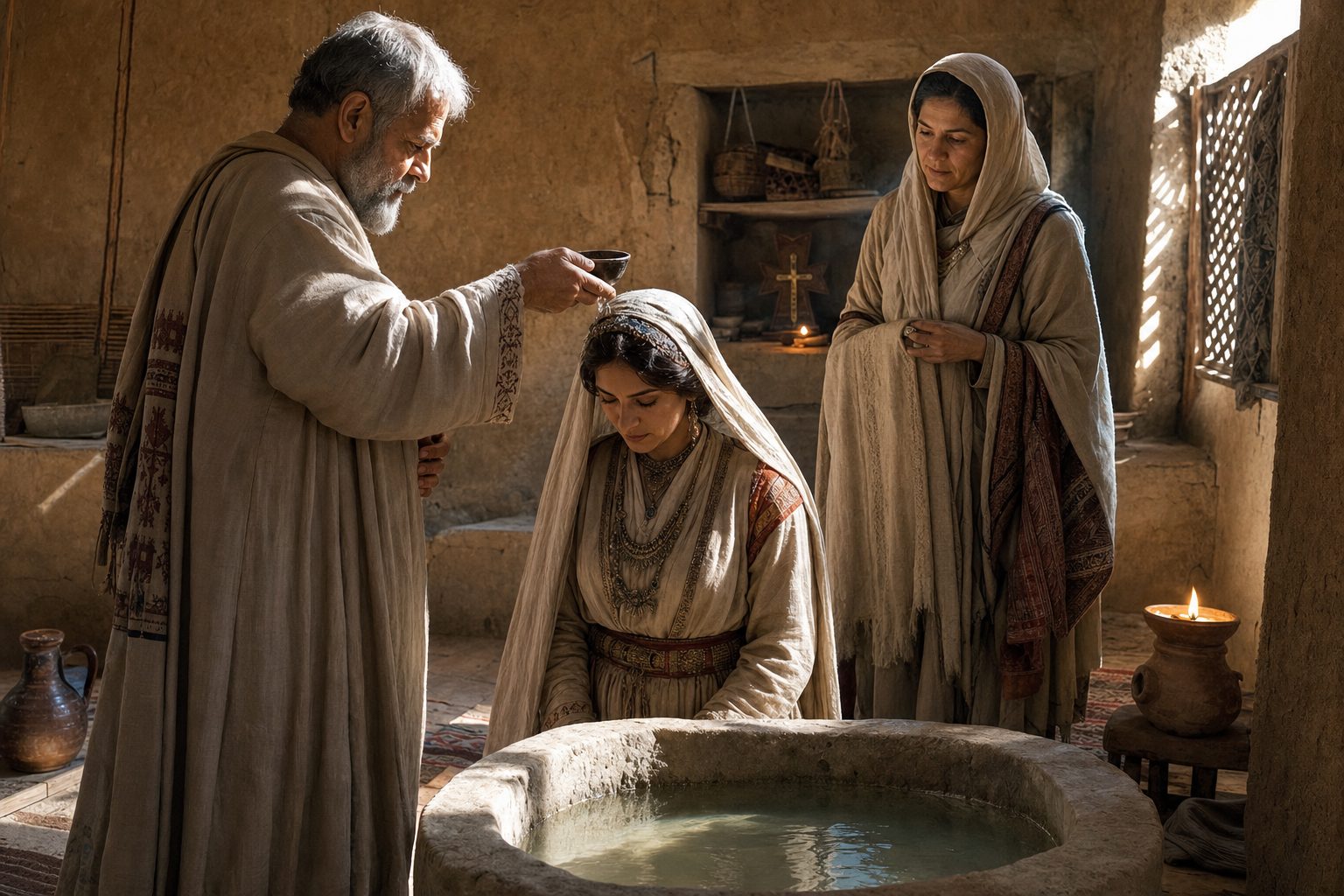
Golinda was brought by a discarnate angel to an angel in the flesh, who instructed her in faith and baptized her; at the time of her baptism she was given the name Mary.
After she was baptized, she returned to her home, but she was no longer subject to the natural law of marriage.
Not wishing to be defiled by an ungodly husband, as she was betrothed to Christ; and at the counsel of her spiritual father, who baptized her, Golinda remained in fasting and prayer, devoting all the nights to her; she spent the day in silence, not wishing to converse with unbelievers, and did not allow her husband to touch her.
I'm going home.
Her husband was surprised at her sudden change and unusual behavior, was puzzled as to what had happened to her, and became concerned about her.
But he especially regretted the deprivation of bodily union with her, for she desired no communication with him at all; and for a long time he tried to break her stubbornness, now with affection and supplication, now with violence and beatings, but he could not reach the goal, since the bride of Christ was strengthened by the invisible power of God, and the husband was unable to
I'm going to beat her.
When he finally learned that his wife had become a Christian, he began to weep over her as if she had died, and in every way he urged her with tears to renounce Christ and to remain with him in the marriage relationship; but he could not shake her, firm as a pillar, in the faith and love of Christ.
He had also used his sorceries on her, calling for help from the demonic power, but this too was of no avail, for the demons dared not even approach her from a distance, seeing that she had the grace of Christ.
And Haman went in to Hazor, and said, Behold, my wife hath taken her to herself a Christian, and abhorreth me.
And it came to pass more than once, that the king sent to her noble men and noble women, with flattery and flattery, that she should return to her former religion and live with her husband; but all their labors were in vain.
And the king sent to tell Golinda that if she should forsake the Christian faith and return to the Persian, he would take her as his wife, and she would be his queen.
I ask you a thing, and now tell me: Behold, the king will take me to himself as his wife. Shall he die, or shall he live for ever? If he die, I will hear him.
I do not wish to be united with the mortal and imperishable King, but with the immortal King, the ever-living Christ my God, for whom I am ready to suffer and die.
And when the messengers returned and told her king, he was wroth, and he bound her with fetters, and cast her into the dungeon, that she might be forgotten as dead; and she was in the dungeon eighteen years.
Meanwhile, Khosrow, the Persian king, died, and his son Ormisdas became king, and in Greece the kings changed: Justinian the Younger [Justinian II <unk> emperor 565-578], Tiberius II [Emperor 578-582], and after them the holy Mauritius [Emperor 582-602].
At that time, a Greek ambassador named Aristobulus, an honest, godly man, came to Persia. He had heard that Maria <unk> Golinda was in prison and wanted to see her and get her blessing.
He deliberately asked the Persian king to allow him to enter the dungeon unhindered, and after receiving permission, he went to the saint, untied the chains with which she had been bound for Christ, and even took some of them as a blessing.
While living in Persia, this husband often visited the saint and taught her the psalms of David, so that the bride of Christ, sitting in the dungeon, as in a dungeon, sang them and thanked God.
After the death of Aristobulus, Ormisdas gave her to the magicians to be tortured as they wished; they brought her out of the dungeon every day, inflicted many wounds on her and tortured her mercilessly, but in the morning they found her unharmed and healthy.
When she was brought out in the morning to be tortured again, her breasts and her whole body were unharmed; and the Persians were amazed, and glorified the power of Christ, and many of them became Christians.
And the magicians roared like beasts at the lamb of Christ, and invented all sorts of new torments: they burned her head with fire, and then they put Goldilocks in fur, and bound and sealed her, and cast her into a deep pit, that she might die.
But by the mighty hand of God that kept her alive, she remained alive, although she had been without food and drink for many days, and perhaps fed on invisible food and drink.
When a supernatural force kept a martyr alive for days, she was ordered to be desecrated by shameless people.
For this she was brought into a special room; but when they went in to her, they did not find her, for God had made her invisible, so that their unclean eyes could not see the pure bride of Christ.
Then he was thrown to be devoured by a great and terrible serpent, who was kept and fed in a deep pit, but he did not shut the mouths of the lions, lest they devour the one who was thrown into the pit [Dan.
And the serpent's wrath was restrained, and he became gentle before her like a lamb, and lay down and rested at her feet, and she remained holy in the abyss with the serpent four months: the serpent all the days of her life
The food was thrown away, but the martyr was alive as before, without food or drink, by the power of God, who miraculously preserved her life.
And after many days she desired to eat, and an angel of God appeared to her, and touched her mouth, and said, Thou shalt not hunger any more, nor thirst any more, but if thou wilt eat anything, as yet without flesh, it shall be thy will.
And when he brought her out of the cave, the wrongdoers took her again, and they said, 'She has cast a spell on the serpent, so that he did not eat her, and she came out of the cave by her spell.'
And when the king saw that she was alive, he cut off her head with the sword; and when she was taken to be cut down, the angel of the Lord delivered her out of the hand of the chief of the guard, and kept her alive.
The deceased martyr, unknown to her tormentors, was among the Christians, who were then few in Persia: they lived in hidden places, as if in hiding, although the unbelievers knew about them.
According to the angel, the saint felt neither hunger nor thirst, except sometimes, only to show that she was not a ghost, but had a body, she took a small piece of bread and, soaking it in water, ate; she did not do this often, but rarely <unk> sometimes for 10 days, or even more.
Not long after the martyr was saved from death, the wicked Persian king Ormisdas, killed by his own men, died with a great noise, and his son Khosrau [Khosrau II Parvez ruled from 590 A.D.] became king.
He took the life-giving tree of the Lord's Cross from Jerusalem in 614, during the war with the Greek emperor Phocas.
He was succeeded by Syroes, the grandson of the elder Khosrow, but the nobles rebelled against him, and he fled Persia.
Wondering where he should go, whether to Arabia, where the Saracens were already present, or to Greek lands to the Christians, he finally decided to let his horse ride and head there.
When he reached the place where one road leads to Arabia, and the other to the Greek lands, the horse went by the Greek road, and headed to the Greek region with Khosra and all his associates, where he was honored and kindly received by the Greek king Mauritius.
Mavrikius gave Khosrau a large force of his army; with him Khosrau went to Persia, defeated the enemies and again took his throne.
With Khosrow came to Persia St. Domitian, bishop of Meliti, sent by Mauritius.
He, like Aristotle before him, saw with his own eyes the holy martyr Mary, called in Persian Golinda, but no longer in chains, but in freedom, preaching to the Persians about Christ; he talked with her, heard about her sufferings either directly from her mouth or from others, and on returning to Greece, told about
She's a lot of people.
By the preaching of Mary in Persia, her relatives, and other eminent persons, and a great number of the people, accepted the holy faith, for they saw many miracles wrought by her, including many prophecies of the future and their fulfillment, for she had the gift of clairvoyance, penetrating into the secret and secret; because of all this in those
And the glory of Christ was multiplied in the countries.
After this, the saint went to the borders of the Greek province, to Kirkizia and Darius, visited Jerusalem and here worshipped the Living Tree of the Honest Cross, the coffin of the Lord and other shrines.
She came, among other things, to a monastery where the heresy of the wicked Severus prevailed, who affirmed the suffering of the Godhead and joined, therefore, to the trinity such words: crucified for us, have mercy on us, Father and Holy Spirit, together with the Son who suffered on the Cross.
She prayed to the holy God to reveal to her about these Severans, whether to receive their communion or not, and saw an angel holding two pots, one full of darkness, and the other full of light, and revealing to her that the pots with darkness are heretical communion, and with light.
The Holy Communion of the Catholic Church [i.e.
She was guided by an angel of God and traveled through other countries and cities, visiting Hierapolis of Syria and Bishop Stephen, who later wrote her life.
When her blessed death drew near, she fell a little ill in the church of the holy martyr Sergius, which was between Nisevia and the city called Dara, prayed for the salvation of the whole world, thanked God for His great mercy, which was manifested in her, and gladly delivered her holy soul into his hands.
The Lord whom she loved so much and for whom she suffered so much, she was counted among the holy martyrs in the kingdom of heaven.
Thus the holy martyr Mary, she and Golindhus, finished her earthly life about Christ Jesus our Lord, to whom be glory forever, amen.
It was written by Eustathius, the presbyter of the Great Church of Constantinople, a contemporary of St. Euthychius.]
On this day, the memory of the holy martyrs Feodor the Varangian and his son John, who were killed in Kiev in 983.