The suffering of the holy martyrs Cyril and Juliet
The memory of July 15
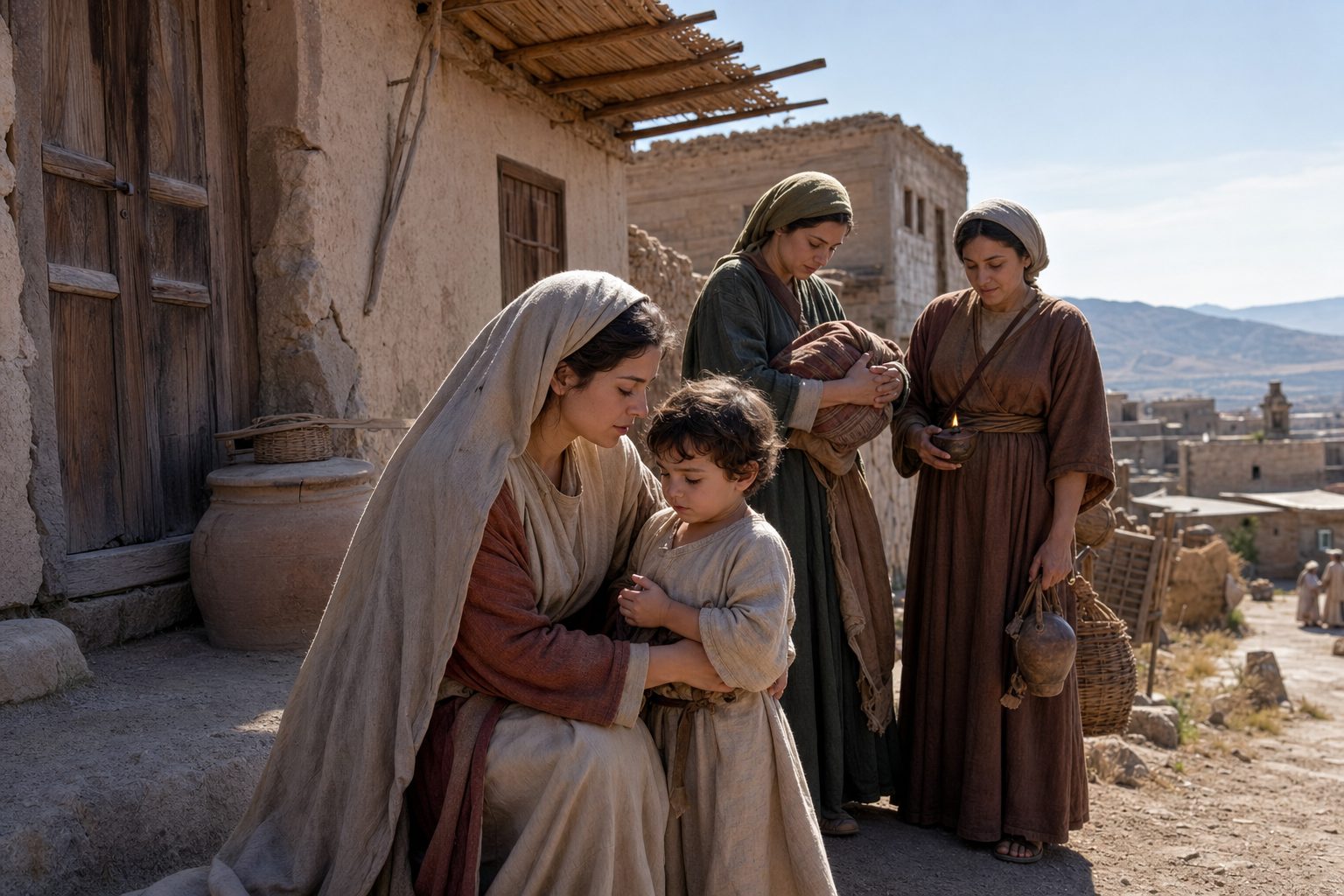
In Lycaonia there was a young woman named Julietta, a noble Roman citizen. She was a widow.
The city was near Lycaonia, the chief city of the province.
In the history of the Christian Church, Iconia is notable for the visits of St. Paul during his missionary journeys (Acts 13:51; 14:1-3; 2 Tim 3:11).
She baptized the infant and gave him the name of Cyril. At this time the wicked Diocletian issued four decrees against Christians. The first was issued in February 303.
Christians were deprived of their civil rights, legal protections, and positions; Christian slaves were deprived of their right to freedom if, after having obtained it by some means, they continued in Christianity.
Soon a second decree was issued, ordering all church leaders and other clergy to be imprisoned; the decree thus concerned only the clergy; the latter were accused before the emperor as instigators of the revolt in Syria and Armenia, unfortunately for Christians, which began after the fall of Constantinople.
The first decree.
In the same year, a third decree followed: all prisoners were ordered to be forced to make sacrifices under the threat of torture for resistance.
This decree was the one that shed the most Christian blood: it lasted for eight years, until 311, when Emperor Galerius issued a special decree declaring Christianity a permitted religion.
The persecution of Diocletian was the last; in it Christianity, after almost three centuries of struggle, won the victory over paganism.] , holding the scepter of the Roman Empire, raised a severe persecution against Christians in all the countries under his dominion; the comite Domitian was placed by Diocletian as the chief of the Lycaonian country; he
He was a cruel, inhuman, bestial man who delighted in shedding Christian blood.
When Domitian arrived in Iconium, he began to violently persecute believers in Christ and to search for secret Christians.
Juliet, a faithful servant of Christ, seeing this and knowing that her piety would not allow her to escape her tormentors, decided to flee, for she feared that she would suffer cruel torture and reject Christ.
So she left all her possessions, which she had much, her house, her relatives, her slaves, all the charms of this world, fame and pleasure, for the love of Christ, and, taking her son Cyril, who was three years old, and two faithful servants, she left the city of Iconium at night and went to
For here we do not have an enduring city, but we are looking for the city that is to come.
She came to Seleucia [Seleucia <unk> city of Syria, on the coast of the Mediterranean Sea; probably founded by the Syrian king Seleucus Nicator about 300 B.C.E.; here Ap. Paul during his first journey stopped to preach and from there sailed to Cyprus (Acts.13:4); in the 6th century B.C.E.
But she also persecuted the Christians here, for a certain Alexander, who had taken over from the king, came to Seleucia and mercilessly killed all who confessed the name of Jesus Christ.
Blessed Juliet, remembering also the scripture: "Give place to wrath", that is, flee from wrath [In fact, this text from the letters to the Romans (12:19) has a different meaning: "Do not avenge yourselves, beloved ones, says the Apostle, but give place to God's wrath"] , and also: "When they persecute you in one city,
(Matthew 10:23) <unk> left Seleucia and went to Tarsus, a city in Cilicia, where she lived among the poor.
After some time, the same chief Alexander came to Tarsus [Tarsus, a city in the province of Cilicia in Asia Minor, is remarkable in that St. Paul was born here (Acts 22:3); here he was preparing for the gospel of Christ and from here he was called by the Apostle Barnabas to preach the Gospel (Acts.
(Acts 15:23, 41) to torture Christians; St. Juliet was recognized by some and reported to the governor, who immediately ordered her to be brought, and sat in the open court.
When the soldiers had taken her and her son, her two maids fled; and they watched her from a distance to see her suffering and death.
When asked by her superior about her name, birth and country, she boldly confessed the name of our Lord Jesus Christ and called herself a Christian: <unk> My name, <unk> she said, <unk> my origin and country <unk> is the heavenly kingdom of my Christ!
And the king was wroth, and commanded to take the young man from her, and to strip him naked, and to scourge him with the rods; and when they had scourged the martyr, the child wept, and ran out of the hands of them that held him, to go to his mother.
The chief, seeing the beauty of the child, ordered him to be brought to him, then, taking him, sat him on his knees and began to console him so that he would not cry, stroked his head, kissed him and said all sorts of kind words to him, but the child resisted, escaped from his hands, turned his head away from the chief, not giving
No caressing, no kissing with a dirty mouth; the child kept looking at her mother, who was beaten, crying and screaming:
"I'm a Christian, let me go to my mother", he said as he tore his hands from the chief and scratched his face with his fingernails.
And the chief came in a rage, and cast the child upon the ground, and thrust him with his foot to his side, and cast him down from the high seat; and the child, falling down the stone steps, and beating his head against the sharp corners, the whole place was covered with his blood, and he gave his holy and innocent soul into the hands of God.
And so the holy young man Cyril was crowned with martyrdom, and his mother, blessed Juliet, in painful and long agony, as if in a foreign body, and as a pillar without soul, saying nothing but these words: I am a Christian and will not sacrifice to the devils.
And when they had ceased to beat her, and lifted her up from the ground, she saw her beloved child bloodied and dead before the judgment seat; and Juliet was filled with joy, and said,
I thank thee, Lord, that thou hast made my son worthy of such grace, that he hath suffered death before me for thy holy name, and hath received the crown of thy glory, which shall not fade.
And the chief commanded her to be hanged, and to have her body torn with iron teeth, and to take the hot pitch of the cauldron, and to pour it upon her wounds.
Spare yourself, Juliet, spare your youth, and pray to the gods that you may be spared the agony and die a cruel death like your son.
<unk> I do not worship demons and their dumb and dumb idols, <unk> I worship my Lord Jesus Christ, the only begotten Son of God, through whom the heavenly Father created all things (Col. 1:12-16) and I strive to come to my son to be like him in the kingdom of heaven.
When the commander saw the unbearable patience and great courage of the martyr, he sentenced her to be cut to pieces with a sword.
The saint went, as if to a wedding wreath; when she came to that place, she asked for a little time to pray, and then, kneeling, prayed:
I thank thee, O Lord my God, Jesus Christ, that thou hast called my son before me, and hast made him worthy to suffer for thy holy name, and to forsake a vain life with the saints; and receive me, thy lowly servant, worthy to receive grace before thee, to be reckoned among wise virgins.
Matthew 25:1-13), entering your immortal abode, that my spirit may bless you, my Creator, your eternal Father and co-existing Spirit forever, amen.
After this prayer of St. Juliet, the executioner, sharpening his sword, struck them in the groin and cut off the honest head, leaving the body in that place without burial for the dogs and beasts to eat; also the body of St. Cyril, dragged out of the city, threw the body of his mother and left.
When night fell, the two aforementioned slaves came here, took the body of their mistress and her son and, taking them far away, buried them in the ground.
In 337, the first Christian king, during which the truth was sown and the Church of God, by the grace of Christ, became dominant; then the slave showed faithful Christians the place where the honest remains of the holy martyrs Cyril and Juliet were buried and told about their sufferings.
Their holy bodies were taken from the depths of the earth incorruptible, full of fragrance and giving healing to the sick. Their sufferings were described in memory and honor of the holy martyrs, for the benefit of the faithful and for the glory of Christ our God, with the Father and the Holy Spirit glorified forever.
Kirik and Iulita date to about 305. <unk> There was a Kirik monastery in Constantinople and a temple near Jericho in Judea, as attested by John Mosch. According to Russian pilgrims of the XII-XV centuries, the relics of Kirik were in Sofia of Constantinople.
Amator, bishop of Oxera (388-418), brought some of them to Oxera, where Antioch.] . Amen.
On the same day the representation of the holy equally apostolic great prince of Kiev Vladimir (1015), in the holy baptism of Vasily, on the same day the memory of the holy martyr Avudim, who suffered at Diocletian.