The Passion of St. Julia the Martyr
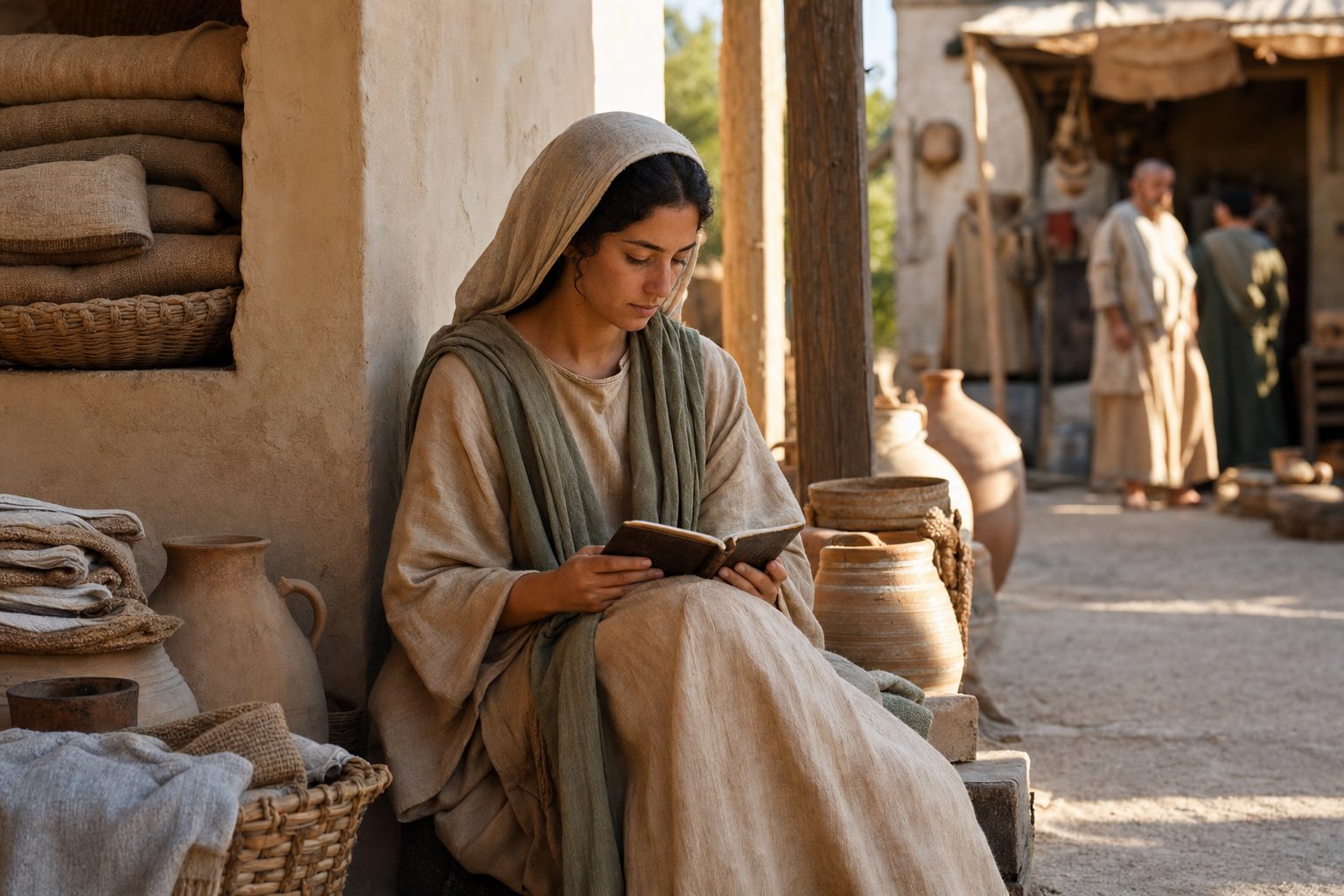
When the Persians captured the famous African city of Carthage [C.E. 625 C.E.] and took many of its inhabitants captive, that little girl, Blessed Julia, the daughter of a famous man named Ansalson, was taken along with other captives from that city and sold into slavery to a wicked pagan merchant in Syrian Palestine.
The girl, although she had an unbelieving master, nevertheless held fast to the holy faith in Christ in which she was born and to the good Christian customs she had learned from infancy, praying and fasting often.
When she became a virgin, she carefully kept herself chaste, lived chaste and strictly abstained, and faithfully served her master, as the apostle said: "In the simplicity of your heart, not with an outward show of slavery, as men pleasing". (Eph. 6:5-6) But as in the eyes of God, she did all that was reasonably assigned to her, doing things that were not contrary to God and her chaste life, and that were repugnant, and no one could force her to do.
Her master tried to force her to renounce Christ and to lead a godless life according to their pagan customs; but no threat could persuade her to do so, for she was willing to die rather than renounce Christ or lose her virginity.
And her master was about to destroy her, but seeing that she served faithfully and diligently, he spared her and marveled at her good character, meekness, humility and strict fasting; he saw that she fasted every day, except on Saturday and Sunday, and spent her free time not in idleness and rest, but either in fervent prayers to God, or in reading books, which she had learned in childhood; rarely even when she went to bed at night.
She looked always pale, dry, exhausted from labor and abstinence. Her master was amazed at this and, seeing that she did the same, began to pity, love and respect her: it was God, fatherly protecting his mistress, St. Julia, who bowed to her the cruel heart of an unfaithful man. She was already more than twenty years old when her master, who was a merchant, planned to sail with many goods to Gaul.
And he took with him his faithful servant Julia, seeing that his goods were increased under her care: and God blessed the house of that merchant for her, as the house of Pantephrius was in Egypt for Joseph's sake (Gen. 39:5).
While there were Christian towns on the island, there were also many Gentiles, and when the merchant landed on the island, he saw a gathering of his fellow believers near the port, feasting and offering sacrifices to demons.
So he went with all his servants and bought a fattened calf, and brought a sacrificial offering, and they all ate and drank and rejoiced.
And the captain of the ship said, Behold, there is a certain young woman in the ship, who blasphemeth against our gods, because we sacrifice to them. And the captain said, Behold, I have heard a certain young woman in the ship blaspheme against our gods.
"Thou speakest of my maidservant? for in no wise could I turn her from the Christian error, nor persuade her to our faith, neither with flattery nor with threats; and if she had not been so faithful to me, and so diligent in her work, I should long ago have destroyed her with many torments".
Or I will give thee for her four of my maidens, or I will give thee a price for her; but give her to me, and I will make her bow down to our gods.
And I said, It is not lawful to compel her; for she would rather die than forsake her faith; and if thou hadst sold her to me, it would not have been worth the price of her service; for she is very faithful, and my property is increased in her hand; therefore have I set her in charge.
Then the captain took counsel with his men, and prepared a great banquet for them, and gave them wine to drink; and they fell into a deep sleep, both he and his companions.
"Girl, sacrifice to the gods, and I will pay whatever ransom your master demands for you, and I will set you free". The saint replied: "My freedom is in the service of Christ, whom I serve daily with a clean conscience, and I detest your sect". Then the commander ordered her to be whipped.
If my Lord Jesus Christ was beaten on the cheek and spat on the face for me, why should I not be beaten for him? Let them beat me on the cheek for him, and let tears flow down my face instead of spitting.
I confess that I suffered for the sake of my Lord, and that I too, as his servant, have suffered with him, so that I may be glorified with him in his kingdom.
Then the tormentor ordered her to have her virginal breasts cut off, and she courageously endured all these fierce torments for the love of Christ. The tormentor, wishing to hasten her destruction until her master awakened, ordered that a cross be made quickly and a martyr be crucified on it, as the Jews once crucified Christ.
When she was hanging on the cross, and was about to die, her master awoke and saw her crucified, and what great pity filled his heart! but nothing could be done: the bride of Christ was already at her last breath.
And when her holy soul was loosed from the bonds of her body, they all saw a dove come out of her mouth, whiter than snow, and fly up to heaven; and they also that tormented her saw angels; and great fear fell upon them all, and they all fled from there, and only the lifeless body of the holy one remained hanging on the cross.
But Christ Christ did not leave her, but he commanded his angels to guard her until he prepared a proper burial, as follows.
Near Corsica, there is a small island formerly called Margarita, now Gorgona, where there was a monastery of men. There an angel of the Lord appeared to the monks, told them all that had happened to the holy martyr Julia, and ordered them to sail quickly to that island, to take down the crucified body of the holy martyr and bring it to their monastery for burial.
When they landed, they found it just as the angel had told them. So they took Jesus down and wrapped him in clean linen.
They found her severed breasts, which had been thrown nearby and lying by the stone, and they took them and put the body in its place; then they carried the body to the ship and returned safely to their monastery, where the body was buried with honor in the church, glorifying Christ God, who strengthened His servant for such a martyrdom.
At her tomb, miracles were performed and she was healed of all kinds of diseases, and miracles were also performed in the place where she had been wounded.
A fountain of water flowed from under the stone where her breast was cut off, and those who drank from it or washed themselves were cured.
And there was another miracle: the stone which touched the breast of the holy woman, and from under which the fountain flowed, every year, on the day of her memorial, sweat, milk drops, and together blood drops, poured out of it, as if by the blood of a virgin, to signify the virginity and martyrdom of St. Julia, who, as with milk, was cleansed of her virginity and clothed with the blood shed for Christ.
But after many years, the church of the Holy Martyr, which had been built on the spot of her suffering, had fallen into disrepair and was partially destroyed.
The next day the foundations were ready. When they had prepared the stone, the bricks, the lime, and everything else, the builders were puzzled. They moved everything else to the place where the old church had stood, but at night they moved it again.
That night the guards saw a bright maiden, putting on a chariot, tied with a pair of bright oxen, all the material prepared for construction, and carrying it to its former place; they understood that the saint desired that the temple should be rebuilt on its former place, and did according to her desire.
And after the transfer of the relics, the people of Corsica come with faith to the holy temple, are not deprived of its help and are kept from the attacks of its enemies by the holy and indestructible prayers and mercy of our Lord Jesus Christ, to whom be honor and glory with the Father and the Holy Spirit, now and forever. Amen.