The life of the reverend father of our Pampa
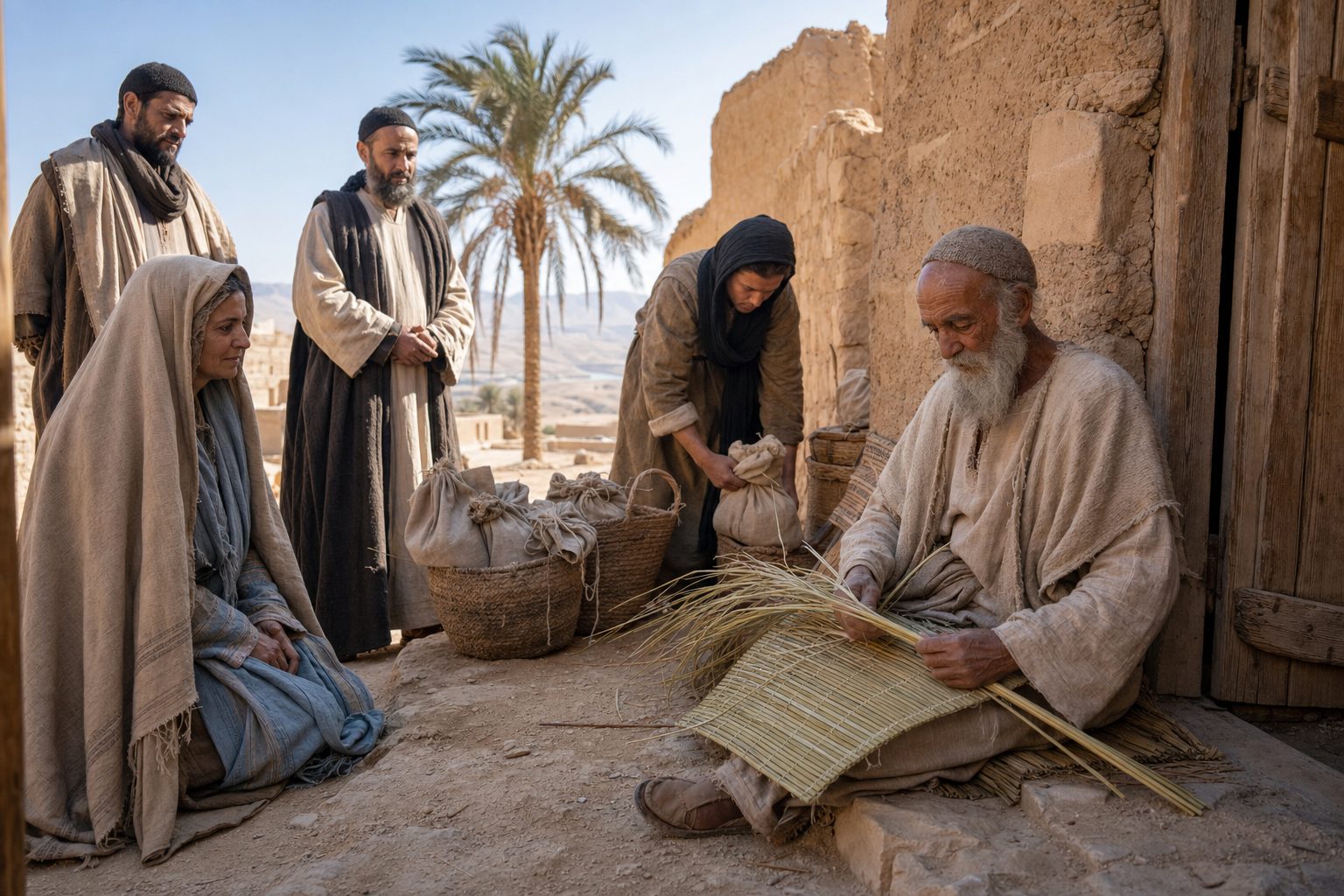
The Monk Pamva lived until his old age as a hermit in the desert near the Nitrian mountain, in Egypt.
He was particularly famous in Egypt in the Nitrian Desert, which was located in Lower Egypt and lay deep inside the country, across the Nile River.]
First of all, St. Anthony the Great [His memory is celebrated by the Church on January 17th] said of him that by the fear of God (which Pamwa was filled with) he infused himself with the Spirit of God.
Three things we have seen in Pamwa's father: hunger every day, silence and manual labor.
Monsignor Feodor Studius [Memory of him - November 11 and January 26] gives this testimony about the same blessed father: "Pamva and deed and word may be delighted worthy, as high as he is" [Canon on Saturday cheese, song 5 (this canon was written by the Rev. Feodor Studius).]
Socrates the Scholastic [Socrates the Scholastic <unk> Greek church historian, lived in the V century. He wrote the "Church History", brought to the reign of Emperor Feodosius II.
<unk> The following passage from the work of Socrates Scholasticus is found in the 4th book of his "Church History" (chapter 18).] writes of him that at the beginning of his paganism he, being illiterate, came to one of his brothers to learn from him the Psalms of David.
Hearing the first verse of the thirty-eighth psalm at the very beginning, namely, "I will watch over my ways, that I may not sin with my tongue", he did not want to listen to the other verses, but left, saying: <unk> This one verse is enough for me, if I learn to do it in practice.
He never came to his teacher again. Six months later, the teacher saw him and asked him, "Why haven't you come to me yet?" Pamva replied, "I haven't learned to do that poem yet".
Pamva replied, "For nineteen years he has been studying and practicing what he teaches.
Although initially illiterate, St. Pamva was later enlightened by God and well versed in the Scriptures, and even to others he was a skilled teacher (as Palladius writes of him).
The following four brothers, famous in Egypt, were his disciples: Dioscorus, Ammonius, Eusebius, and Euphemia, called great and mentioned in the life of St. John Chrysostom [His memory November 13].
The first of these, Dioscorus, was later bishop of Hermopolis; this is not the same Dioscorus who was beaten as a heretic and condemned at the fourth ecumenical council of the holy fathers [The Fourth Ecumenical Council took place in 451 in Chalcedon and was convened by Emperor Theodosius II to condemn the heresy of Eutychian.
The heresy was founded by the Constantinople archimandrite Eutychius, who argued that in Jesus Christ the human nature at the hypostatic union was completely absorbed by the divine.
At the same council Diocletian was condemned, but another of the same name, who lived earlier.
In addition, Dracontius the Honorable, mentioned in the life of St. Ilarion the Great [His memory is celebrated on October 21], bishop and confessor of Christ, who suffered exile from the Arians, was also a disciple of the blessed Pampa in his youth.
This reverend, among many other great virtues, was also distinguished by his utter contempt for gold and silver.
When St. Melania, a Romaness, who had distributed all her wealth to the needy for Christ's sake, arrived in Alexandria, she heard of St. Pampa and came to him with the hospitable presbyter Isidore of Alexandria, bringing with her three hundred liters of silver and
She asked Pamwa to take as much as she wanted from the silver she had brought.
But he did not look at her, nor did he cease to touch her, for he had struck the horn, but he said to her, "May the Lord reward your love for him". And as she kept asking him to take something, the saint said to his brother who served him,
Take what they give you, and take it carefully, and send it to your brothers in Libya, 12 and to the islands, for they are in great need, for the land is barren to them.
Then blessed Melania gave all the silver brought to the brother to distribute to the poor and said to the reverend Pampa: "Father, see how much silver I give: three hundred liters".
Does not the God to whom you have brought the silver ask how much you have brought: "Who has measured the waters with his fist, and with his spindle has measured the heavens, and has set the dust of the earth in measure, and has weighed the mountains in the balances?" (Isaiah 40:12) Does not know the quantity of your silver?
If you had given me the silver, you would have told me how much you would have given, but you gave it to God, who did not despise the two small pieces of silver that the widow gave him, but gladly accepted what she gave more than many wealthy people.
And it came to pass, when the father of Pehor came to Pammah the priest, that he brought with him a small piece of fresh bread, that Pammah said, Why, my father, hast thou brought bread with thee? And he said, That I may not hurt thee.
A few days later, the monk Pamva went to his father Pior, took a piece of his fresh bread, soaked it in water.
Once St. Athanasius of Alexandria [May 2 and January 18] asked Father Pamus to come to him in Alexandria. On the way the elder with several brothers saw seated laymen who did not pay attention to the passing monks; Pamus said to these laymen:
And when he came into the city, he found a prostitute clothed with the attire of men, and the old man wept; and his brethren said to him, Why weepest thou, father?
And I weep for two things, for the soul of this woman to perish, and that I have no more zeal for my soul than she has for her flesh; for she adorneth herself to please men, but I seek not to adorn my soul to please God.
And he was always full of grief, and he never laughed, and there was never a smile on his face, and one day the demons tried to make him laugh, and they tied a rope to his feather, and they pulled it before his eyes as if it were a heavy burden, and they said and shouted to one another,
Help, help!" When Pampa's father saw this, he laughed. Then the demons, happy, shouted, "Now Pampa has finally laughed". He replied, "I didn't laugh, I laughed at your weakness. You can't lift one faith". The demons ran away in shame.
And his disciples marveled at him, because his mouth answered with understanding, and he did not answer them at once concerning the scriptures, or concerning the things of God.
I don't know how to answer that question.
And it was after three days, and after three weeks, and sometimes after three months, that he answered the question; and his answers were just and very profitable, for the grace of God was upon his mind; and they feared the words from his mouth, as from the mouth of God; for God spoke by his mouth.
At the time of this monk, two brothers, Paisius and Isaiah, were living in the same Egyptian lands, the children of wealthy parents; their father was a well-known merchant who traveled with expensive goods as far as Spain.
And when they divided the wealth between them, they said, 'What shall we choose, if we follow our father in trade?
We are in danger of being shipwrecked or killed by pirates. In order to do this, we must choose a better life - a life of godliness and a fatherly inheritance that will bring salvation to our souls. " So they decided to renounce the world.
One of them immediately distributed part of his inheritance to the poor, churches and monasteries, leaving nothing for himself, went to the desert and there learned some small craft, by which he fed himself with the work of his hands; and he lived alone, pleasing to God, fasting and working hard.
Another built a small monastery near the houses of the laity and, taking a few brothers into his home, gave shelter to travelers and fed the poor.
He built a hospitable house and hospital, took in all who came to see him, and served the sick with great diligence, and on the Sabbath and Sunday he arranged two, three, and four lunches for the poor.
After their deaths, many of the brothers began to talk about those brothers, some praising the one who gave away his property immediately and quietly went into the desert, while others gave preference to another who for a long time served the travelers, the poor and the sick with his property.
And when they had spoken long, the brethren went to ask the father of Pamua, to know which of the brethren's life was pleasing to God, and which of them would receive the greater reward.
<unk> Both were perfect in the sight of God, the stranger was likened to the righteous Abraham, and the desert man to the holy prophet Elijah, and both were equally pleasing to God.
And the brethren disagreed, and they disputed among themselves; and some praised the desert man more, saying,
He fulfilled the commandment of the gospel: Sell your possessions and give to the poor, and take up the cross and follow Christ, enduring daily hunger and thirst, and the hospitality, though he served the poor, yet he himself used his property, eating and drinking with strangers, eating with the sick.
Opponents objected, saying that the foreigner had fulfilled Christ's words: "I came, not to be ministered to, but to minister" to others.
For he hath served so much, that he went out daily into the street of the people, seeking the stranger, the needy, the sick, and the poor, and bringing them to his house, and giving them all food. And if a cup of cold water given to a thirsty man is a reward from God, how much more a reward shall the brother who is hospitable receive?
He satisfied countless thirsty and hungry and served all the sick, as Christ did.
And when he saw that there was a contention among the brethren, he said unto them, Wait a little, brethren, until I have received a revelation from God, and then I will tell you.
When they heard this, they were all quiet and praised God.
After this revelation, the former reverend of the two brothers, it became clear to all what great grace he had from God, if he was worthy to see the blessings of paradise until death, and he himself was like the inhabitants of paradise because of what he saw of them, and even more because of the abundant grace of God.
Who dwelt therein.
And he was in the midst of men, and his face shone with glory, as the face of Moses shone with glory, as it is written of the holy fathers.
"Lord, I beg you, do not glorify me here on earth. "But God glorified him so much that his brothers could not look at his face because of his glory.
And it came to pass, when the time of his blessed death was come, when he was seventy years old, that he said unto his brethren that stood by him,
Since I dwelt in this wilderness, and have made a tabernacle, and have dwelt in it, there is not a day that I have not worked with my hands, until I was weary; neither remember I that I have eaten bread, which was given me, but it was always the labour of my hands; and it came not out of my mouth.
I am ashamed to say these things, but I have not yet made a covenant with the Lord.
With these words he entrusted his honest and holy soul into the hands of God, without suffering any bodily illness.
May his holy prayers teach us to live godly lives and to receive good gifts through the mercy of our Lord Jesus Christ, to whom be glory and honor now and forever. Amen.
I 'm going to ...