The life of the holy Olympiad of the deaconess
Her father, Anisius Secundus, was one of the most respected senators, and her mother was the daughter of the famous bishop Eulavius, who is mentioned in the story of the miracles of St. Nicholas and who was the first person after the king during the reign of Constantine the Great.
Olympias, daughter of Eulavius, was first betrothed to the younger son of Constantine Constantius, who after his father reigned in ancient Rome; but he was killed before marriage, and she was given to Arsac, king of Armenia, with whom she lived a short time and became a widow, then Olympias married the above-mentioned senator Anisius Secundus and bore holy Olympias, who had not yet reached the age of majority, as her parents had already betrothed her to a noble youth, the son of bishop Nevridius;
The marriage itself was postponed.
But after twenty months, the bridegroom died, and Olympias was left a virgin and a widow at the same time; she did not want to marry another man, although she reached the age of majority, but wanted to remain a virgin and chaste all her life.
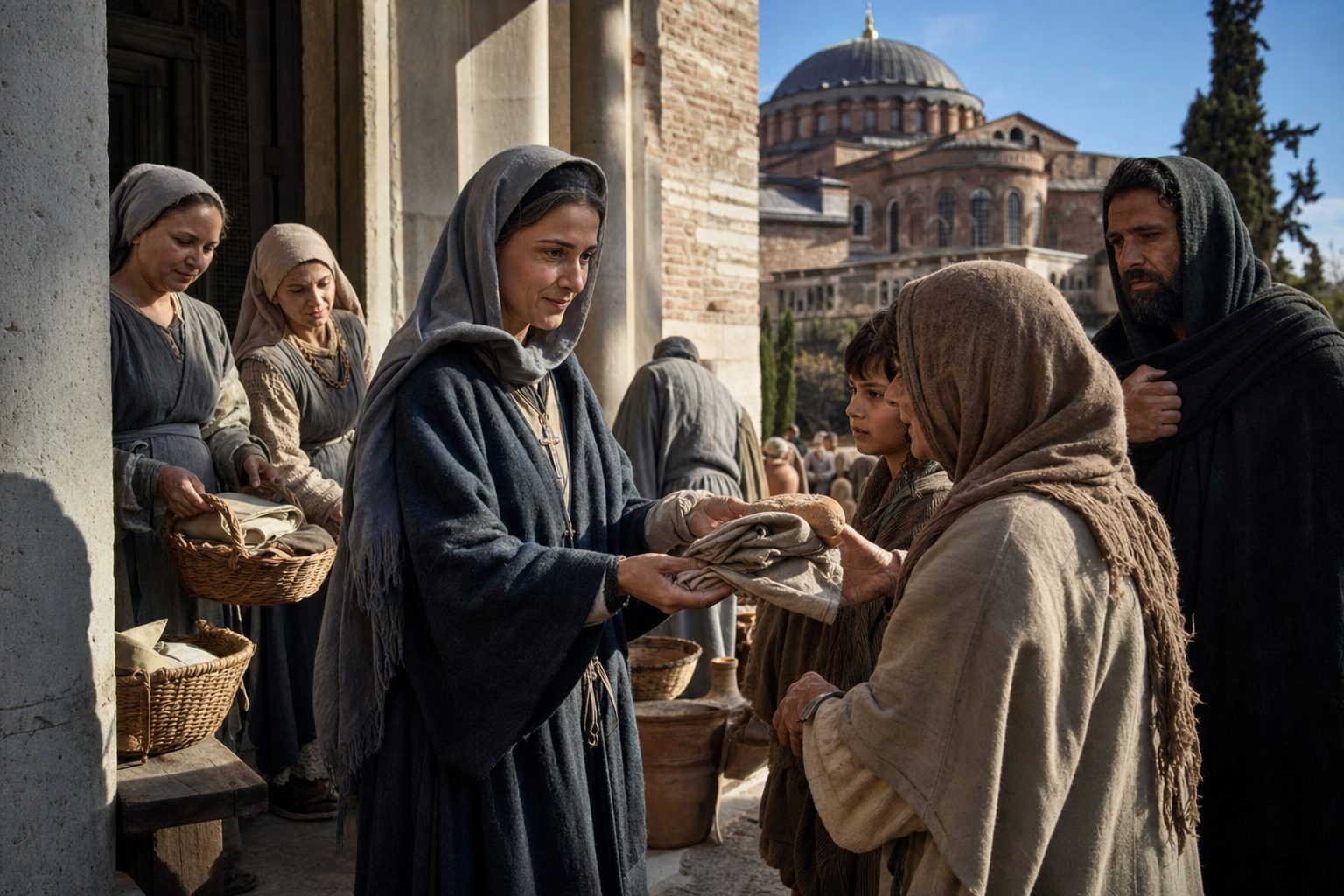
After her parents died, she inherited great wealth and countless estates; all this she dedicated to God and began to distribute with a cedar hand to the needy: to churches, monasteries, hermits, hospitals, shelters for the poor and travelers, orphans and widows, and those who fell into poverty; she sent generous charity also to prisoners and those exiled into captivity; so in many places her generosity spread.
But she was constant in fasting and prayer, putting her body to death and her spirit in bondage.
At that time Theodosius the Great, father of Arcadius and Honorius, reigned; he had a relative named Elpidius, for whom he wished to marry the blessed, young and beautiful Olympias, but she did not want to.
And the king was wroth, and commanded the chief of the city to take away all her property, and to keep it until the thirtieth year of Olympia.
The chief, not so much by the king's command as by the connivance of Elpidius, so abused and humiliated her, that she was not only in her property, but even in herself, not in power: he did not allow her to talk with the godly saints, nor to visit the church, trying to get her to marry, but Olympia rejoiced and thanked God.
<unk> Thou hast shown me, my lord, the king's mercy, and hast done truly episcopally, 2 in commanding another to take care of and keep my burden, which I have taken care of myself; thou wilt do me even greater good, if thou commandest thy steward to distribute all my goods to the churches, to the poor and needy, that I may avoid vain glory, by giving not myself, and then I will not neglect my present wealth, 3 free from the care of earthly riches, and soon
They're dying.
And the king read the letter, and took counsel with himself, and restored her to her estate, because he had heard of her virtue and godliness, and of her great abstinence, and of the cruel killing of her body.
She did not eat meat at all, nor did she go to the baths; but when she was in need, she would sit in a warm bath in one shirt and bathe naked, for she was ashamed not only of the maids but of herself and did not want to see her naked body.
By such a chaste and honest life, holy Olympias, whose virtues amazed even the saints, was taken into the service of the church, <unk> by the most holy patriarch Nectarius 4 she was appointed deaconess 5 and she served the Lord honestly and righteously with other deaconesses, like the evangelical widow St. Anna, "who never left the temple, serving day and night with fasting and prayer" (Luke 2:37).
The life of the blessed Olympia was so blameless that even her enemies could find nothing in her to reproach.
Those who were at enmity with St. John Chrysostom, who became patriarch after Nectarius, were hostile to this innocent slave of Christ, and the most of them was Theophilus, the patriarch of Alexandria, who was angry with her for driving out honest monks from the Egyptian desert (they are described in detail in the life of Chrysostom) 6 She received them when they came to Constantinople and fed them for Christ.
And when she had received the pilgrims, and the monks, and the bishops that came to the city, and had given them of her goods, she was very hospitable and gave them rest, and Theophilus himself had often before been hospitable and generous to her; and afterwards he was hostile to her, and to the above-mentioned nuns, and to St. John the Baptist, and sought to defame her with unjust accusations; but no one believed his malicious lies and slanders, for all knew of her pure and holy life.
(Luke 10:30-37) Yes, she gave shelter to all who had nowhere to lay their head; she spoke of the poor and the leprous, who were cast upon the ground, and of the sick and the sick, who were thrown upon the ground.
She cared for the street and all the abandoned and she was not pretending at all and she was totally committed to charity.
And she spent much on good works, gold and silver, and clothing, and daily she gave food to the poor, and to those who came to the king's palace from their affairs, and satisfied all their needs.
So she came to the aid of her property, donating a lot of gold, silver and church ornaments to St. Amphilochius, the bishop of Iconium, and Onesimus of Pontus (and before that to Gregory the Theologian, who had been a priest in the Cathedral before Nectarius), and Peter the Seventh, the brother of Basil the Great, and Epiphanius of Cyprus.
And she did not only good to the saints, but also to the scribes and to her enemies, to Antiochus, the bishop of Ptolemais, and to Achaia, the bishop of Veria, and to Seberyanus, the bishop of Galilee, and to others like them; and she was not angry, but gave herself wholly to God, because she did not regard her property as her own, but as God's.
(Romans 16:12) St. Olympias made no less of Persis, who worked hard in the Lord and served the saints with great and warm love.
When the innocent St. John Chrysostom was unjustly deposed, blessed Olympias wept bitterly with the other deaconesses, and leaving the church for the last time, John Chrysostom went into the baptistery, summoned blessed Olympias with the deaconesses Pentadius, Proclia, and Salvina, a virtuous widow, and said to them:
"Come, my children, and hear me. "A great deal is being done against me, I see, toward the end. "I have done my work, and I think you will hardly see me again.
And they wept, and fell down before him, and he departed, a holy man, to his place of captivity.
After his expulsion, the cathedral church caught fire; and not a small honor of the city burned; therefore, all the supporters of St. John, innocent, were interrogated by the chief of the city about this fire: it was assumed that they had set the church on fire; then the holy Olympiad suffered, as if she were also guilty of that fire; she was brought to court and severely interrogated (the chief was cruel and heartless).
After this, the saint left Constantinople and went to Kizik 7; however, the enemies did not leave her alone there; she was condemned to exile and exiled to Nicomedia [Nicomedia <unk> city in the region of Bithynia on the shore of the Marmara Sea, in the north-western part of Asia Minor.
She was imprisoned in Nicomedia in 405 A.D.]; upon learning of this, St. John Chrysostom wrote her a letter from her captivity, consoling her in her sorrow [From St. John Chrysostom 17 letters reached Olympia.]
"Put my body in a wooden box and throw it into the sea; wherever the waves cast it on the shore, let it be buried there". The bishop did so. The ark was thrown by the waves on land in a place near the city called Vroxti, where the church of St. Thomas the Apostle was.
Many years later the barbarians attacked the place, burned the church, and the sacred relics, which were not damaged by the fire, although the ark was burned, were thrown into the sea, and the water became blood in the place where the relics were thrown.
When Sergius, the patriarch of Constantinople, learned of this, he sent the presbyter John to bring them with honor to Constantinople, and when the presbyter arrived at the place and lifted the holy relics, a lot of blood flowed from them: and they were amazed that after two hundred years the blood flowed from the dry bones as if from a living body.
So these holy and miraculous relics were carried to the reigning city and placed in the virginal monastery founded by holy Olympia; and many miracles were performed by her holy relics: all kinds of diseases were cured and demons were cast out by the prayers of holy Olympia and the grace of our Lord Jesus Christ, to whom be honor and glory now and pleasing and forever. Amen.
On the same day the saintly Anna, mother of the Holy Mother of God, fell asleep (Her life, together with the Rev. Joachim, see 9 September).