The Passion of St. Julian the Martyr
During the reign of Emperor Antoninus, pagans forced Christians to offer sacrifices to the gods; otherwise, they threatened Christians with fierce torture and death. In the province of Campania, Italy, it was bounded on the west by Lazio, on the north by Samnium, on the east by Lucania, and on the south and southwest by the Tyrrhenian Sea.
The ancient authors praise its favourable climate, and the fertile soil, which allowed for three harvests a year. It had many vineyards, olive groves, and dense forests. The inhabitants of Campania were known for their tenderness and love of luxury.]
Hegemon Flavian sent his wicked servants throughout the province of Campania, ordering them to take all the Christians they encountered and bring them to the city of Athena, where he himself was at that time.
Dalmatia was subjected to Roman rule in the 6th century A.D.; from then on it, together with Illyric, became an imperial province. The inhabitants of Dalmatia belonged to the Illyrian tribe and were engaged in hunting, farming and cattle raising.] some husband, young in years, but old in conduct and Christian wisdom; most beautiful and body, but even more beautiful in grace and holiness; honest in origin, but even more honest in faith.
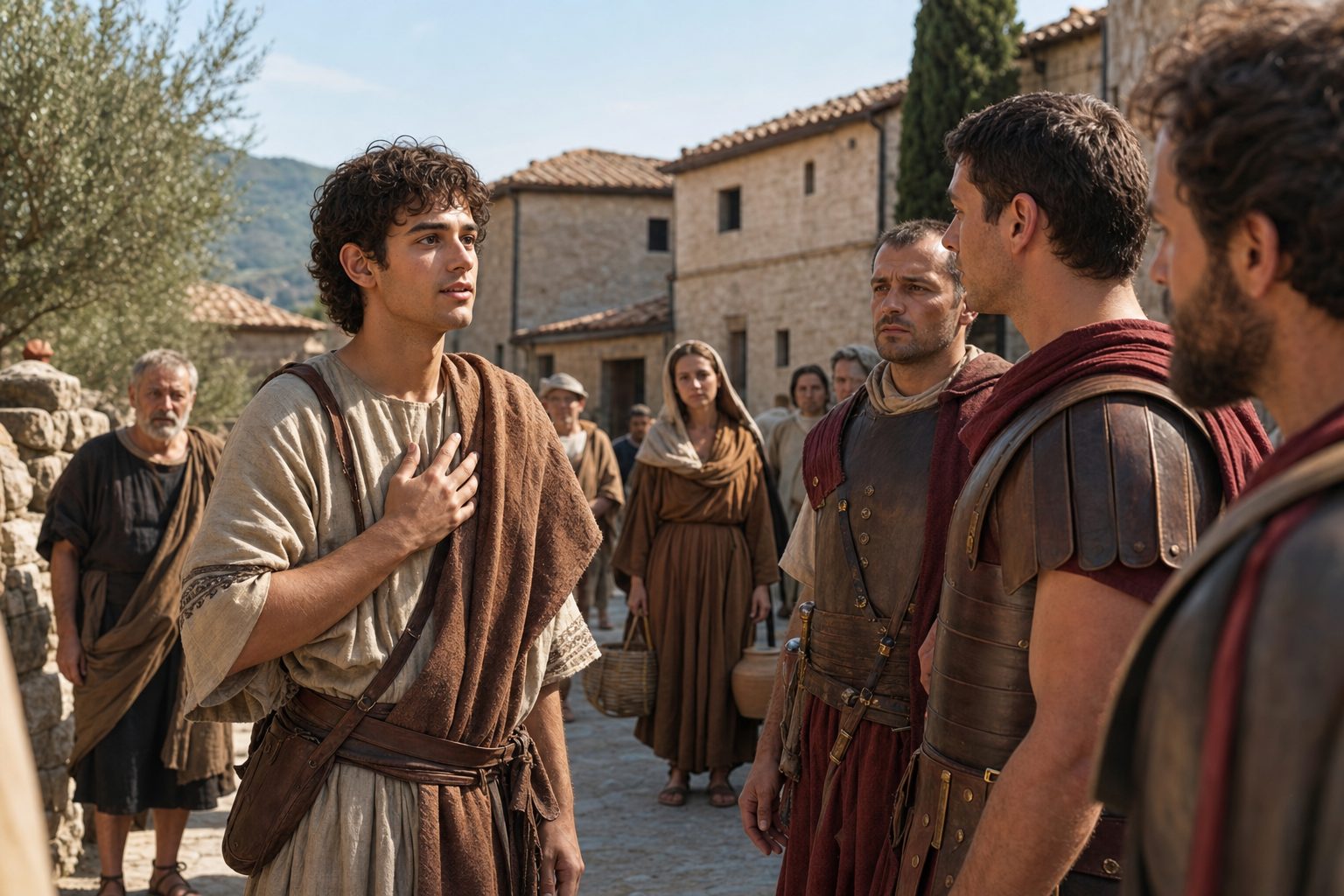
And when he had come to the city of Ananyas, he met with the soldiers of the Ezymonites, and greeted them, and said, Peace be unto you, brethren. And they asked him who he was, and whence he was, and what his name was, and what faith he professed.
But Julian, the servant of God, being willing to suffer and to die for the name of Christ, answered fearlessly, saying, I am a Christian, my name is Julian, and I am a native of Dalmatia, and I go into these countries, exhorting men everywhere to forsake the worship of idols, and to believe in the only true God, and in the Son of his Lord Jesus Christ; I exhort men to honor Him of whom I preach, and for whom I am ready to lay down my life.
And the soldiers were astonished at the courageous answer of the saint, and they took him, and bound him, and led him away, beating him with sticks and swords, and saying, Let us see how true will be thy words, that thou wilt die for the Crucified.
"Fear not, Julian, for I am with thee, and will give thee strength and courage". Then the holy youth thanked the merciful God, and was taken to the egemon, and by his command was confined in the terrible prison called the Cold Pit, where the saint was kept seven days without food and drink, in the thought of destroying him with hunger and thirst.
But God did not forsake his servant, for he sent to him a holy angel, and the prisoner of Christ enjoyed seeing and talking with the angel, receiving heavenly food from his hand.
Seven days later the egemon went out to the public court (here later a church was built in the name of the Most Holy Mother of God) and sat down in the courtroom in the presence of a crowd of people; then he ordered to present the martyr for questioning.
Are you not ashamed, O fair and upright young man, to worship the Nazarene who was crucified? Would it not be better for you to renounce this wicked faith? Worship our gods, and the king will have mercy on you.
But as for me, let me not glory in anything except in the cross of my Lord, for I am ready to die for the holy faith, which you call foolishness.
And when he had said these things, he was enraged, and commanded to beat the saint on the lips, and to torture him, and to hang him on the torture-tree. And the saint, being beaten, prayed to God, saying, I trust in thee, O Lord; save me by thy strength. Thou art my God, my helper, my refuge, and my deliverer. Let all them be ashamed that worship idols, and that devise evil against me. To thee, O Lord, I call: deliver me not into the hand of mine enemies.
And again a holy voice was sent from the silence, strengthening the saint, saying, Fear not, but take courage. Then the martyr of Christ, addressing the people, said, Hear, ye wretched ones, trust not in the gods which your hands have made, but know God, who made heaven and earth out of nothing.
The next morning the saint was again brought to the court. Hegemon said to him: "I would spare you, who do not spare yourself and do not wish to worship the invincible gods". To these words the holy martyr replied: "You are saying this to me in vain; you will not change my mind anymore. I worship the God whom all should worship.
And when the king heard these words of the saint, he was angry, and commanded to hang him on the gallows, and to torture him with whips and iron, but by the power of God, who was marvelous in his saints, the hands of the torturers were weakened and made sick, so that they could not touch the saint, but could not even hold the instruments of torture in their hands, and could do nothing at all.
While Egimon was very surprised, a messenger arrived to announce that the temple of their god, called Serapis [Serapis <unk>, the Egyptian deity, was considered by the Egyptians to be the supreme god, just as Zeus was considered the main god by the Greeks and Romans.
The cult of Serapis was especially patronized by the emperor Nero and Antoninus Pius, mentioned in the life.
When the emperor and his officers heard this, they were greatly astonished, but the people who were among them rejoiced and glorified God for his Christ.
Hegemon, filled with anger and malice, immediately agreed to the people's demand and handed over the martyr to death, expressing his decision in these words: <unk> We order to cut off the head of Julian with a sword, taught by Christians to magic trickery, blasphemer of the gods, disobedient to the king's order; we order to cut it off in the place where the temple was destroyed, in order to avenge the disgrace inflicted on our gods. And the saint was brought to that place.
When he arrived, the saint knelt down and prayed to God:
O infinite goodness of God, I thank thee, O God, that thou hast made me worthy of such an honourable death, as the death of thy holy name. I beseech thee, cleanse me by the very shedding of my blood, cleanse me from my sins, and admit me into thy blessed kingdom. Receive my spirit in peace. Remember not in thy mercy, and all those who desire to glorify thy holy name, the memory of my suffering.
After the saint prayed these words, a voice from heaven was heard, confirming that his prayer had been heard, and calling the saint to the mountainous places.
His holy soul, having renounced the flesh, ascended into the heavens, to Christ our God, who reigns with the Father and the Holy Spirit, to whom be glory, now and forever and ever. Amen.