The performance of the Reverend Ora the Blackbeard
In Thebes of Egypt, the ancient city of Thebes was named after the city of Thebes, and in general all of Upper (Southern) Egypt.
The region abounded with pagan deserts.] , a country adjacent to Ethiopia [Ethiopia <unk> country to the south of Egypt, <unk> Nubia and Abyssinia], among the monastics was a wonderful man named Or, who founded many monasteries, the nuns of which, numbering up to a thousand, were under his rule; this was a ninety-year-old, adorned with gray-haired elder-shimon, possessed of an extremely noble appearance: his face expressed such spirituality that he produced
The impression of a disembodied being.
St. Orr began his life in the desert, where he lived for many years in complete solitude, observing strict fasting. Then, at the command of God, he moved from there and built a monastery near a city; so that the brothers would not have to walk far behind the wood, he planted a grove around it with his own hands; before his arrival there was not a single tree.
And when he was in the wilderness, he ate only green vegetables and roots, which seemed to him to be very good food; and he drank water only when he could find it; and he devoted much of the day and night to earnest prayer.
He lived this way until he was very old, and one day an angel of the Lord appeared to him in a dream and said,
And thou shalt be the father of many, for thou shalt be a trusted father, and shalt bring many thousands to salvation, and thou shalt have a reward in the life to come, according to the rank of thy works, which thou hast acquired for salvation.
After this vision the old man approached the villages; first he built himself a small cell and planted vegetables; and here, as before in the distant desert, the reverend Or ate only vegetables, and even tasting them in small quantities: often during the week he ate only once.
He had never been able to read before, but when he moved from the far desert, the Lord revealed to him the gift of understanding the scriptures: when one of his brothers brought him a book, he opened it and began to read, as if he had learned the art of reading for a long time.
At the same time, St. Horus received glory from God over the demons: to him were brought in a layer of demoniacs, who in all hearing spoke of the mysteries of God's works that were being done by them; and many other healings were performed by the saint by the grace given to him from above by Christ.
He had a habit of first tasting spiritual food, and then he began to eat fleshly food: only after acquiring the Divine Secrets, he went to the table, teaching his brothers inspired instructions or telling soulful stories.
One day, he encouraged the brothers in this way: "I found a man in the wilderness who for three years did not eat food from the earth.
"I know", said St. Horus on another occasion, "of a monk to whom the demons appeared in the form of heavenly hosts and angelic orders, and they pointed to a chariot of fire, in which was a king surrounded with glory.
And the queen thought, and said, What is this? And he thought, I worship my Saviour, who is my king; and if he were seen of me, we would not have asked of me to worship him, for I know that I worship him. And the queen said, I have a king whom I worship, and thou art not my king. And the demons departed from him, and from his king, and from the chariot.
Reverend Orr told the brothers all this as if it were about someone else, but many of them knew well what had happened to him.
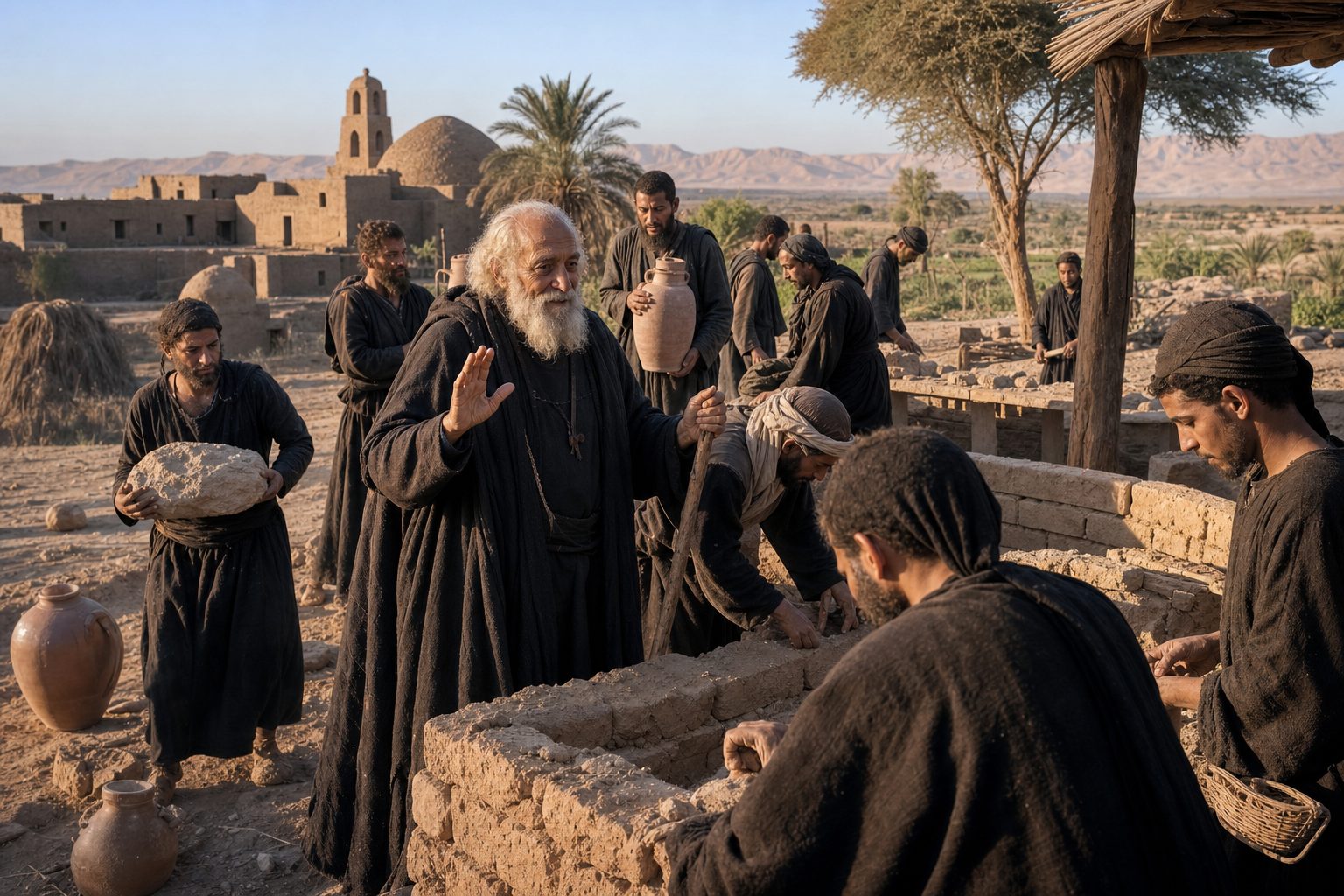
Monsignor Or was very hospitable and kind to everyone: when a brother came to him and expressed a desire to live with him, he would one day build him a cell: taking up the work, Monsignor Or called all the brothers and all helped him diligently: some carried stones, others sand, others water, the fourth trees, and by evening, thus, the cell was ready; giving it to the brother who came, the monsignor in a sufficient degree supplied him and everything
It's essential for life.
God gave abundantly to his servant all that he asked of him. There is also a story about the holy father that relates to the time of his life when he had only one disciple: One day, when the bright feast of the Resurrection of Christ came, this disciple said to his teacher: "Do you know, father, that today is the Passover, and we must celebrate it as everyone does?"
And when he was come out of the cell, he stood under the open sky, and stretched out his hands, and remained three days in that same position, meditating on God. And after three days he returned to the cell, and said, My son, behold, I have kept the passover according to my power. And the disciple said, Father, what hast thou done?
For the monk, the old man replied, the feast and the Passover consist in his mind passing by, as Israel passes by on dry feet on the sea (Exodus 14), the talk of life and approaches God.
And when a woman came to him, and hid her garments, and came half-naked, and asked him for clothing, and he told her lies before them all.
And they were afraid, when they saw that their father was a seer, and that he knew all things. And they would not hide anything from him, or hide anything from his eyes; for God had made it known to him.
Having instructed many not only from among the monks, but also from the world, St. Horus ascended to the Lord [90 years from his birth, about 390 A.D.] in the heavenly abodes and is counted among the great holy fathers who stand before the throne of the Father and the Son and the Holy Spirit, the one God in the Trinity, to whom be the glory forever.