The suffering of the holy martyrs , Marin and Asteria .
In the days of the pagan kings Valerian and his son Gallien, there lived in Rome an honest and virtuous nobleman named Asterus, who professed the faith of Christ; he was a noble and wealthy man who enjoyed the favor of the kings.
One day, while in Palestine, St. Asterius came to Caesarea Philippa, a city known to the Phoenicians as Paneada, a pagan festival celebrated near the spring that flows from Mount Paneas, where the Jordan River is thought to have its source.
On this festival, the demon sacrifice was made invisible: the demon inhabiting it stole the victim, hiding it from the voice, and the blinded by error pagans glorified this demonic deception as a great miracle.
The servant of Christ, Asterius, being present at the most demonic feast, could not help but be troubled by the delusion and spiritual blindness of the deceived people; he lifted up his eyes to heaven and raised up his hands, and prayed with faith to Christ God to cast out the demon that had seduced the people.
And when the miracle was ended, the feast ceased, because the heathen ceased to gather to the fountain. And the prayer of St. Asterius, joined with faith, cleansed the place of the filth of the devil. And his suffering for Christ was done, according to the will of God, in this manner. In another Caesarea, of Palestine [Caesarea Palestine <unk> was called in the deep antiquity the city or tower of Straton].
The city was rebuilt by Herod the Great, who named it Caesarea in honor of the emperor Augustus. It was located on the shore of the Mediterranean Sea. St. Paul during his missionary journeys visited it several times (Acts 9:29-30; 18:28; 21:8) and spent two years in prison (Acts 23:23; 24:27; 25:4-6).
Philip (Acts 21:8); here Agrippa died, struck by an angel and eaten by worms (Acts 12:20-23). In the Gospel of Caesarea Palestiniana, there is no mention of a noble and rich soldier named Marinus, but he was even more honest in his faith in Christ and rich in good deeds.
When he was about to take the place mentioned, another soldier, jealous and wanting to become a centurion himself, went to the judge Achaeus: he revealed to him that Marin, as a Christian, did not want to offer sacrifices to the gods and images of the kings, and therefore, <unk> the informer added, <unk> such a man by virtue of Roman laws could not be made a centurion.
The judge immediately summoned Marin and asked him about his faith; upon hearing from Marin himself that he was a Christian, the judge gave him three hours to ponder whether to choose life or death.
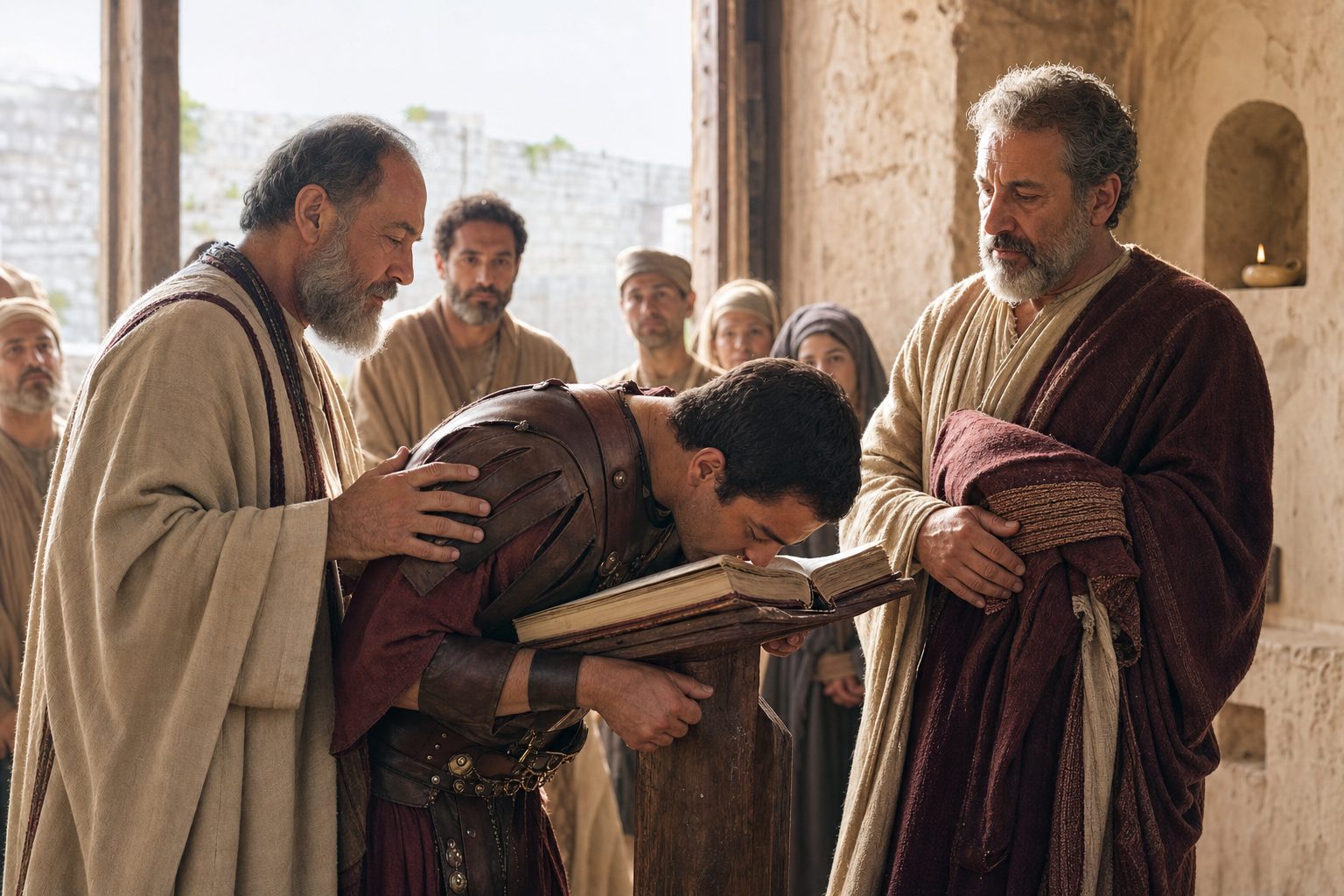
At this time, the bishop of Caesarea, Palestine, Feteik, came to the confessor, took him by the hand, and led him into the church, giving him some spiritual instruction, and when he had brought him to the holy altar, the bishop, pointing to the holy Gospel and the military sword with which Marin was girded, said:
Choose one of these two things, O worthy man, or bear this sword, to serve the earthly king for a time, and in death be destroyed for ever, or become a soldier of the heavenly King, and lay down his life for his holy name written in this book, and reign with him forever and ever.
St. Mary stretched out her right hand to the holy Gospel, and with passionate love embraced it, showing that she was ready to die for Christ. Then the bishop said to her: "Cling to God with all your soul, and strengthened by His power, accept what you have chosen".
When St. Maryn left the church, the herald was already standing at the door of the court, calling out to her by name, for the hour had already passed.
At his martyrdom, St. Aster came to the city by the will of God, and after the death of St. Marin, he took off his precious robe, spread it on the ground, then covered the body of the martyr with his head, and, carrying him to the grave on his own shoulders, gave him an honorable burial.
For this he himself was awarded the martyr's crown: the wicked pagans seized him and cut off his head [in 250], and thus St. Asterius, together with St. Marin, appeared in the face of the holy martyrs to the heavenly King <unk> Christ.
For the shedding of the blood of many Christians, he was punished by the wrath of God: during the battle, the Persians defeated the Romans, and Valerian was captured alive by the Persian king Savarius; he was taken to Persia, and there he replaced Savarius' foot when the latter mounted his horse.
At the same time, Valerian could not be redeemed from his shameful captivity: Savory did not want to take any treasures for him, cherishing the glory that he had the opportunity to step on the shoulders of the Roman emperor.
Gallienus feared that his father's death would be God's punishment for the merciless shedding of Christian blood, so he issued a decree for all the provinces of the Roman state to stop persecuting Christians and allow the bishops to govern their churches freely.
But before the decree came to Caesarea of Palestine, the saints Marin and Asterius accepted martyrdom for Christ's sake and entered into the joy of their Lord and our Lord Jesus Christ, reigning with the Father and the Holy Spirit.