The Passion of the Holy Apostle Matthias
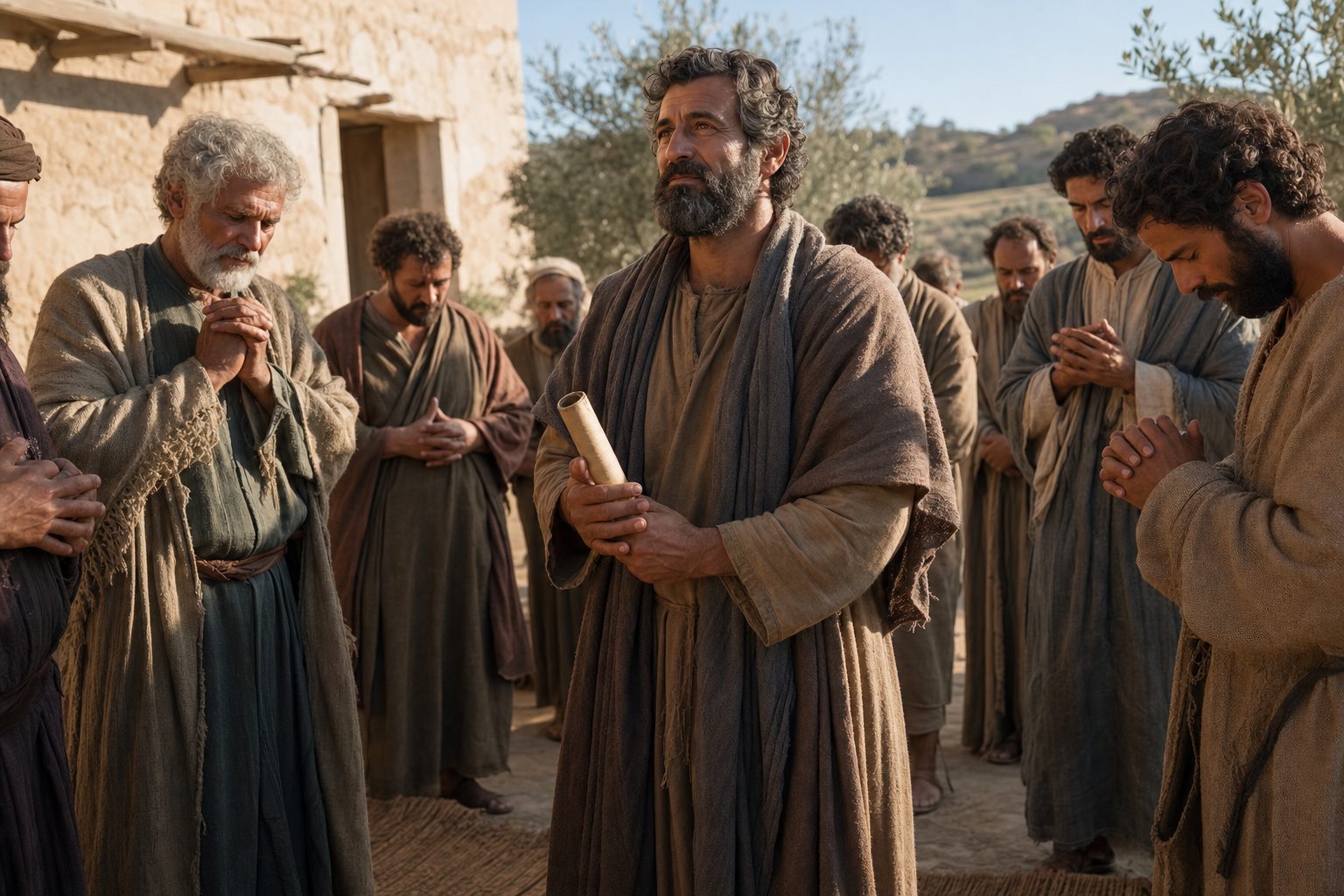
August 9 St. Matthew, a native of Judaea, was born in Bethlehem; from an early age he began to study the holy books and the law of God in Jerusalem under the guidance of St. Simeon the God-bearer, from whom St. Matthew was instructed in virtuous living: he led a godly life, strictly following the path outlined in God's commandments.
The time came when the Lord, thirty years after His birth from the Blessed Virgin Mary and after receiving baptism from John, appeared to the world; He gathered disciples, He preached the coming of the Kingdom of God, at the same time performing innumerable signs and wonders.
St. Matthias, listening to Christ's teaching and seeing His miracles, was filled with love for Him: leaving the cares of the world, he followed the Lord with other disciples and the people, enjoying the face of the incarnate God and the joy of His teaching.
The Lord, who knows the innermost thoughts of the human heart, saw the zeal and purity of St. Matthias and chose him not only as one of His disciples but also for the apostolic ministry.
At first, St. Matthias was one of the seventy lesser Apostles, of whom the Gospel says: "The Lord appointed seventy others [disciples], and sent them out two by two before his face". (Luke 10:1) After the voluntary suffering, resurrection, and ascension of our Lord Jesus Christ to heaven, St. Matthias was numbered among the twelve apostles.
When Judas fell away, the last of the twelve apostles, because no one was chosen in his place, he lost his fullness, and with him the right to be called the twelve. Therefore, the chief of the apostles, St. Peter, standing in the midst of the congregation of the first Christians, addressed the believers with the word that in place of Judas's fall and death, men should be chosen from among those who had been with the apostles all the time the Lord Jesus was with them,
so that the group of the twelve whom he had chosen would be perfect and unchangeable.
"They set two men before them, Joseph who was called Barsabbas . . . and Matthias; and they prayed and said: 'You, Lord, who know the hearts of all, show which one of these two you have chosen to take this ministry and apostleship from which Judas turned aside . . .
This election was soon confirmed by the Lord in the descent of the Holy Spirit in the form of tongues of fire, for the Holy Spirit descended upon the other holy apostles as well as upon St. Matthias, giving him equal grace with the Lord's disciples.
When the Holy Spirit came upon the apostles, they cast lots to decide which of them would go to preach the gospel in which country. The lot fell to St. Matthias in Judea, where he worked hard, going from town to town preaching the good news that Jesus Christ is the way of salvation for the world.
Tradition says that St. Matthias preached the gospel of Christ to the inhabitants of Ethiopia [Ethiopia is understood to mean Ethiopia of Pontus or Colchis, present-day Mingrelia and Imeretium] and suffered many different torments: he was dragged to the ground, beaten, nailed to a stake, his bowels tightened with iron and set on fire; but strengthened by Christ, St. Matthias courageously and joyfully endured these torments.
According to some accounts, St. Matthias also preached the Gospel in Macedonia [Macedonia <unk> a country on the Balkan Peninsula, bordering the northwestern corner of the Aegean Sea (Gulf of Thessalonica).] where wicked Greeks, wishing to test the power of the teaching proclaimed by the holy Apostle, seized him and forced him to drink a poison that deprived a man of his sight: whoever drank it became blind.
But St. Matthias, having drunk the poison in the name of Christ, suffered no harm from it, and even those who were blinded by this poison, <unk> more than two hundred and fifty of them, <unk> were healed by laying on their hands and calling on the name of Christ.
The devil, not tolerating such insults, appeared to the pagans in the form of a boy, ordering the killing of Matthias, since he destroys the worship of demons; when they wanted to arrest the holy Apostle, they were forced to search for him for three days without success: although St. Matthias walked among them, he was invisible to them.
Then the holy apostle appeared to the heathen who sought him and willingly surrendered himself into their hands; they bound him and put him in a prison, where he was visited by demons, who furiously gnashed their teeth at him, but the next night the Lord appeared to him in a great light; encouraging St. Matthias and freeing him from the chains, He opened the doors of the prison and released him at will.
When the day came, he again stood among the people, speaking more boldly in the name of Christ; but when some, hardened in heart, did not believe his preaching and were enraged and wanted to kill him with their own hands, suddenly the earth parted and swallowed them.
After this, the apostle of Christ returned again to his home in Judea and converted many of the Israelites to the Lord Jesus Christ, preaching the word of God to them and confirming it by signs and wonders. By the name of Christ, St. Matthias restored sight to the blind, hearing to the deaf, life to the dying, restored the lame, cleansed the lepers, and cast out demons.
Calling Moses holy and urging him to observe the law given to him by God on the tablets, St. Matthias at the same time taught to believe in Christ, in the signs and images foretold by Moses himself, foretold by the prophets, sent by God the Father to save the world and incarnated from the Pure and Immaculate Virgin.
At that time the Jewish high priest was Annas, who hated Christ and blasphemed His name, persecuted Christians, ordered the church to throw the roof of the holy Apostle and brother of God James and thus killed him.
And it came to pass, when St. Matthias was going through Galilee, and preaching Christ the Son of God in the synagogues of Galilee, that the Jews, blinded with unbelief and malice, being filled with great wrath, took the holy Apostle, and brought him to Jerusalem unto Annas the high priest.
For the whole world and the whole assembly know what reproach our people have brought upon themselves, not by our own fault, but by the corruption of some who went out from us, and by insatiable greed, or rather by torture, of the Roman governors; and it is not proper to mention these new heretics, who have seduced so many thousands of peoples: you yourselves know how many of them were slain by the Roman soldiers; so our deceivers and deceivers perished, covering themselves with shame.
These are the men who formed the heresy of Judas the Galilean and Theudas the Magician. They perished, and all memory of them vanished.
But among all such heretics arose the heretic Jesus of Nazareth: He called himself the Son of God and God, and astonished many with his magical signs and wonders, attracting to himself the hearts and preaching the abolition of the law; for what reason did he receive judgment according to the law, which he blasphemed?
We know that the Law was given to Moses by God himself, and that it was kept by the prophets and patriarchs, to whom God gave the power to perform such miracles as Jesus could not.
And the other pleasing to God did many miracles, yet none of them dared to do such a thing as Jesus, to take the glory of God to himself and to establish a new law; the prophets, inspired by the Holy Spirit, spoke in full humility, and He spoke with pride of His own inventions and went to such a madness that He subjected the chief priests and rulers to rebukes, and called the scribes and Pharisees hypocrites.
any of the prophets?
And his pride hath taken its due end, and he hath received the recompense of his doings; and if his remembrance had perished with him, and his doctrine had died with him, there would have been none to raise him up.
It is especially grievous that the temple of God, the holy city, and the laws of the fathers are in the hands of the Romans, and there is no one to sympathize, sympathize, or deliver; we are dragged without fault to the courts, and we endure; we are seduced, and we give our silent consent; we are robbed, and we make no sound; and, what is more grievous, the Galileans deliver us into the hands of the Romans, and without shame accuse us and our nation of the blood of Jesus as innocent.
It is better that these few Galileans perish than that this holy place and our whole nation should perish at the hands of the Romans. Of these two evils, if it is not possible to avoid both, the lesser and more tolerable should be chosen.
And this disciple of Jesus, who stands before us now, is worthy of death; but let him first consider himself, for we do not take time to think, because we have not perished, but we wish him to be corrected, let him choose one of these two, or to keep the law of Moses, which God gave through Moses, and so live, or to call himself a Christian and die.
"Brothers, I will not say much more about this accusation against me. It is not a crime for me to be called a Christian, but a glory, because the Lord himself said through the prophet, 'In the last days I will call my servants by a new name.'
"If you will listen to me", said St. Matthew, "I will tell you that the doctrine we preach is not a myth or a magic, but a truth that has long been attested in the law.
When the high priest gave his consent, St. Matthias opened his mouth and began to interpret the Old Testament types and prophecies about Jesus Christ, how God had promised to the patriarchs Abraham, Isaac and Jacob from the seed to raise up such a Man, through whom all the families of the earth will be blessed, as David says in the words of the psalm: "and in him [the tribes] will be blessed, all the peoples will bless him" (Ps. 71:17) <unk> as an unburning heap has formed
The incarnation of Christ from a pure virgin (Exodus 3:2), about whom Isaiah foretold: "The virgin will conceive and bear a son, and they will call his name Immanuel" (Isaiah 7:14), which means God with us.
(Deut. 18:15) He foretold the Savior's willing suffering, being carried on a serpent's stake, of which Isaiah said: "Like a sheep he was led to the slaughter" (Isa. 53:7); "and he was numbered with the evildoers" (Isa. 53:12); the prophet Jonah, coming out of the whale's belly unharmed, was a type of the Lord's resurrection three days later.
These lengthy explanations of the Old Testament books about Jesus Christ made Annas so angry that he couldn't help but say to St. Matthew:
Do you not know the words of the Scriptures: "If there should arise in your midst a prophet or a dreamer of dreams, and he should show you a sign or a wonder, and the sign or the wonder should come to pass, which he spoke to you, saying, 'Let us go after other gods, whom you have not known, and let us serve them,' . . . and that prophet or that dreamer of dreams should be put to death?"
He is not only a prophet, but also the Lord of the prophets. He is God, the Son of God, to whom true signs and wonders bear witness. Therefore I believe in him and hope to bear witness to his holy name without wavering.
The holy apostle answered: "I do not want to abandon the truth that I have received. I believe with all my heart and openly confess that Jesus of Nazareth, whom you rejected and put to death, is the Son of God, the only-begotten Son of the Father.
And the book of the law was opened, and there was read the part wherein it was written, And he that curseth his God shall bear his iniquity, and he that curseth the name of Jehovah shall certainly be put to death: all the congregation shall certainly stone him with stones; and your eye shall not spare him; and ye shall put away evil from Israel.
And when they were come to a place which is called Bethesda, which is the house of the stoned, St. Matthias said unto the chief of the Jews,
<unk> Hypocrites, the prophet David rightly said of people like you: "Many people are pressing against the soul of the righteous one, and they are condemning innocent blood". (Ps. 93:21) The prophet Ezekiel also said of such people that they kill souls that should not die.
After these words of the Apostle of Christ, two witnesses, as the law required, laid their hands on his head and testified that he had blasphemed God, the law and Moses; the first of whom threw stones at St. Matthew, the latter requesting that these first two stones be buried with him as witnesses of his suffering for Christ.
But the wicked Jews added to the torture mockery: when the martyr was already dead, they, in order to please the Romans, cut off his head with the sword, as was the custom of the Romans, as if the apostle of Christ were an enemy of Caesar.
And the believers took the body of the Apostle, and buried him with honour, and gave glory to our Lord Jesus Christ, the Father, and the Holy Ghost, now and forevermore. Amen.
Now the head and part of the relics are on display in Rome, the other part in Trier and Pavia.] . .Condak, voice 4: Bright as the sun, rising in all the world, your broadcast enlightens the pagan church with grace, miraculously more than the Apostle Matthias.