The suffering of the holy martyrs, Archdeacon Lawrence, Pope Sixtus and others with them
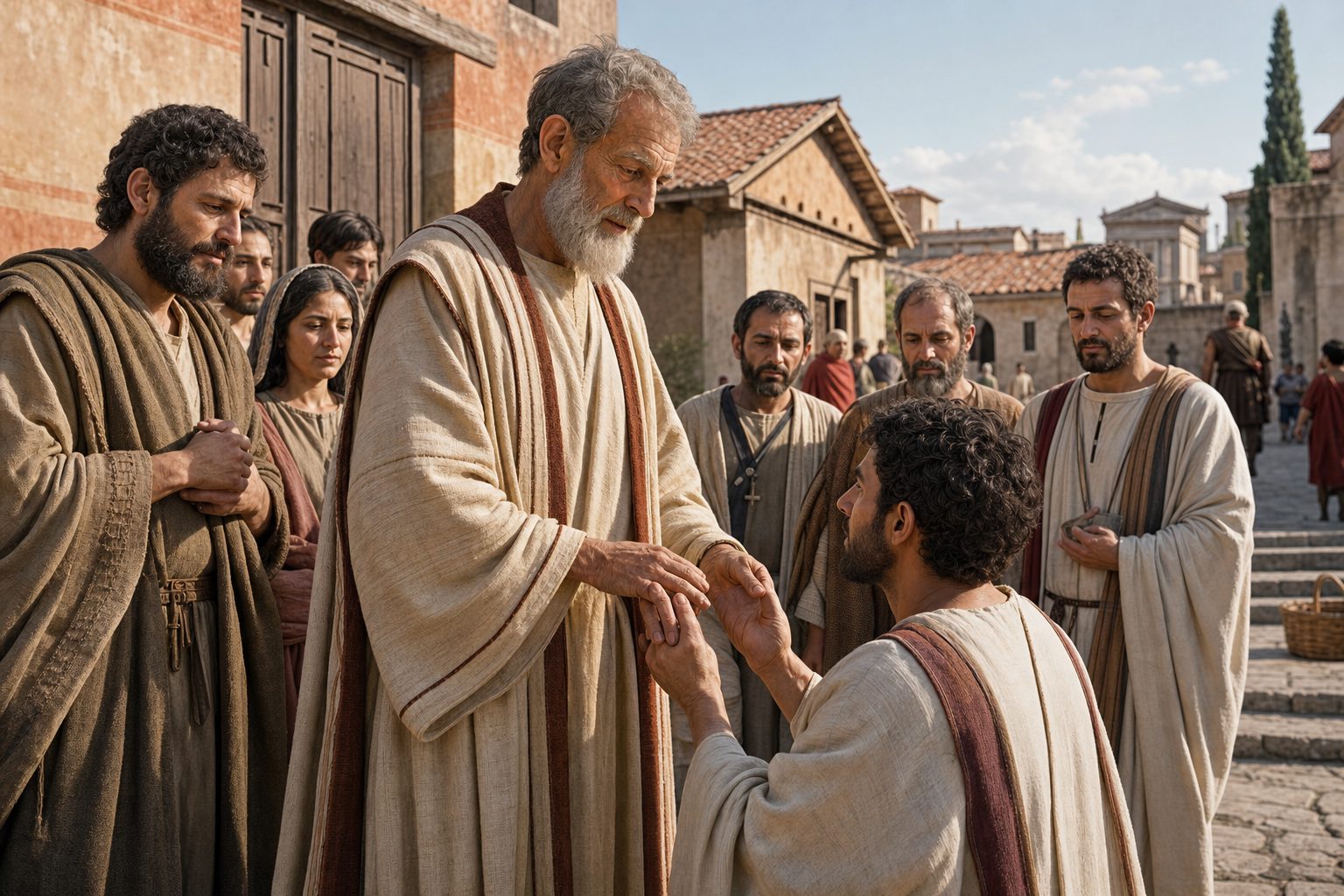
The memory of August 10
Pope Sixtus the Holy Roman [The name Sixtus, according to others, derives from xystos <unk> smoothed, polished, or xyston <unk> spear; others derive from Latin sisto <unk> firmly standing, firmly placed.] was seized along with his clergy and imprisoned by the Roman ruler Valerian at a time when the king Decius [Decius <unk> emperor 249-251] was solemnly returning to Rome [Rome <unk> capital of the Roman Empire, located in the middle of
Italy.] after defeating the Persians.
St. Sixtus was born in Athens, Greece, first as a philosopher, then as a disciple of Christ. When he came to Rome, he proved to be a wise and pious man, a very useful member of the Church of Christ.
When Pope St. Stephen was killed for his confession of Christ [Remember him August 2], St. Sixtus was put in his place, as if to a certain death: at that time there was no pope who would pass the chalice of suffering.
After their martyrdom, King Decius and King Valerian ordered that Pope Sixtus be brought to them at night in a temple known as Telluda.
<unk> Dear brothers and sisters, do not be afraid of the temporary suffering, remembering that the saints before us have endured great suffering to receive the crown of eternal life. Christ Himself suffered for our salvation, leaving us an example to follow.
"Do you know", said the boy to his father, "why you have been taken and brought before us?" "I know very well", replied his father. "If you know", said the king, "then do as others do in your place: this will save your life and increase the number of your clerics". "Indeed", my father confirmed, "I am constantly concerned about increasing the clergy.
"Then offer sacrifice to the gods, and you shall have dominion over all priests", said the king. "I always offer a pure and spotless sacrifice to the almighty God the Father, his Son, our Lord Jesus Christ, and the Holy Spirit".
"Until now", said St. Sixtus, "I have taken care of myself and my clergy, and I am taking care of myself now, so that I may save them all from eternal death". "Take him", decreed Decius to the soldiers, "to the temple of Mars, that he may offer a sacrifice there; if he does not do this, then imprison him in a special dungeon, Mamertinoff".
O blinded by the devil and worthy of all pity, why do you worship dumb and deaf idols that cannot help themselves or others? Listen to me, my children, repent and save your souls from eternal torment.
Saint Archdeacon [The duties of the archdeacon at the time described were not only to minister to the church, but also to administer church property, to provide for the poor, and to provide for the homeless.] When Lawrence saw that the pope was being taken to prison, he exclaimed to him: <unk> Where are you going, my father, without your son?
You have always been a partaker of the mystery of God. How much more, then, can I be a partaker of Christ's blood?
Take, therefore, my father, your son with you, do not leave, teacher, your disciple, offer me up to God as a sacrifice, as Abraham his son Isaac (Gen., chap. 22) and as the supreme Apostle Peter the first archdeacon Stephen (Acts, chap. 6-7), and after you have seen me come with the martyr's crown, you yourself go to him.
I am old, and therefore I go out to a lighter fight; but thou shalt find a more glorious victory and triumph over the tormentor. Do not weep: know that three days after my death, thou, Levite, shalt go after thy priest; thou needest not my presence for thy support.
Go, take advantage of this time: distribute the treasures of the church to the poor and needy as you see fit. St. Lawrence obeyed: taking all the treasures of the church, not excluding the utensils, he went around the city, looking for hidden clerics and poor Christians, and helped them as they needed.
There he found a widow named Kyria, a widow for thirty-two years. She had been a widow for thirty-two years.
I beg you, servant of Christ, lay your hands on my head, for I am in great pain. St. Lawrence gave her a towel, with which he wiped her feet and laid his hands on her head, making the sign of the cross, and said, "In the name of our Lord Jesus Christ, be healed".
And immediately she was healed. And that same night he went to a city called Canaries, and found in the house of a certain man named Narcissus, and many believers. And he washed their feet, and gave them out of the treasury of the church.
Our Lord Jesus Christ, who opened the eyes of the blind, enlighten you. With these words, he made the sign of the cross on the eyes of the blind; the latter immediately regained his sight and rejoiced to see the face of St. Lawrence.
When he heard that Pope Sixtus was being led to the temple of Telluda with two deacons, he hurried there to see what would happen. When the pope appeared before Decius and Valerian, the king said to him:
"Sorry for your old age, we wish you well, but listen to us and offer a sacrifice to the gods". "Sorry for yourself", said St. Sixtus, "and do not blaspheme the God of heaven, but repent of the shedding of the blood of the saints, lest you perish".
Then the deacons cried out to the tormentors, saying, "Oh, if you unworthy men had listened to our father's admonition, you would have escaped the eternal torment that awaits you". "How long will they live", said Valerian, "and threaten us with torment?
The temple of Mars was behind the city wall, in front of the Appian Gate. When the saints were brought here, St. Sixtus said, looking at the temple: <unk> May Christ, the Son of the living God, crush you! Before the Christians who were present could say "Amen!", the earthquake began, part of the temple collapsed and the idol in it broke. St. Lawrence cried out to the pope: <unk> Do not leave me, my father, I have already given the treasure entrusted to me by you.
When the soldiers heard of the treasure, they seized St. Lawrence and did not let him go, and the holy pope and the deacons were put to death on the hill in front of the temple, leaving their bodies unburied.
St. Sixtus was martyred on the sixth day of the month of August [258 A.D. The earliest evidence of St. Sixtus' martyrdom and veneration as a martyr is found in St. Cyprian's letter to Successus (80 or 82); St. Cyprian died five and a half weeks after Sixtus (14 September).
The relics of St. Pope Sixtus II are in the church of his name in Rome; the relics of the martyrs Felicissimus and Agapitus are in Rome, in the church of Our Lady of Mercy.] After the murder of St. Sixtus, the soldiers took St. Lawrence to the king and said to him: We have seized the archdeacon Sixtus: he has received a treasure from the bishop and has hidden it somewhere.
Where are the treasures of the church that you have hidden? St. Lawrence answered nothing to this. Then Decius gave it to bishop Valerian, saying: "Ask him about the treasures of the church and make him worship the gods: if he does not open the treasures and worship the gods, let him die in torment".
And Valerian took him, and delivered him into the hand of Hippolytus the captain of the guard, who was at the same time the keeper of the prison, and put him in the dungeon, where the rest of the prisoners were; and among them was a certain Greek, whose name was Lucilius, who was kept in the dungeon a long time, and was blinded with weeping.
"Believe", said St. Lawrence, "in the Son of God, our Lord Jesus Christ, and be baptized, and he will restore your sight". "I have long desired to be baptized in the name of Christ", replied the blind man. "Do you believe with all your heart?" St. Lawrence asked.
Hippolytus listened patiently to St. Lawrence's conversation with the blind man, wishing to see whether the blind man's eyes would indeed be opened and how this miraculous event would take place. St. Lawrence, after reading Lucilius and blessing the water, baptized him; and immediately the blind man's eyes were opened, and he cried out with a loud voice: "Blessed be the Lord Jesus Christ, the eternal God, who has given me sight!"
When the other blind men heard of this miracle, they came to St. Lawrence, who, laying his hand on their eyes with the sign of the cross and calling on the name of Christ, restored their sight.
"If you believe", St. Lawrence replied, "in the almighty God the Father and in the Son of his Lord Jesus Christ, you will have treasure and eternal life". "If what you say is true, I will do everything you say", said Hippolytus. "Listen to me", continued St. Lawrence, "and do what I command you: renounce the deaf and dumb idols and be baptized".
Hippolytus consented, and took St. Lawrence from prison to his own house, and after giving him instruction concerning the holy faith and proclaiming it, St. Lawrence baptized him. I saw, said Hippolytus at baptism, sinless souls in great joy.
"I beg you", said Hippolytus, "by the Lord Jesus Christ, baptize my whole household". And Saint Lawrence baptized in the house of Hippolytus nineteen persons, male and female. At this time, the order was given to Hippolytus to bring Saint Lawrence to Valerian.
When they both appeared before Valerian, the latter said to St. Lawrence: "Leave your stubbornness and show us the treasures you are said to possess". "Give me two or three days, and I will reveal the treasures to you", St. Lawrence offered him.
"I entrust him to you for three days", said Valerian to Hippolytus, "and let St. Lawrence go". And in these three days St. Lawrence gathered to the house of Hippolytus many poor men, widows, orphans, blind, lame, and sick.
"Behold, in them", said St. Lawrence to Decius and Valerian, "whom you now see as vessels of eternal treasures, and whoever puts his property in these vessels, he will receive it again in abundance in the kingdom of heaven".
"Why do you conspire", said Valerian, "offer sacrifice to the gods and cast off your sorceries, which you hope for. "Why do you allow the devil to teach you to force Christians to worship demons?" asked St. Lawrence, "Judge for yourselves whether it is right to worship a man-made idol with a demon in it, while forgetting the heavenly God, the Creator of all things visible and invisible".
When the king was enraged, he ordered the saint to be stripped naked, spread on the ground, and beaten with scorpions (the scorpion was called a tool for torture, <unk> it is a thin iron stick with sharp teeth). The holy martyr was beaten so cruelly that his blood covered the ground; Decius himself said at that time: <unk> Do not curse the gods, do not curse!
I thank my God that he has made me worthy to share in the sufferings of his servants, the holy martyrs, while you, you wretch, are blinded by your madness and rage. Then the boy ordered the torture to be stopped and lifted up from the land of St. Lawrence; then he ordered to bring and set before him an iron handkerchief, boards, tin rods and other instruments of torture; pointing to all this, he said:
"All will be for your torment, if you do not sacrifice to the gods". "I have long desired such a feast", replied St. Lawrence, "for your torment, but for our glory". "If these torments", scoffed Deikios, "are for you a feast and a glory, tell us where others like you are hiding, so that we may bring them here, and let them feast with you".
"You wicked men", said St. Lawrence, "you are not worthy to see those whose names are written in heaven". Then the king ordered the martyr to be brought bound to the palace of Tiberius, where he himself was going.
"Tell us", he said, "where the wicked Christians are hiding, so that we may purge the city from them. But you worship the gods and do not trust in the treasures that you have hidden".
"I am a slave of Christ", answered the martyr, "and in Him I place all my hope, and I know the heavenly treasures which Christ, my God, has prepared for me and all His servants".
Lord Jesus Christ, God of God, have mercy on your servant. I have been slandered, but I have not denied you. I have been questioned, and I have confessed your most holy name. Then the child ordered the martyr to be beaten with tin sticks, and St. Lawrence cried out. Lord Jesus Christ, receive my spirit. Then a voice from heaven came to him: You still have many sufferings to endure.
And when the people heard this voice, they came to a tumult and cried out, "Men of Rome and people, you hear the voice of the demons, comforting this sorcerer and saint, who does not honor our gods, does not listen to me, the king, and does not fear torment". Then he ordered that St. Lawrence be stretched out again and beaten with scorpions.
"Blessed are you, O Lord God and Father of our Lord Jesus Christ, "I thank you that you have counted us unworthy of your mercy, "but grant me also your grace, "so that all who stand here and see me may know that you are the comforter of your servants.
St. Lawrence, I see a bright young man standing beside you and wiping away your sores and all your body, I implore you in the name of Christ, who has sent his angel, do not leave me.
"We are defeated by this sorcerer!" and, having ordered the martyr to be loosed from his tongue, he delivered him to Hippolytus in prison. And the soldier Romanus brought a pitcher full of water to St. Lawrence, and fell at his feet, with tears, imploring him to baptize him. When he was baptized, other soldiers suddenly came, took him and brought him to the emperor; and before they even began to question him, he exclaimed: "I am a Christian!"
The king immediately ordered his head to be cut off, and Romanus was taken out of the city through the Salarian gate and beheaded on the ninth day of the month of August.
That night Decius and Valerian, being in the Olympic baths near the palace of Salius, ordered to prepare the court for the presentation of St. Lawrence to the last trial; with this they ordered to prepare all the instruments of torture. When Hippolytus learned of this, he began to weep.
"Why can't I cry out before you, 'I am a Christian,' so that I may die with you?" asked Hippolytus. "Keep your confession in your heart now", said St. Lawrence, "for in a little while I will call you, and you will hear and come to me". When the king and Valerian sat in the court, the holy martyr Lavrentius was brought before him. "Quit your magic", said Deceus, "and tell us what kind you are.
"I was born", answered the saint, "in Spain, brought up in Rome, and most of all a Christian; I have been taught the law of God since childhood". "Is this what you call the law of God", asked the king, "that we should not fear gods or suffer pain?" "The law that I have been taught", answered the saint, "has revealed to me and compels me to fear my God, the Lord Jesus Christ, whose name is strong.
"Bring a sacrifice to the gods", said the king, "or if you do not, you will be tormented all night". St. Lawrence replied, "My night is not dark, but all is bright". The tormentor ordered a stone of St. Lawrence to be placed in his mouth, and the holy martyr was even more strengthened in spirit, as he humiliated the king and thanked God. "Bring the iron scepter", said Deceus, "that the proud Laurent may sit on it that night".
And they brought a manger, which was an iron grating, and set it before Decius and Valerian, and laid upon it a naked holy martyr, and laid under the manger hot coals; and the servants pressed upon the top of St. Lawrence with iron hornets, and burned him, as though it were edible flesh. "Bring the sacrifice to the gods", said the king. "I myself", answered the martyr, "with a broken spirit offered the sacrifice to my God as sweet incense".
At this time the servants were making the fire hotter and hotter. 'Know, you wretch,' said the martyr to the king, 'that these hot coals give me cold, and you eternal torment: my Lord knows that I, who have been slandered for confessing His holy name, have not denied Him, but when questioned I said that I am a Christian, and now, being in the fire, I give Him my thanks. 'Where is that fire with which you threatened us?' asked Valerian.
"O foolish and blind!" said the saint, "know that these coals on which you burn me are cool to my soul, but they prepare an unquenchable fire for your souls". All who were present were astonished at the cruelty of the king, who ordered the man to be burned alive. St. Lawrence said with an enlightened face: "I thank you, Lord Jesus Christ, for you have strengthened me". And, looking up at Decius and Valerian, said:
"Behold, my beloved, you have already baked one part of my body, turn it over to the other and eat the baked thing". Then he praised God and said, "Thank you, Lord Jesus Christ, that you have made me worthy to enter through your gates". With these words he gave up his spirit.
Hippolytus, however, having stolen before sunrise the honourable and much-suffering body of the holy martyr, wrapped it in a robe of perfume and informed the holy prelate Justinus, who immediately came to Hippolytus, and the two carried the body to the aforementioned house of Kyriachia, where it remained until evening, and they fasted and wept all day long.
Late in the evening, in the presence of a large crowd of Christians, the body was carried with tears to the cave on the land belonging to the widow; after praying all night, the martyr was buried with honor.
And St. Hippolytus suffered with the others on the third day after St. Lawrence, as shall be said in his place more fully: for all this glory be to our God, in the Holy Trinity, glorious now and ever and unto the ages of ages. Amen.
The relics, or rather part of the relics, of St. Laurence were placed in the church of his name in Tsaregrad under Theodosius the Younger on 27 September. Currently the relics of St. Laurence are in Rome, in the out-of-town church in his name on Tiburtina Road, and the head <unk> in the house church of his name in the treasurer's palace of Quirinus.]
The fire of passion has burned you to the ground, the suffering affirmation, the god-bearer martyr Lawrence, and in suffering you cried out truthfully: nothing will separate me from the love of Christ.