St. John of Damascus 's words on the worship of holy icons
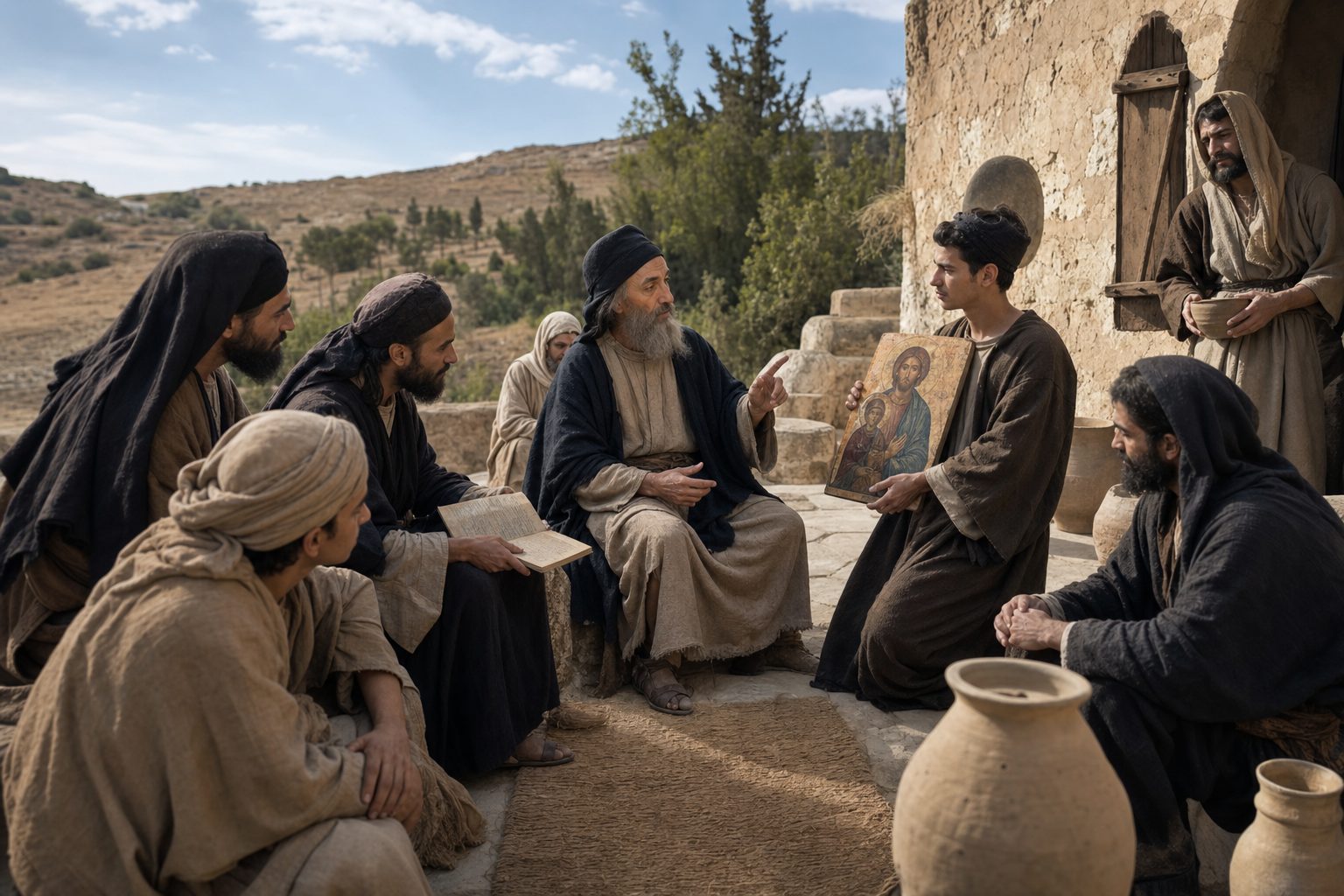
For as some reproach us for worshipping and venerating the image of our Saviour and the image of the Mother of God, and also the image (icon) of the other holy servants of Christ [Speaking of people who reproach Christians, St. John of Damascus is referring to the idolaters.
The heresy of iconoclasm began in the eighth century, and therefore St. John of Damascus was its contemporary.
<unk> Constantine, bishop of Nacoli (in Phrygia <unk> of the Asia Minor region), is considered the founder of the heresy of iconoclasm.
The most ardent advocates of the Iconoclasm were the emperors Leo III Isavranian (717-741) and Constantine V Kopronim (741-775). This heresy was condemned at the VII Ecumenical Council in 787.
Let them know that in the beginning God created man in his own image. Why do we worship one another (greet one another, if not because we are all created in God's image?
Basil the Great <unk> the most famous father of the Church of the IV century <unk> his memory is celebrated by the Church on January 1 and 30.] says that the honor paid to the image goes back to the original.
This is because the people were commanded to make the tabernacle "according to the pattern shown you on the mountain".
Are not the cherubim, which cover the altar, the work of hands? Is not the temple of glory, which is in Jerusalem, the work of hands?
And the sacrifices of the Hellenists and of the Jews were to be sacrificed to demons, and to God; and the sacrifices of the Hellenists were to be abhorred and cursed, but the sacrifices of the Jews were acceptable to Jehovah.
The sacrifice was offered to God by Noah after he came out of the ark (Gen. 8:15-20) and was a type of the sacrifice of Christ.] , and "the Lord smelled a pleasant odor" (Gen. 8:21), for this sacrifice was offered from a pure and benevolent heart; but the idol worship of the Elves, as abominable and God-hating, was forbidden and
They were cursed because they worshiped demons.
Who else can depict the face of the invisible, incorporeal, indescribable, immutable God? It would be a foolish godlessness to desire to depict the Godhead as it exists in itself.
But when the time came for God's mercy to be revealed in the form of a man, not just in the form of a man, but in the form of a man,
He was buried, raised from the dead and taken up to heaven. These things are real, seen and unseen, and they were written down for our instruction.
And as not all men had the knowledge of the scriptures, and not all had the gift of reading the scriptures, the holy fathers unanimously decided to depict all this on icons for quick remembrance, as glorious victorious signs.
For we often forget the sufferings of the Lord in our own inflexibility. But when we look at the image of Christ crucified, we immediately remember his saving sufferings, and, bowing, we worship not things, but Him whose image we see before us; for we do not worship the material of which
The gospel, however, is the written word of God, just as we worship, not the material, but the figure of the crucified Christ.
The cross would be no different from the material of which it is made if it were not the image of the Crucifixion of Christ.
In the same way, the courageous deeds of the holy pilgrims depicted in the icons inspire us to be courageous, zealous, and to imitate their virtues and to glorify God, and as we have said, the honor we pay to the venerable pilgrims depicted in the icons is a testimony of our
zeal before the common Lord of us all, and besides, that honor rises to the true original.
What we have said is not in the Scriptures, nor is it in the worship of the east, the veneration of the cross, and many other such things.
In the History, it is written that Avgar, the king of Edessa, sent his painter to paint the image of the Lord, but he could not do what he was told because of the wonderful light emanating from the face of Christ.
Then the Lord himself put the veil over his divine and animate face and painted his likeness on the veil, which he sent to Agar to fulfill her desire.
And that the holy Apostles have transmitted many things to us without the Scriptures is borne out by the Apostle of the Gentiles, St. Paul, when he says: "Therefore, brothers, stand firm and hold fast to the traditions that you were taught, whether by word of mouth or by letter from us". - 2 Thessalonians 2:15.
And in another place: "I praise you, brothers, because you remember me in all things and hold fast the traditions as I handed them on to you". (1 Cor. 11:2)