The life of our Mother Makrina
St. Makrina was born in Cappadocia during the reign of Constantine the Great (306-337), the first child of Vasily and Emilia, and was the older sister of Vasily the Great (1 and 30 January), Gregory of Nyssa (10 January) and other brothers and sisters.
This first daughter, before her birth by divine revelation, was given the name of Fekla by the former mother in a dream: it was just before the time of birth that the mother fell asleep and saw in a dream that she was carrying an unborn child in her arms.
And there came as it were some fair and honest man, and looked tenderly upon the child, and three times called him Phecla, signifying that this child would be the imitator of the chaste life of the holy first martyr Phecla, and a free martyr without blood.
After awakening from this vision, Emilia gave birth to this child and named him Fecloa; but her household and relatives preferred to call her Macrina, after her paternal grandmother, Saint Macrina, who ruled the eastern half of the Roman Empire from 305 onward.
She was persecuted with her husband for Christ, and for seven years she wandered in the wilderness, enduring extreme poverty until the persecution ceased.
The custom of calling her Macrina was so strong among the people that some did not even know her first name, and everyone called her differently: we believe that under both these names is written in heaven, in the book of life, this bride of Christ.
The girl was breastfed, and when the child came of age, her mother began to educate her and teach her literacy, not starting with pagan fables (as other mothers usually did) and not with the works of poets, which contain many things unworthy of a pure virgin's ear; she chose from the book of Solomon's wisdom [Book of Solomon's wisdom <unk> a biblical book of the Old Testament; belongs to the non-canonical ones].
It contains praise of God's Wisdom.] and from the Psalms of David or from other books of divine scripture appropriate verses, and precisely those that contained either prayers and praises of God or good moral teachings.
The girl learned well, she was able; and she had constantly on her lips the words of the book and the prayer song at all times of the day: whether she got up from her bed, or took up some business, sat down to lunch or got up from the table, noon and evening she did not miss without singing, psalms, and, going to save, she performed the prescribed prayer.
She was taught by her mother and the handcraft that is typical of a girl, and she was not allowed to spend time in idleness and child's games, but was constantly engaged in either reading books or handcraft.
And when the child was twelve years old, she was so fair that there was none like her in all the land; and the beauty of her face could not be portrayed even by the painters; and many rich men and nobles besought her father, every one desiring to marry her to his son.
And Makrin's father, being a wise man, chose a young man from among them, and he gave him Makrin, his fair daughter, in marriage; but he delayed until she grew up, and he waited, and he learned.
Then the blessed maiden, who in her youth had the wisdom of an old woman, resolved firmly not to marry anyone, but to keep her virginity pure until the end of her life. Many young men begged Makrina to marry, and her parents and relatives themselves urged her to marry; but she, not in her years of reason, as if she were not young, but rather an old woman, in her prudence and prudence, answered:
<unk> It is not good for a virgin, betrothed to one husband, to marry another, it is illegal to violate the once made engagement; for by natural law marriage must be one, as one birth and one death, and he to whom I am betrothed and who is said to be dead, is not dead, <unk> I believe in the hope of the resurrection, <unk> but alive and has only gone far into another country until the time of the common resurrection; not a little sin and shame to a wife, if she, in going somewhere of her own
and if she be unfaithful to her husband, and join herself to another man,
Thus answered the wise maiden Makrin to every one that spoke to her of marriage, and advised her to marry, and she kept herself in a pure virginity; and she was continually with her mother, as with a watchful keeper of her life, and she served her diligently, with humility, not ashamed of those works which the maidens did, but worked all together with them as one of the slaves.
Especially when her father went away to the Lord, she became for her widowed mother an indomitable servant and comforter in all her sorrows and sorrows; she watched diligently over the whole house, and to all her other brothers and sisters, as the eldest, she was a teacher and mentor, as a second mother, especially to the last brother Peter, who was born at the time of his father's death: when he appeared in the world from his mother's womb, the father left the world; this last brother herself.
St. Makrina taught him to read, to read, to be wise and to live a good life, and he became a saint, not the last among God's people.
When her brother Vasily, who was born after her, returned home after many years of studying in various countries and began to be proud of his learning in his youth, Saint Makrina's gentle and godly speeches soon led him to such humility that he soon despised all the things of life and chose a monastic life for himself.
This true servant of Christ and another brother, Necratus, who was still a young man, converted him to the love of God and to a pure life by his soul-serving conversations: leaving everything, Necratus went to the desert, where, serving elderly deserts, he ended his life in his younger years.
At the counsel of this prudent maiden and her mother, Blessed Emilia, having given the rest of the daughters in marriage and set free the slaves and maidens, they left the cares and care of this vain world and became Christ's brides, taking upon themselves a pagan form.
Some of the slaves also wanted to renounce the world with them and go to the monastery, and they had everything in common, one cell, one table, one garment; they had all the necessities of life equally; they served the Lord with one mind, in humility, meekness and love, and they had no anger, envy, hatred or contempt, anything that would not please God, but they were completely alien to worldly desires and vanity.
And they said, 'We have no power to save you from the torment of the Fire, nor can we save you from the torment of the Fire, nor can we save you from the torment of the Fire, nor can we save you from the torment of the Fire.
They are as the mediators between men and angels, as pure as men, and equal in purity and restraint. They are not like the angels, but they have bodies.
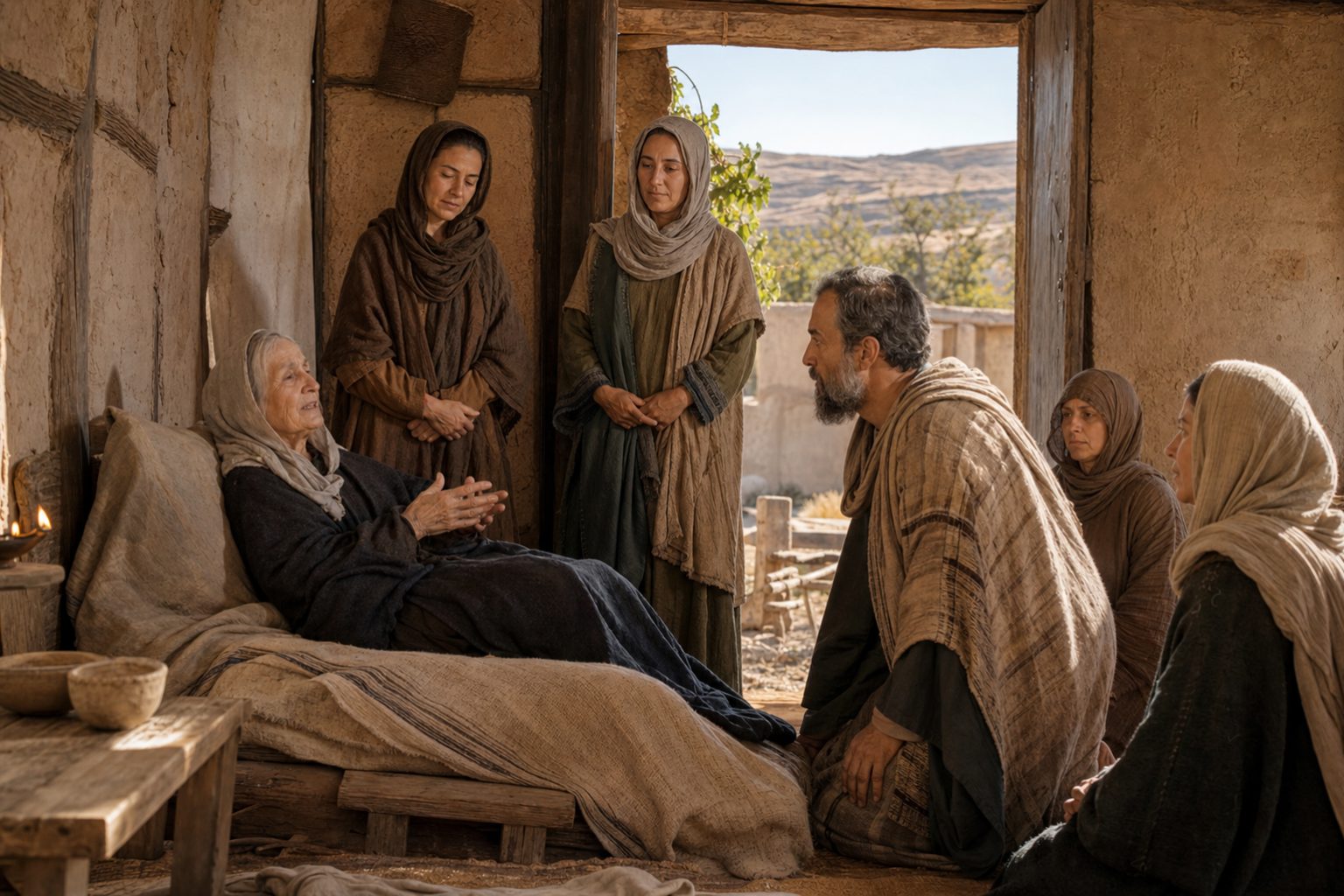
When St. Emilia was approaching the end of her life and her body was weak, her last son Peter, who led a godly life, came to her and, together with St. Makrina, cared for her mother during her illness.
When she was separated from her body, her children, Macrin and Peter, sat on either side of her dying bed, and called out the names of the other brothers and sisters, and she, as a treasure, left her motherly blessing to all.
Thou hast commanded in the old covenant to bring unto thee the first-fruits of the harvest, the first-baked bread of the new wheat, the wool of the first-fruits of the sheep, etc.; all these were brought in the old covenant into the tabernacle for the support of its ministers, the priests and the Levites.
The number of firstfruits is not specified in the law of Moses, but it is believed that it was at least the sixteenth honor of all the produce of the land.] and the tenth of the fruits [Tenth, i.e. the tenth part.
And the children of her mother buried her with honour, and laid her in the sepulchre of her father, beside the dead of her husband: thus she commanded before her death.
Some time after this, St. Basil the Great was appointed archbishop of Caesarea of Cappadocia and consecrated his brother Gregory (called Nissus) as presbyter, and also invited another brother, Peter, to himself and assigned him to the church priory; upon learning of this, St. Makrina rejoiced in her soul.
After nine years she heard again of St. Basil, that he had turned to the Lord, and she was bitterly grieved, grieving not so much for the death of her brother, as for the fact that such a lamp of the Church had gone out and such a pillar of piety had fallen.
He was summoned for the consecration of the temple, founded by Emperor Constantine (306 <unk> 337), but completed by his son, Constantius.
At the council there were 25 rules for church administration.] After the death of Basil, a council of bishops was convened at Antioch, at which I was also present (says Gregory); after the council I went to visit and see our sister Makrina; we had not seen her for a long time, <unk> hindered by the many troubles and troubles to which I was subjected, persecuted everywhere by Arians.
And I went to her, and when I had gone a long way, and was near my destination, the night before I came to my sister, I had the following vision in a dream, and it seemed to me that I was carrying in my hands the relics of martyrs, from which came bright rays, as from a bright mirror set against the sun, so that my eyes could not behold the bright glow.
And the vision was repeated three times in one night, and I could not understand it; and I was grieved in my soul, and went on my way, waiting for the fulfillment of the dream. And when I was near the place where the blessed Makrin lived an angelic and heavenly life, and many came out to meet me and saluted me, I asked one of my acquaintances about my sister Makrin, and they told me that she was gravely ill.
I hurried, sorrowful in heart, and when I came to the monastery, I went first to the church, where all the nuns were waiting for us. After prayer and blessing I saw that among the nuns there was not their abbot, my sister Makrina, and my heart was heavy. I went to her cell and found her gravely ill, lying not on the bed, but on the floor, on a plank covered with a chisel; the wooden head was also covered with a chisel.
And when she saw me, and came in, she bowed herself and fell on her hands, and could not rise, but bowed herself as low as she could from the bed, and I hastened and laid her in the same place, and kissed her with tears.
Then she began to speak to me, concealing her illness: she did not want to grieve my soul, so she occasionally groaned faintly, trying to somehow contain her frequent sighs, and looked at us with a calm face.
When she saw my bitter tears, she immediately stopped talking about Basil and began to talk about something else; she began to talk about God's marvelous plan and His care, about the coming age, about why man was created and how he became mortal, how through temporary death he passes to eternal life, and other divinely inspired speeches she gave, giving us great benefit and joy to her soul: she was full of the Holy Spirit, as if from a source from which all grace flowed from her mouth, and all the grace of God flowed from her lips.
Her mind was occupied with heaven.
And when she had ended her conversation, she said unto me, My father, take a little rest from the long journey, and strengthen thy body with food. And I would not leave her, and would not cease my conversation, in which my soul was at rest; but I dared not disobey her, because she desired it; and I departed from her.
We had a place to rest in the nearby garden, very beautiful, under the shade of the trees, but nothing pleased me; my heart hurt; I saw that my sister was close to death, and I waited for the fulfillment of my dream, which, I already understood, was beginning to be fulfilled, and which I interpreted to myself as: the relics of martyrs. This is Sister Makrina, who, indeed, exhausting herself for so many years with fasting feats for the love of God, died.
Her body was like a martyr to sin, so that the rays of light that came from the wombs were a sign of the gift of the Holy Spirit that dwelt in her.
In the midst of these sorrowful reflections, the blessed one, knowing this in spirit, sent to tell me that her illness was lessening and she was getting better. This she did so that I would not be sad and lose hope in her recovery; this she comforted me with, speaking in a tongue-in-cheek way not of her bodily but of her spiritual health, so that, rejoicing in this good news, I took food and slept a little.
When I came to her again, she began to talk to me again, remembering all the good things that had been done to her and to our whole family, and I thanked God for them. I listened to her and enjoyed her words, thinking to myself, "If only this day were real, I would enjoy her talks more".
And when I came to her the next day, I saw that she was dying, and I saw that all the strength of the body had departed from her, and I was very sorrowful; and she understood my sorrow, and comforted me with many inspired words and comforting words, and she was full of spiritual joy, having neither fear of death, nor even of any sorrow, but only hope in God.
And at midday she became even more weary, and ceased to speak to us, and she began to talk to God, lifting up her hands, and she prayed in a voice so low that we could hardly hear her, saying, "O Lord, You have removed from us the fear of death, You have made the end of this life the beginning of a better life for us.
Thou hast entrusted to the earth as a treasure our frail body, the work of Thy hands; and what Thou givest to it Thou wilt again require of it, turning the mortal and unpleasant into the immortal and beautiful; Thou hast delivered us from the curse and sin; Thou hast crushed the head of the serpent [i.e., the devil (compare Gen. 3:15) ], and from its mouth Thou hast delivered the devoured man.
Thou hast broken the gates of hell, and subdued the power of him that had power over death, and hast opened the way to the resurrection, and hast given to them that fear Thee a sign, thy holy cross, to confirm and preserve our life. Eternal God, to whom I have been devoted from my mother's womb, whom I have loved with all my soul, and to whom I have given my body and soul from my youth.
Send unto me an angel of light, that he may lead me to a place of light and coolness, where there is resting water, and the bosom of the holy fathers.
Thou who didst remove the fiery weapons, barring the entrance to Paradise to the thief crucified with Thee, and entrusted thyself to Thy mercy, remember also me, Thy servant, in Thy kingdom, for I too have crucified myself with Thee, abiding in Thy fear, and always obeying Thy commandments.
Let not the great abyss separate me from Thy elect, nor let envy hinder me in the way, let not my sins be before Thy eyes, which I have committed before Thee, either in word, or in deed, or in thought, because of our natural weakness. Forgive me, for Thou art able to forgive sins.
"Make my soul pure, without blemish, pure, and blameless before you, and let it be like incense to you". With these words, the blessed crossed her eyes, mouth, heart, and with prayer committed her soul to the hands of God.
It seemed as if she had fallen asleep in a normal sleep: her eyes closed, her mouth closed, her hands properly on her chest, her whole body so well dressed that it did not require any clothing from human hands. I looked at her and wept bitterly, as did the nuns who had held back their tears for fear of upsetting their spiritual mother by weeping, and who hid their heartbreak when they saw that she was no longer breathing, and they immediately wept loudly and bitterly.
It was hard to get them to stop crying and to start the usual song and prayer, and then I asked them to leave the room for a while and stay with the deceased with a few people who were closer to her in life and served her, one of whom was named Vestiana.
She was of senatorial birth, married, but lived with her husband only a short time, for he was soon gone from this life, and she, being a widow, desired not to marry again, but, despising the fame, wealth, beauty, and pleasures of this world, went to the blessed Makrina, found in her the tender guardian of her widowhood, and remained with her many years, successfully venturing into the life of paganism.
Now let this dead virgin's body be clothed in clean clothes. Then Vestiana asked another nun, Lampadia, what our spiritual mother had said about her funeral. Lampadia, in tears, said to me, "The death of this venerable mother of ours was adorned with a pure life, and body decoration, as she never demanded in her temporary life, she did not prepare for her burial.
Here's a hairdresser, here's a simple dress, here's a worn-out cloak and a head covering, here's a bad sandal, here's all her wealth, and nothing is hidden anywhere, not in a chest or in a chest: she only had a chest and a treasure, a heavenly abode, where she put all her belongings, and left nothing on earth.
And the nuns said unto me, If she were alive, she would not have refused thy gift; for she esteemed thee, and loved thee; she esteemed thee as a saint, and loved thee as a kindred, and as a sister; and I sent for the burial garments, and commanded Vestiane and Lampadiah to clothe the dead.
Vestiana, wearing the fair body of St. Macrina, took off her wrist the iron cross and the ring, also of iron, on which the cross was depicted, and said to me: <unk> This is the ornament she wore on the neck of the bride of Christ! Then I took the ring, and gave the cross to Vestiane. At the same time she said to me: <unk> You have chosen a good part for yourself, father; in this ring there is a part of the life-giving tree of the fair cross of the Lord. Then she said to me:
"Behold, my father, a marvelous thing, "and opening a little of the dead woman's breast, "she showed me the mark of the former wound on her body,
When the Blessed Mother was still living with her mother, she had a painful and incurable wound in this place, which had to be cut, for which it was necessary to seek the help of skilled doctors: otherwise it would have to spread throughout the body, touch the heart and cause her death.
And when she saw her naked breast, she was afraid to let a man look at it or touch it, and she preferred to suffer and die rather than go to the doctors, and one evening she went to the prayer-room, and shut herself in, and prayed all night, and prayed, and watered the earth with her tears, and asked God, the true Physician of soul and body, for healing.
Then she took a handful of earth, soaked with her tears, and laid it on the wound. The next day her mother, grieving for her, again persuasively asked her to allow the doctors to heal her wound. She replied: "It will be enough for me, mother, if you put your hand on my wound and cross it with it.
And when the mother put her hand under her robe and cross, and touched the place of sickness, she found no sickle: by the power of God she was healed, and the wound and pain disappeared, and only a small sign remained in the place of this sickle in remembrance of the miracle of God.
And they laid her in the sepulchre of her parents, beside the sepulchre of her mother; and she commanded that they should lie with the dead.
Of her miracles, St. Gregory, her brother and the author of her life, mentions only one: how she healed a girl who was blind in one eye (she had cataracts) while she was still alive, kissing the girl in her diseased eye: from the kisses of her holy lips, the cataracts disappeared, and her eye began to see well.
And many other things which I have heard from nuns who lived with her, and knew her works well, I have not written in this account, because many, when told, believe only those things which they themselves can do, and that which they cannot believe, and count it a lie.
So I will not go on to tell you how in times of famine she did not run out of wheat, and how she fed the needy with her hands, and how she gave bread to the hungry, and how many other miracles she performed: quick healings of diseases, casting out demons, prophesying, foretelling the future.
Yet I will keep silent because I do not want to condemn those who are weak in the faith.
The good God was loved by the holy Makrino with all her heart, and she accepted the cross on her shoulders and followed Him diligently, and was forgiven of her sins.