The life of St. Julian .
St. Julian (known by some as Simon the Leper, mentioned in the Gospel (Matthew 26:6) and who changed Simon's name to Julian in baptism), was appointed bishop by the Supreme Apostle Peter and sent by him to Gaul to preach the word of God.
Dionysius the Areopagite, a member of the Athenian Areopagus, who was converted to Christ by the preaching of Paul the Apostle, who ordained him bishop of Athens; then he was sent to Gaul to preach in 90 together with the presbyter Rusticus and the deacon Eleferius and suffered with them in 96 under the emperor Domitian.
Dionysius the Areopagite October 3.]: for in one year both of them laid the foundation of the holy faith in those lands and established the church of Christ, laboring apostolically in preaching and caring for the salvation of human souls.
At first the new doctrine preached by St. Julian was a temptation to the unbelieving Kenomans, but when the Kenomans saw the miracles wrought in the mighty name of Christ, they gradually began to believe it.
For by the hands of the preacher of the true God many miracles were wrought: he cast out devils, cleansed lepers, opened the eyes of the blind, and healed every kind of disease; and he testified to his doctrine of God by miracles, calling upon the name of Christ, and making the sign of the cross upon the sick, and healing their bodies, and at the same time healing their souls, preaching the gospel of Jesus Christ, and enlightening them by holy baptism.
At first, the saint lived in a small house on the outskirts of the city, and many people began to come to him: new converts for instruction, and unbelievers for healing from their diseases, and here the latter received double healing, becoming believers.
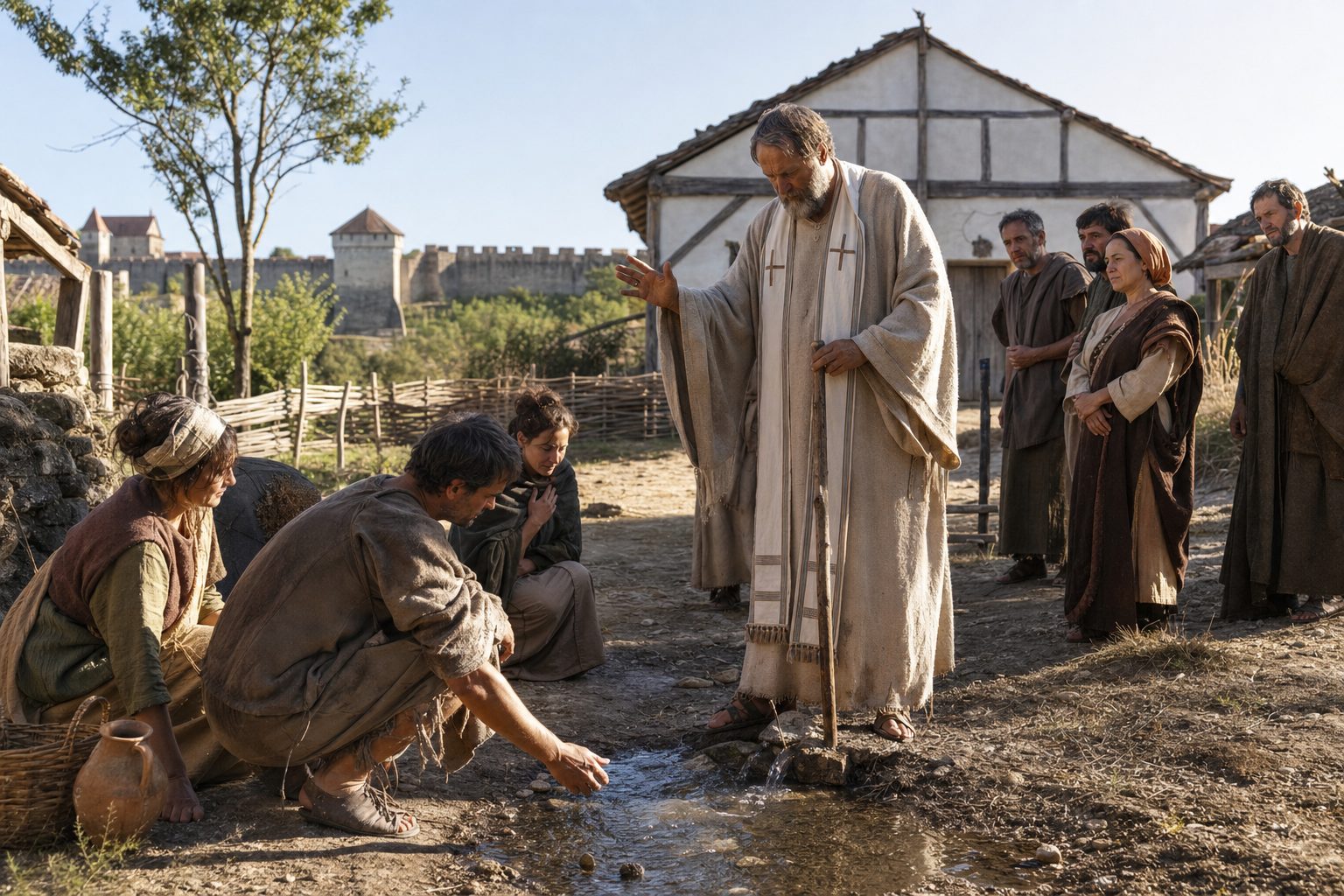
And there was no water in the place where he dwelt; and the people that came to him and that remained with him were in great want of water, and they came from afar. And the man of God and the men that were with him went out to a brook, and cast his staff into the earth, and cried to God in the ears of all the people.
O Lord our God, who once drew water out of the rock for Thy thirsty people in the wilderness (Numbers, chapter 20), look upon us, Thy servants, and open to us the treasury of Thy bounty, and cause a fountain of living water to flow out of this dry land, that all that are to come may know that Thou art the true God, who in the end of the ages hast sent Thy Son into the world to lead believers in Thee into the true promised land.
When the saint finished praying and the faithful said "Amen", immediately a spring of water gushed from the ground where the rod was thrust, showing the people the omnipotence of God's power and the great faith and boldness toward the God of holy pleasure.
When the holy bishop Julian became famous for his miracles, the prince of that city, named Defensor, desired to see him and sent for him with honor. The saint went to the prince; as he approached his house, he noticed at the gate a blind man begging for alms; feeling pity for him, he called on the name of Jesus Christ and, shading his eyes with the sign of the cross, restored his sight.
And when the prince saw the blind man and the holy man, he bowed himself to the prophet, and brought him into the house, and fell at his feet, and humbled himself, and asked him to show him the way of eternal life.
The Holy One, blessed be He, instructed the prince and his household in the holy faith, that is, in the knowledge of the true God, and, having appointed a fast, prepared them for baptism; and after a few days the prince with all his family was baptized and gave the saint his house in the middle of the city for the arrangement of a church, providing the church itself with the donation of the appropriate funds.
He also built a beautiful church, lavishly decorated it, and began to gather here a people who were taught the faith, enlightened by holy baptism and confirmed by miracles, for St. Julian had such miraculous power from God that he even raised the dead.
And there was in the city a certain nobleman named Anastasius, who had not yet received the holy faith, and was a worshiper of idols; and he had a beloved son, and he fell sick and died. And the father, being filled with great compassion and sorrow for his lost son, came to the saint, and weeping cried unto him, saying, Julian the servant of God, who teaches Christ as the true God, I beseech thee by Christ the God, whom thou preachest, bring me my son again.
And he swore, saying, If I have a living child, I will put my trust in Christ the true God, and will forsake idols.
And when the priest came with his clergy to his house, and saw the dead body of the young man, and many weeping and wailing, he commanded them to be silent, and all looked at him, and wondered what he would do with the dead body.
Lord Jesus, who raised the son of the widow of Nain from the dead (Luke 7:11-16) and called Lazarus, who had been in the grave for four days (John 11:43-44), command that this boy also rise from the dead, for when he rises in the body, many souls will rise who believe in you.
Let all who are to come know that you are the Christ, the Son of the living God, who brought salvation to the world by the command of the Father, and through you we are to be praised forever. " The clergy said, "Amen. " Immediately the boy stood up, as if he were sleeping, and was in good health.
And he believed and was baptized, he and all his household. And it came to pass after some days, that the Lord wrought another sign by the hand of Julius, a servant of the Lord, for the glory of his holy name.
The deceased had one son, a single son, named Junias, who was a member of the Sanhedrin. A large crowd of people was with him when he died.
When the holy bishop came to them, he ordered the bearers to stop and, waving to the people to be quiet, he said loudly to the father of the deceased:
John, the Christ whom I preach, who came in the flesh for men, raised the dead, cast out demons by the word, and lived among men to manifest the power of his divinity,
Then fell Ioannis and all the people at the feet of the saint and begged him to resurrect the dead. With tears in his eyes, Ioannis said to the saint: "Great servant of God, Julian, if you will save my only son, who has been the comfort and joy of my life, not only will I believe in Christ the true God, but all this people, having abandoned their gods, will accept with zeal the faith you preach.
The holy man, full of miraculous grace, knelt down, raised his eyes to heaven, raised his hands, and in the hearing of all, prayed to God:
Lord Almighty, who took flesh for our salvation, who lived among men and who drove out death from the human race by the sign of your cross, command that this boy be raised from the dead, so that by the manifestation of your great power the faith of believers may be strengthened, and the hearts of unbelievers may be made obedient to you, the only Son of the living God, whom we confess with the Father and the Holy Spirit to reign forever and ever.
And they said, Amen. And immediately the dead man arose from his bed, and they were all amazed.
We have indeed been in error before, in ignorance of the true God, for our gods are demons. I have seen them in hell, and I have seen them restless and continually tormented in fierce torment.
And all the people began to praise Christ the true God with a loud voice, and believed in him, and were taught by the holy bishop, and were baptized with John and his son. And so the good shepherd found the lost sheep and went on his appointed way, accompanied by a multitude of people who wanted to enjoy his inspired words and see his miracles.
When St. Julian approached a village called Proilaiacus, the day had already fallen and they entered the village late in the evening, wishing to rest there. At this hour the lord of the village had a young son who had died; the saint, hearing the weeping in the house, entered here, remembering the words of Ecclesiastes: "It is better to go to the house of mourning than to go to the house of feasting" (Ecclesiastes 7:2).
And when he was delivered alive to his parents, they turned it into joy and gladness, and the people of the town came out to see him.
And when they saw the miracle which he did, they brought unto him many of their sick, and he prayed and healed them all.
As he neared the town of Lydda, some men went to the chief of the village and urged him to come at once. His only daughter was possessed by a demon, and she was suffering greatly. Her parents and relatives were greatly distressed.
The Saint of Christ went there with an accelerated step and, having driven out the demon from the youth, brought her parents to the faith of Christ, the idols there, destroyed and built a church, and stayed here until the whole village and its surroundings were brought to God by holy baptism.
From that place Paul went to the town of Artemis, where there was a temple of the evil god Jupiter.
The inhabitants of that village and its environs, who were zealous ministers of demons, heard that a Christian bishop was coming to them, and they gathered in a crowd and did not want to let him in, for they were afraid that he would do to their idol what he had done in other villages, throwing them into the ashes.
And when the man of God came to them, they cried out with a loud voice, saying, Let him be put to death, for he is a destroyer of the ancient customs of the fathers; and they cried out, saying, Let him be burned, for he is a sorcerer, a liar, and an enemy of their gods. And they were very angry with him, but they could do him no harm, because the right hand of the Most High was upon him.
Armed with armor and the weapon of the invisible divine power, he, like a brave warrior, boldly passed through the people's revolt, entered the idol shrine and, calling upon the almighty name of Christ, ordered the idol to fall, and the demon to come out of it; and immediately the idol, falling to the ground, crumbled into dust, and the demon clearly came out of it in the form of a huge and terrible serpent, spewing fire from its mouth, and he rushed at his servants, for many of the unbelieving people had entered the shrine.
He began to devour and destroy people in a rage.
The people, not being able to escape from the anger and venom of the serpent, began to call upon St. Julian for help, asking him to save them from such a calamity. The servant of God stretched out his hand to the serpent and the sign of the cross, as if with an iron rod, began to beat and drive him away and ordered the visible demon to stop harming people and go to the abyss of destruction.
O servant of the true God, save us from the dead. The saint, having taught them enough, won them all to Christ, for those men diligently accepted the faith, were baptized, the shrine was destroyed, and in its place, by the order of the saint, a church was built to the glory of Christ God, and in other places where there were idols, they destroyed them, and great joy came into the land on the occasion of being freed from idolatry.
And the shepherd went out from the fold of his flock, and led the sheep of the word into the spiritual field, and delivered them out of the mouth of the wolf; and there remained a small number of the slain, who did not forsake their former beauty.
Then he himself went to the priest and, after a kindly greeting, begged him to come to his village; the prince had a beautiful house and a great name; the latter wanted the priest to make a spiritual celebration here on the occasion of the victory over the eradicated idolatry, and to be present at the feast <unk> let all rejoice in the glory of God, thanks to the human loving kindness of the Lord.
And when they came to the king's house, they found a young man lying on the ground, and a great man bound his feet as with a rope, and girded his whole body, and they were all afraid.
"Lord Jesus Christ, the man who lost paradise from the serpent's clutches, who saved this creation from its clutches by your cross, save this creation from its clutches, so that the future may know that you are the Savior of all who put their trust in you".
When they came near the village to which they were going, a crowd met them. Two demon - possessed men came running to meet them. They cried out to the holy man who had been possessed by the demon, and he immediately drove the demon out by using the name of the Lord.
The healers and all who were there believed in Christ, and the saint of God was received with great honor and love in the village, in the prince's house, and there was a great celebration, not only for the body but also for the spirit, for all the discussions of those present were about the glory and power of Christ and about the destruction of demons, defeated and humiliated in idols.
At the end of the feast, which was to the glory of God, the prince showed the bishop all his treasures, asking him to take whatever he wanted, but the saint did not want to take anything, because not gold and silver, but the salvation of human souls served as his most precious treasure.
After spending some time there, Paul and Silas preached the word of the Lord to the governor and to all his family. They were baptized, and Paul went back home.
The merciful father took pity on them and, before going home, went to the magistrates, who were entrusted with the administration of the city, and begged them to release the prisoners in exchange for his return; but they did not respect the request of the bishop, and he went away sad.
And when he came to the church, and gave thanks to God, who had saved so many souls, he entered the house, and there was a table set before him, and he would not eat, because of the fate of the prisoners.
When they came out of the prison, they went through the whole city to the house of the chief priest, and no one spoke to them, because everyone saw that it was not the hand of man, but the power of God, that had freed them from the chains and released them from the prison.
The holy bishop Julian, guiding the newly enlightened church and feeding the newly gathered flock of the word sheep, stayed on his throne for quite some time and, laboring apostolically in the gospel of Christ, being already a masticated elder, approached his honorable death, having completely eradicated idolatry and demon worship in the land of Kenenani.
A few days before his death, the priest left the city for a village belonging to the church, where he fell ill.
In the city they learned of his illness and gathered to the saint clerics, devout citizens and all who were burning with love for him; the saint, having taught them for some time, after his death ordered him to be elected successor to the presbyter Turivius, who worked with him to save human souls; after that, having performed the last kiss and given the blessing of peace, he gave his holy soul into the hands of God.
It did not happen at the time of the saint's death that he was not in the city at that time, but he was slowing down in his remote village, but it became known to him in this way: on the day when he pretended to be a saint, the prince was having dinner in his house with his friends, suddenly his spiritual eyes were opened and he saw that St. Julian, dressed in sacred robes, with three deacons carrying lamps, entered him and offered a blessing, and the deacons placed
The lamps were on the table, and they were gone.
"Do you see all this magnificence? " he asked those around him". No, " they replied.
Have you not seen our father Julian, who has shown us so much goodness and done so many miracles? Now he has come in here with three deacons and three lamps, and with a bright and joyful face he has blessed us, leaving us the lamps, and has gone away. I think he has already recovered, for we have heard that he is ill.
And the prince rose up and went in haste to the city, and to the village, where he thought he was holy; and behold, he was dead in the Lord, and wept bitterly, and all the people wept for their father and for the shepherd. And they set his honourable horses upon his chariot, and brought him into the city.
When they came to the river called the Sarta, which flowed near the city and was very deep and had to be crossed by ferry, the horses carrying the chariot with the saint's body instead of getting on the ferry rushed straight into the river and, guided by an invisible hand, walked along the deep river as if on a bridge, without soaking their feet even to the knees.
And when they were come over to the other side, all were astonished and terrified at that glorious miracle, that the wonderful miracle-worker St. Julian not only worked miracles in life, but also in death.
And when his body was carried in the city, and all the people were running to meet him, a woman was washing her infant in a copper basin, under which she had put a small fire to warm the water; and when she saw the body of the saint, and the multitude with candles and incense, and heard the singing, she forgot her infant, and left him, and went out to see the procession of the righteous man's body; and she stood and watched until they had passed the house.
And when she returned, she saw the fire burning, and the water in the basin boiling, and she cried, and she drew the basin out of the fire and poured out the hot water, and she found the child alive, and in no way damaged by the boiling.
St. Julian of Christ was buried in the church he built on the site of the former princely house, which was given to the saint, and at his coffin many miracles were performed: in all diseases healings were given by the prayers of this saint, by the grace of our Lord Jesus Christ, to whom with the Father and the Holy Spirit honor and glory forever and ever, amen.