The memory of our holy father Juvenal, Patriarch of Jerusalem
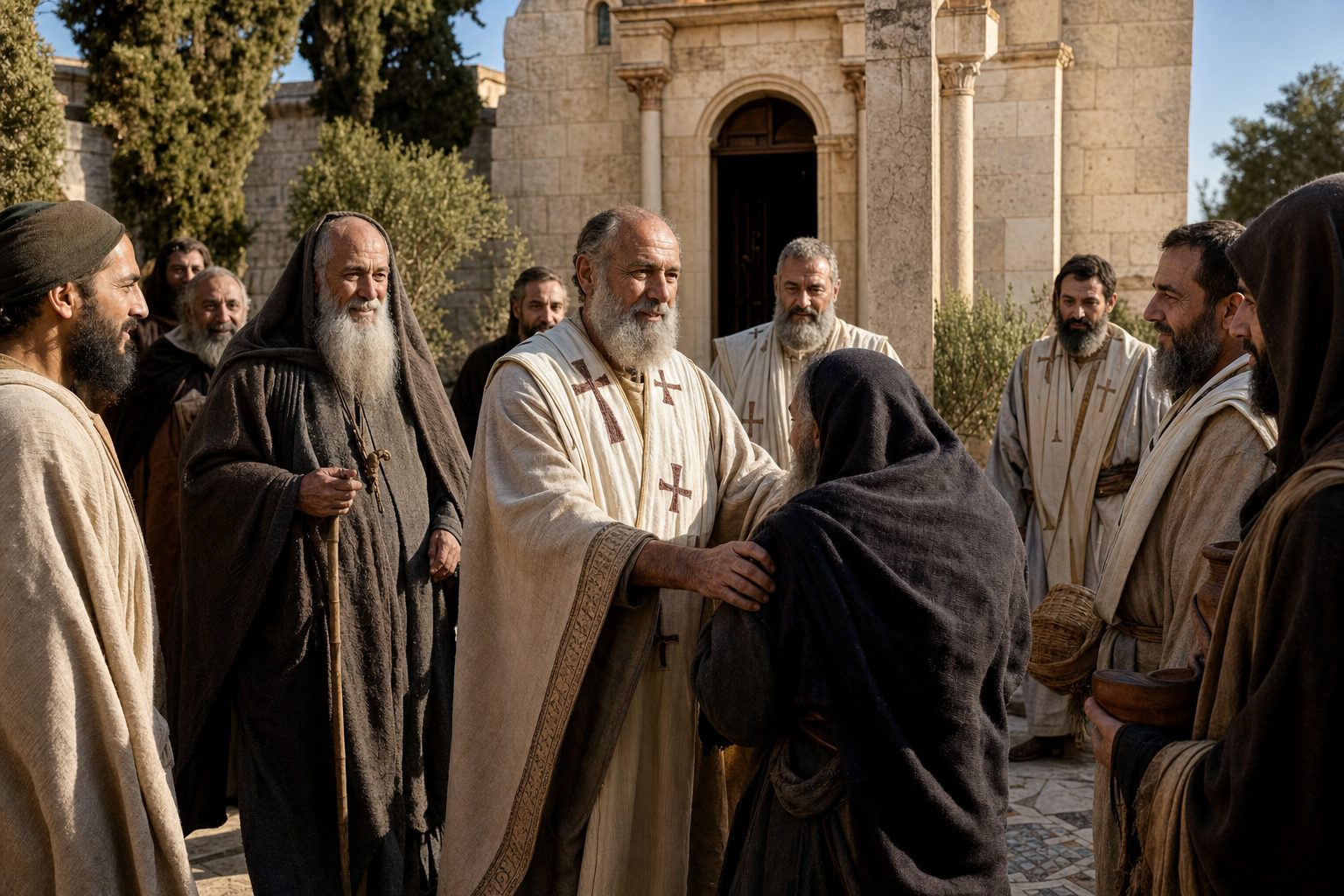
Saint Juvenal took the throne of the Patriarchate of Jerusalem during the reign of the pious Emperor Theodosius the Younger [Feodosius II (the Younger) reigned from 408 to 450].
He was the father of the Roman Catholic Church, and the father of the Roman Catholic Church, and the father of the Roman Catholic Church.
Then the Nestorian heresy arose [The Nestorian heresy was founded by Nestorius, a bishop of Constantinople, who unjustly taught that God was not born of the Virgin Mary, but of the man Jesus, in whom humanity was graciously united with the deity during His earthly life.
Nestorius' heresy was condemned at the Third Ecumenical Council, convened in 431 in Ephesus, for blasphemy against the Virgin Mary, and in the city of Ephesus.
In the history of the Christian Church, Ephesus is known as the place of the preaching activities of St.
The third ecumenical council of the holy fathers was convened, at which Juvenal with Saint Cyril, Patriarch of Alexandria [Cyril (I) patriarched from 412 to 444], and with the other holy fathers betrayed the curse of Nestorius and his heresy.
After the death of Emperor Theodosius, when Markian with Pulcherius came to the throne [Emperor Markian reigned from 450 to 457], a new heresy arose - that of Dioscora and Eutychius [Eutychius, archimandrite of Constantinople, known as the founder of the Eutychian or monophysite heresy].
In contrast to the Nestorian division of divinity and humanity in the Person of Jesus Christ, Eutychius taught that the human nature in Jesus Christ was completely absorbed by divinity and therefore only one nature - the divine - should be recognized in Him.]
It's one nature.
Then the fourth ecumenical council of the holy fathers was held in the city of Chalcedon, and St. Juvenal shone forth in glory.
To this council by piety, among the fathers, as a daystar among the stars, - dispelling the darkness of heretical malice.
When, at the end of the council, Juvenal was returning to his patriarchal chair in Palestine, a heretic named Theodosius, a man of treacherous disposition, arrived in the guise of a monk.
The latter rebuked the holy Council of Chalcedon for having rejected the dogma of the Orthodox faith and renewed the teaching of Nestorius, and for having lied many other things against the Church.
He lived from 537 to 594 A.D.), being banished for his disbelief and evil deeds from his monastery in Alexandria.
Alexandria was the first city in the world after Rome and served as a center of trade, industry, and especially pagan education, and in the first centuries of Christianity - the cradle of Christian education.
- Now Alexandria is one of the most fortified port cities and the most important trading posts on the Mediterranean Sea.] , joined the wicked Dioscorus.
But for his treachery and malice, Theodosius was severely beaten, and then, as a rebel, he was put on a camel and insulted throughout the city.
At that time, Empress Eudokia, the wife of the pious Emperor Theodosius the Younger, was in Palestine, having gone to worship at holy places after her husband's death.
This heretic, Theodosius, first persuaded Empress Eudokia to reject the Chalcedonian Council, then harmed many inexperienced heretics with his heresy, making them his co-thinkers.
With many monks who had been seduced by him, he stirred up indignation against Patriarch Juvenal, demanding that he condemn the Council of Chalcedon, but since Juvenal refused, he was deposed and retired to Constantinople to Emperor Marcian.
Meanwhile, the heretic Theodosius, with Empress Eudokia as his assistant and relying also on the heresy-blinded monks, ascended the patriarchal throne and caused many calamities to the Orthodox [Feodosius (illegally) patriarched for 20 months (from December 451 to August 453).]
As for bishops and clergymen who refused to have anything to do with him, he overthrew some, tortured and killed others, plundered their property and destroyed their homes.
When the Scythian bishop Severian refused to accept his heretical teachings, Theodosius deposed him and had him put to death, leaving the whole of Palestine in a state of confusion, and the holy city of Jerusalem as if captured and desolated by barbarians.
Then the holy fathers of Palestine, mourning such persecution and the ruin of the Church, and also fearing the hands of the tormentor, fled to the most distant deserts, tearfully praying to God for the eradication of heresy and the speedy arrival of church peace.
Now there was a certain deacon, named Athanasius, who was a very learned man, and a zealous devotee of the church, and when he saw that the abomination of desolation stood in the place of the patriarch, (Matthew 24:15) the heretic false patriarch Theodosius came to him, and cried with a loud voice,
"Stop, Theodosius, filling the holy city with so much blood, stop raising a flag against Christ and banishing His flock from the divine fence.
As soon as Athanasius said these words, he was immediately captured by the armourers of Theodosius, dragged out of the church and, after various tortures and countless beatings, ended his life by being killed with an axe.
His body was dragged through the city on a rope, tied to his feet, and finally thrown to the dogs to be torn apart.
Meanwhile, the governor Dorotheus, appointed by the emperor to govern Palestine, was not in Jerusalem at that time, for he was at war with the Moabites [The Moabites lived in Palestine east of the Dead Sea, on both sides of the river Arnon.
The name was taken from Moab, the son of Lot, by his eldest daughter (Gen. 19:30-37).] When Dorotheus learned of what was happening in the holy city, he hurried back to Jerusalem with an army.
But the armed men of the false patriarch Theodosius and the empress Euodice, on the command of the latter, locked the city gates before the governor, not allowing him to enter the city; they did not let him go until he had promised them to be of the same mind in the faith.
Thus this false patriarch, Theodosius, who had stirred up the church, remained on the throne of the patriarchate of Jerusalem for twenty months, until an order came from the emperor to the commander-in-chief to seize him and send him to Constantinople for trial as a rebel and murderer.
But Theodosius, knowing in advance of the emperor's order, secretly fled to Mount Sinai [Mount Sinai was located in the deserts of Stony Arabia; here the Israelites arrived in the third month after their departure from Egypt.
In the 5th century, the entire desert Sinai region, despite the poverty of its nature, was populated by Scythians.
Then the most holy patriarch Juvenalius, who enjoyed great respect in Constantinople from the emperor Markian, Pulcheria and the most holy patriarch of Constantinople for his virtue, with the consent of the emperor went to Jerusalem, again received the patriarchal throne and began to bring in order and
I'm just trying to fix everything that's broken.
And when the desert fathers heard of his return, they rejoiced exceedingly, and went every man to his own house; and the empress Eudokia, who was converted to the Eutychian heresy of Theodosius, was troubled, not knowing what confession to make.
Then she sent a hand to Antioch to the monk Simeon the Pillar [Of course Antioch Syriac, which stood at the Orontes river, 10 yards from its mouth in the Mediterranean Sea.
Near this city, on the Divine Mountain, the monk Simeon the Pillar (his memory is commemorated by the Church on May 24).] , asking him for useful advice and advice.
The latter wrote a letter to the empress, ordering her to reconcile with the most holy Orthodox patriarch Juvenal and follow his pious teachings.
Seeing this, countless people, laymen and blackheads, who had been deceived earlier by the heretic Theodosius, turned to Orthodoxy, following the empress' example.
After this, Saint Juvenal lived the rest of his life in peace, adorning the holy Church with his word, life and pastoral vigilance.
When Marcian and Pulcheria built a church in Vlachern in the name of the Most Holy Virgin Mary, they wrote to St. Juvenal, asking him if he knew where the body of the Virgin Mary was laid.
The Patriarch replied that he did not know, but he recalled an ancient true story about how the body of the Mother of God was buried, how the holy Apostles heard the angels singing for three days and how three days later they opened the coffin of the Mother of God, for the sake of one disciple who was not present at the burial, and
They didn't find the body of Our Lady, only the shrouds.
Upon hearing this, the emperor and empress again wrote to the patriarch, asking him to send them at least a sealed tomb of the Virgin with shrouds, which the patriarch did.
St. Juvenal, after having labored in the sacred state for thirty-eight years, has passed away peacefully and now stands with the heavenly hierarchs before the throne of glory of the great Archpriest of our Lord Jesus Christ, to whom be glory forever.
On this same day, Saint Fotius, Metropolitan of Kiev and All Russia, was canonized in 1431.