The memory of the holy Apostle Aquila
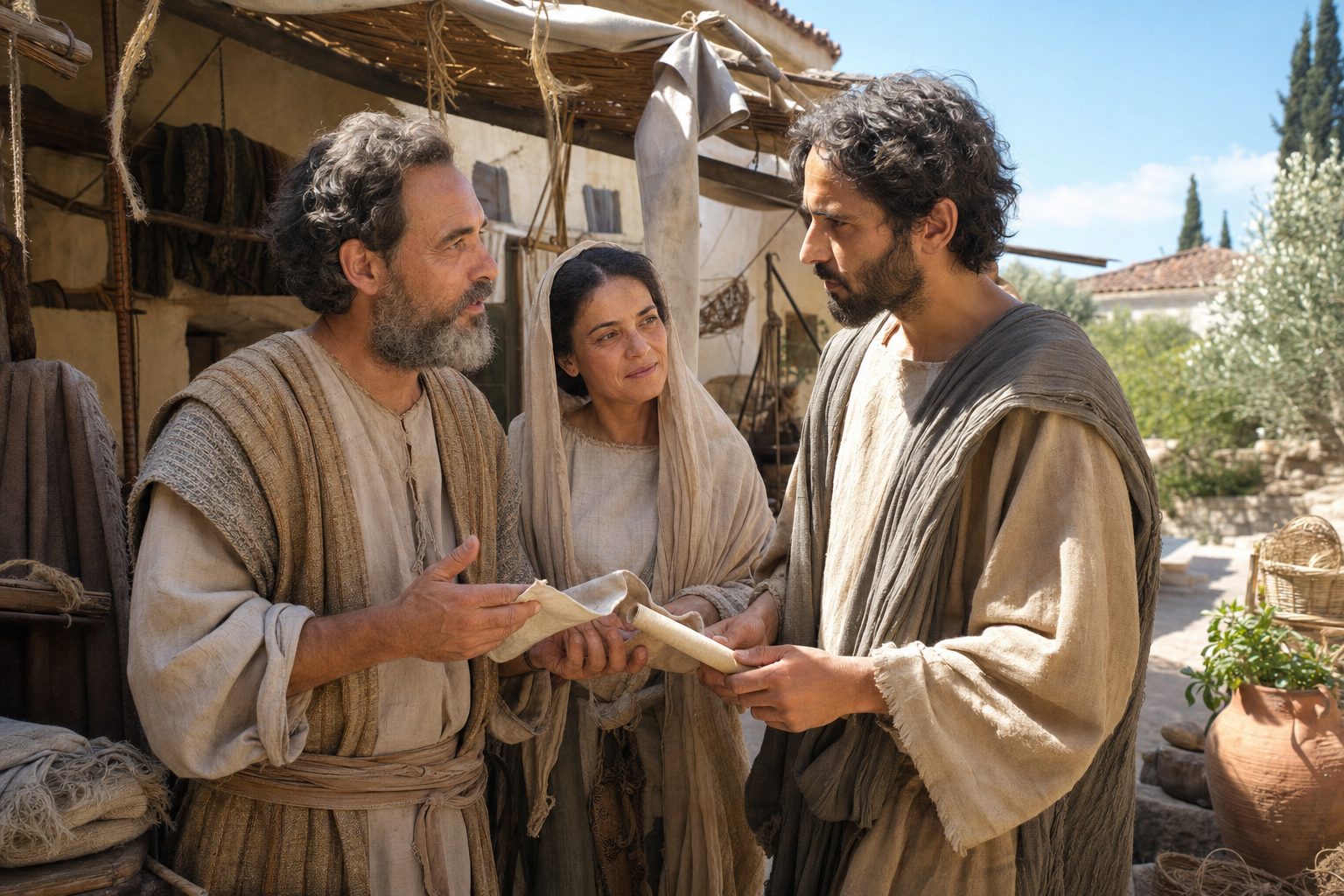
Saint Aquila, one of the seventy, was a disciple of Saint Paul [His Feast Day is 29 June] and was consecrated a bishop.
He was a Jew of the land of Pontus [Pontium or Pontus <unk> the northeastern region of Asia Minor by the Black Sea.]; before converting to Christianity he lived with his wife Priscilla in Italy; when Caesar Claudius [Emperor 41-54 C.E.] ordered the Jews to leave Rome [Italy's main city, lying on both sides of the river Tiber, at its confluence with the sea], Aquila and his wife went to Corinth [Ancient, famous and commercial city of Achaia,
It was founded by St. Augustine of Hippo.
There are two letters written by St. Paul to the Corinthians.]
The reason for the expulsion of the Jews from Rome was this: when the gospel of Christ began to be preached in Rome and the holy supreme Apostle Peter arrived, many of the Jews living in Rome accepted the holy faith in Christ, but many remained in unbelief; therefore, a great controversy arose between the Jews: some recognized Christ as the true Messiah, others rejected and reviled Him.
There was a great uproar among the Greeks, both in Jerusalem and abroad. Claudius heard about it,
Because the believers called the Lord Jesus Christ the Son of God and the King of Israel, Caesar feared that some disturbance might arise in the nation and that some new king might seek to take his power away, so he issued an edict to expel all Jews and non-Christians from Rome and all of Italy.
Aquila, a Jew, was exiled along with the exiles and settled in Corinth, where he enjoyed the labor of a tentmaker.
Meanwhile, Paul left Athens and went to Corinth, the chief city of Achaia. There he found Aquila and Priscilla, and stayed with them. Since they had the same trade, they worked together. Paul baptized them.
After spending a year and a half in Corinth, Paul sailed for Syria, teaching the word of God and convincing both Jews and Gentiles with the help of Christ.
John the Theologian; here in 431 was the Third Ecumenical Council; now Ephesus <unk> poor Turkish village of Ayasaluk. (Acts 18:18-21).] , then, wishing to be in Jerusalem for the approaching feast of Passover, he left Aquila and Priscilla in Ephesus to instruct the Ephesians in the holy faith of Christ, and he went to Jerusalem [Great city of Palestine, at the head of the river Kidron on the slopes of the three peaks of the Judean mountains of Acre, Zion and Moriah.
Jerusalem is dear to every Christian, as the center of the great events of Old and New Testament history, <unk> as the mother of the Christian churches, from which the word of the gospel has spread throughout the universe.], promising to return again to Ephesus.
He was an eloquent speaker and taught the Way of the Lord. He spoke with great fervor and taught about the Lord, but he had not yet been baptized, except for John's baptism. When Priscilla and Aquila heard him, they invited him in and explained to him the way of God more accurately.
After this, St. Paul returned from Jerusalem to Ephesus, and from there he wrote his first letter to the believers in Christ at Corinth, ending it with these words: <unk> Aquila and Priscilla greet you warmly with the church in their house (1 Cor. 15-19),<unk> that is, with my servants.
And when Claudius the king was dead, and the Jews were again free to dwell in Rome, every one of them returned to Italy to his place, to his property, and Aquila and Priscilla returned to Rome.
<unk> Greet Priscilla and Aquila, my fellow workers in Christ Jesus, who risked their own necks for my life, to whom not only I but also all the congregations of the nations give thanks. (Rom. 16:3-4) In Rome, St. Aquila stayed for a short time and with his wife went again to Asia [i.e., the western part of Asia Minor] after being appointed bishop and sent there by his teacher, the apostle Paul, to preach the word of God.
When he came to Ephesus, he helped the holy apostle Timothy, a disciple of the apostle Paul.
Paul circumcised him "for the sake of the Jews", since they would not dare to hear the word of God from an uncircumcised man whose father was a Gentile. (Acts 16:1-2.)
Later, when the apostle Paul was being persecuted by the Jews in Jerusalem, he was brought in chains to Rome and wrote from there a second letter to Timothy in Ephesus, he again remembered these beloved disciples, saying: "Greet Priscilla and Aquila". (2 Timothy 4:13) St. Aquila, preaching Christ in Asia, Achaia and Heraklion, led a great number of souls to salvation, converting the Gentiles from idolatry and baptizing them.
He went through all the countries, proclaiming the kingdom of God, teaching people about the holy faith, destroying idols, building churches, and appointing priests.
By the grace of our Lord Jesus Christ, to whom be the glory for ever and ever. Amen.
The fourth voice.
4 The capital of Italy, lies on both sides of the Tiber River, at its entrance into the sea. 5 The oldest, most famous and commercial city of Achaia, in the province of Greece; the beginning of Christianity in it was laid by St. Paul during his 2nd tour of Greece (Deuteronomy chapter 18). There are two epistles written by the Apostle Paul to the Corinthians.
8 Jerusalem is the capital of Palestine, at the river Kidron, on the slopes of the three Judean mountains of Acre, Zion, and Moriah. Jerusalem is dear to every Christian, as the center of the great events of Old and New Testament history, as the mother of the Christian churches, from which the word of the gospel has spread throughout the whole universe. 9 That is, the western part of Asia Minor. 10 St. Timothy was the son of a Jewish woman (who had converted to Christianity) and a Gentile, and himself a sincere Christian, approved by the brothers; with his consent, St. Paul circumcised his "Jewish father", since they did not dare to hear the word of God from an uncircumcised father, who was a Gentile (Acts 11:1-2).