Transfer of the relics of the first martyr and archdeacon Stephen
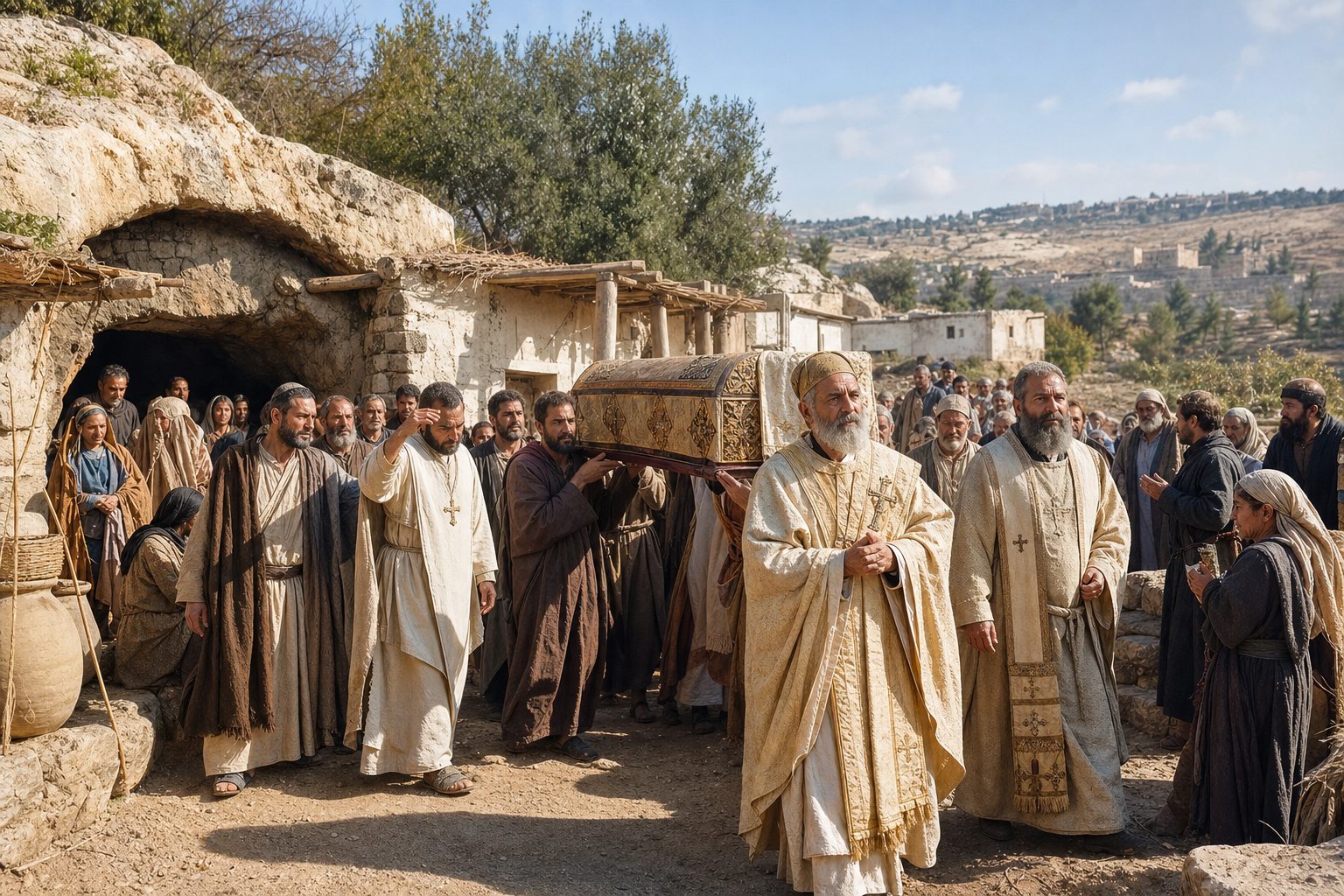
After the stoning of the holy archdeacon Stephen by the Jews (Acts 7:55-60) his body lay unburied day and night: it was given to dogs, beasts and birds to eat; but nothing touched the body, for the Lord guarded him.
On the second night, the famous law teacher Gamaliel of Jerusalem [Gamaliel <unk> a famous Jewish law teacher who held a high position in the Sanhedrin of Jerusalem, respected by all the people, so that he was called "the glory of the law".
John, mentioned in Acts 5:34; 22:3), who began to lean toward the faith of Christ and became a secret friend of the holy Apostles.
He sent pious men to take the body of the first martyr and bring it to his own country, which was called Capernaum, which is the land of Gamaliel, and was about twenty stadia from Jerusalem.
Then Nicodemus, a ruler of the Jews, who came to Jesus Christ at night (John 3:1-2), stood weeping over the tomb of St. Stephen, and was buried by the same Gamaliel, near the tomb of the first martyr.
Then Gamaliel also, after receiving holy baptism with his son Abib and having lived godly for some time in Christian godliness, died; both were buried in the same cave, near the tomb of Stephen and Nicodemus.
After many years, when the tormentors, who had persecuted the Church of God for a long time, had died, and insisted on the conversion of Constantine the Great [Constantine the Great, Roman emperor, son of Constantius Chlorus, ruler of the Western part of the Roman Empire, and Helena, was born in 274.
His memory is celebrated on 21 May.] days of the Christian kings, <unk> days of church silence and everywhere shining piety, <unk> then were obtained, according to divine revelation, the honest remains of the holy first martyr Stephen and the godly men buried with him: Nicodemus, Gamaliel and Aviva.
They were obtained by the presbyter of the said weighing house, Lucian, after such a vision.
One night at about three in the morning, Lucius had a vision of a certain tall, handsome old man, who was wearing a white robe and gold crosses. In his hand he held a golden scepter.
And when he had pushed them aside, he called to him the third time, saying, Lucius, Lucius, Lucius! Go to Jerusalem, and tell the holy archbishop John,
For in thy holy days it is fitting for us to be manifested; open, do not delay, our sepulchre, where our strength lies in neglect, the wet ones in the rain, the trodden by the feet of the unbelievers.
I care not so much for myself, as for the saints who lie with me, worthy of great honour; open the powers that are shown thee, that God may open the doors of his mercy to a world enveloped in many troubles.
"Who are you, Lord, and who are these with you?"
"I, Gamaliel, the teacher and teacher of the apostle Paul, and the chief deacon Stephen, whom the Jews at Jerusalem stoned for the faith, and whose body I gave to the dogs and to the beasts and to the birds to eat,
in order that I may share with him in the resurrection of the dead.
And in another tomb, in the same cave, lay the Lord Nicodemus, who had been instructed in the holy faith by the Lord Jesus himself, and had been baptized by the apostles.
Because Nicodemus, who was of my kindred, was a chief among them, the Jews took him away, and set his property against the church, and they cursed him, and cast him out of the city with many insults.
near the remains of the first martyr Stephen.
There in the third tomb, dug in the cave wall, I buried the deceased in the twentieth year of his life, my beloved son Aviva, who came with me to be baptized by the Apostles of Christ; with them, when I was dying, I bequeathed my body to be laid.
And he said, Look for us. And it was about the sixth hour, in the field of Delagauri. And he awoke, and blessed God, and said, Lord Jesus Christ, if this thing is from thee, and not from a lie, command it to be done to me three times.
And Lucian fasted, and ate nothing but dry bread, until the next Friday, and prayed, and told no man the vision. And at the third hour of the night on the next Friday, Gamaliel appeared again to Lucian the governor, as at the first.
And he said, Why didst thou not go and tell Archbishop John all that I have told thee?
And he said, My lord, forgive me, for I was afraid to go forth at once to tell, because of the first vision, lest I should be found false; and I besought the Lord, that he would send thee to me the second and the third time, that I might know the truth. And he stretched out his hand, and said,
"Peace be to you, bishop, rest", he said, as if he were leaving the priest's sight. Then, turning to him again, he said, "Lucian, you think you can gain and know the power of each of us. So look and understand what you are shown.
And he brought out four basins, three of gold, and the fourth of silver, one basin of gold, full of scarlet, and the other of saffron.
And he put the first basket of gold with the red flowers on the right side of the altar toward the east, and the second basket of gold with the white flowers on the north side, and the third basket and the fourth basket he put together on the west side, opposite the first basket which was toward the east.
"Teacher, " he said", what do you mean?"
<unk> These are our tombs in which we rest: so, the first gold basket with red flowers, placed to the east <unk> the tomb of St. Stephen, covered with the blood of the martyrs for Christ; another gold basket with white flowers, standing to the north, is the tomb of Mr. Nicodemus; the third also with white
And the fourth basket of silver, full of saffron, and it is by my side, is the basket of my son Abijah, who was clean in body and soul from his mother's womb, and died a virgin.
And when he had said these words, he was taken from them, and the baskets were taken from them.
After this vision the presbyter gave thanks to God and intensified fasting and prayer until the third Friday, waiting for the third apparition.
Why hast thou not taken care to go to the archbishop, and to declare unto him the vision and the words which were spoken unto thee? Seest thou not how great is the drought and the sorrow under heaven?
But as we pass by them, we would like to be seen by you. So get up, go and tell the archbishop to open a place of rest for us, and to build a temple there, so that the Lord may have mercy on his people for us.
And he rose up, and gave thanks to God, and came in haste to Jerusalem, and told John the things which he had seen, and the commandment. And the archbishop wept for joy, and said,
"Blessed be the Lord God, who has shown mercy to us by the revelation of his saints. And when it is fitting for us to receive their strength, I must bring Stephen, the first martyr, to this city, where he was killed against the Jews, where I saw the heavens opened and the Christ of God standing in his glory.
(Acts, chap. 7) How can we do this?
And thou, my son, saith he unto the chief, Go into that field, and find the place where the saints lie; and when thou hast dug up their sepulchre, declare unto me. And the chief, having returned from the city to his own country, called the godly men together, and went with them into the field of Delagauri.
And there was a hill in the midst of the field, and he thought that it was the resting place of the relics of the saints, and he desired to dig, and he spent the night praying on the hill.
"Go and tell the governor, that he should not trouble himself to dig that hill, for we are not there, but that he should seek us at the mound, at noon, where we are buried. On that hill we were taken to be buried, and here, according to the ancient custom, wept over us, as a testimony of it.
Weeping for the old man over us and the hill is littered.
And she rose up, and went as she was told, and found on the hill above, the presbyter Lucian with many men, who had begun to dig; and she told Lucian what she had seen and heard, and praised God, who had appeared to her as another witness to the revelation.
And they came to Debir, and found a stone upon which was written in the Hebrew language, Eliel: and when they had rolled away the stone, they found a narrow entrance into the cave. And they went into the cave with a candle, and saw the sepulchres that were hewn in the wall, and in them the bodies of the saints.
The entrance to the cave was from the noon side; so that on the right side to the east was the tomb of St. Stephen, opposite the entrance, to the north, the tomb of St. Nicodemus; on the west side opposite St. Stephen rested St. Gamaliel with his son, as had been previously indicated to the presbyter by the vision of the baskets.
At once the presbyter reported the discovery of the holy relics [This discovery of the relics took place in 415 C.E.] to the archbishop of Jerusalem, John.
The archbishop, taking the two bishops who had joined him, Elevfery of Sevastopol and Elevfery of Jericho, hurried to the place where the relics were found, enlarging the entrance to the cave, they entered.
When he opened the tomb, the earth shook, and I heard the voice of the angels in heaven singing: "Glory to God in the highest, and on earth peace!"
It was flying for 10 yards, and everyone in the audience thought they were in paradise.
Crowds gathered also from Jerusalem and the surrounding villages, bringing with them many who were ill with various diseases, the blind, the crippled, those who had seizures, the lame, those suffering from evil spirits, the paralyzed, and the wounded.
The healing.
And the number of them that were healed was about seventy-three; and they took the bodies of the four angels, and brought them up into a hill, and sang psalms, and praised God; and the people touched them, and worshipped.
Soon the archbishop established a church on that hill in the name of the newly recovered saints and placed in it the relics of Nicodemus, Gamaliel, and Abib; and the relics of the holy archdeacon Stephen he solemnly carried to Jerusalem and placed in the church in holy Zion.
And it came to pass at the same time, that a certain noble man, Alexander the senator, and his wife, Julianias, came from Constantinople to Jerusalem to worship the holy places. And when Alexander saw the miracles that were wrought at the tomb of the first martyr, Stephen, he built in the city a church of stone in his name, and earnestly asked the bishop to bring it into the city.
And the priest, being persuaded by the earnest prayer of St. Stephen, granted the request.
And it came to pass after these things, that Alexander fell sick in Jerusalem, and was at the point of death; and he made a will to his wife, that she should make an ark like unto the ark of the first martyr, and lay it there beside the relics of Stephen.
She made a coffin like the coffin of St. Stephen, and buried her husband with honor beside the coffin of the first martyr. She lived in Jerusalem with the church mentioned, not wanting to be separated from her dead husband, because she believed that he was alive for God.
Because Alexander's wife was still young, beautiful, and wealthy, many of the nobles urged her to remarry.
She was determined to remain faithful to her first husband, hoping to share with him in the resurrection as the righteous do. - Matt. 25:34.
When one of the noble chiefs harassed her, wanting to marry her, Juliana, wanting to get rid of him, thought of the following: taking her husband's body, return to her homeland to the Castle, despite the fact that eight years had already passed since her husband's resignation.
She begged the archbishop not to forbid her to take her husband's body; the archbishop did not agree; so Juliania immediately wrote to her father, who lived in the castle, asking him to ask the king for such an order that she could take her husband's body without hindrance and come to the castle.
Soon the king gave them the permission they wanted, and they showed it to the archbishop.
And she, having opened with blessing in the earth the place where the two ark stood, the holy first martyr Stephen and her husband Alexander, took the ark with the relics of the saint instead of the ark of her husband; so did Juliana, as if deceived, but in fact by the will of God and by the will of the first martyr.
Loading the ark onto a chariot drawn by mules, Julianius set off.
When evening came, the voice of the angels singing praises to God in the skies above the ark, and the aroma of the ark was like the aroma of a great ball of brass poured out.
"Woe to us! " they shouted". We have come to kill you. " And when they heard what had happened, they were afraid.
And she answered with tears of joy, and said, Be still, my children; for all things are done according to the will of God, and of his holy servant. And they came to the seashore of Ashkelon, and found a ship going to the king's castle; and they paid the price of the ship, and went into the ship with the relics of the holy man, and set sail.
But when the ship was being carried away in the midst of the sea, there arose a great tempest, so that the ship was being swallowed up, and they were afraid when they saw the great waves.
And he said, Behold, the sea ceased, and all navigation was made safe; and there was a light of the night over the pillars of the ark, and the sweet odour of the ark, and the singing of angels in the air. And we came to Chalcedon, where we thought to stay five days.
When the inhabitants of the city heard of this, they brought the sick to the ship, and all who had diseases were cured by the power of the holy spirit. Even the evil spirits came out, shouting in a loud voice:
The Jews had stoned Stephen, and he caused us much trouble. He sailed from Chalcedon and arrived safely at Constantinople.
Then they went with their father to the king and the patriarch, and told them the same; and all were filled with great joy. And the patriarch and the clergy and all the people went to the harbor to meet the remains of the first martyr.
And they took the ark out of the ship, and put it in the king's chariot, and brought the psalms with it, and brought them into the king's palace; and king Sokol commanded that many miracles should be done at that time by the holy relics, and that they should not be told.
When the procession reached the "Constantine Baths" [These baths were founded by Constantine the Great, continued by his son Constantine and completed in 427 by Theodosius the Younger.
Now they are called Teukur-hamam and are on the 4th hill.], then the mules carrying the king's chariot with the relics stopped; and no matter how their servants beat them, forcing them to go on, they could not move from the place.
"Why are you beating us? " they demanded". This is the place where the law was given that Stephen should be put to death. " When they heard this, they were all filled with awe and praised God.
And the king commanded at once that a church of stone should be built in this place; and in a short time a beautiful church was built in the name of the holy first martyr and archdeacon Stephen, in whom his righteous powers were laid to the glory and praise of our Lord and Saviour Jesus Christ, with the Father and the Holy Spirit.
[In 1200 our Russian pilgrim Antony was in this temple; he saw in it the forehead of the first martyr, stoned and sewn.], to Him and from us sinners honor and glory, worship and thanksgiving now and pleasantly and forever.
Amen. Trooper, voice 4: The crown of the kingdom is crowned over your suffering, and I am the crown of God's suffering for Christ, the first martyr of the death of Stephen, because of the public hatred of the Jews, you have seen Jesus your Savior on the right hand of the Father.
The first to be sown on earth by the heavenly doer, all-powerful Stephen, the first to be sown on earth for Christ's sake, the first to shed his blood, the first to be crowned with victory, the first to be crowned with martyrdom.